“Kids will never understand fully if you just tell them the answer. They have to break it down and understand it, take it piece by piece ‘cause if you get it straight on you’ll never know what happened. Like if you’re building something you’ll never understand how it’s built, you can never build it again because you don’t know what to do.”
You might think this quote comes from an experienced teacher who has worked with many students over years of seeing how they learn best. Someone who has found that over time best practices have shown that individuals must spend time with material and grapple with their own understanding in order to learn for understanding. However, this weekend I heard a fifth grade student named Jessica say this very quote in a video. Words of wisdom from this young student who has experienced learning in a way that has been very meaningful to her. Another teacher puts it this way:
“We’re asking students to do things that, at first, may be a little beyond them. But because of the way we present it, they find that they can do it. They’re not finding out how to do it by listening to the teacher explain. They’re experiencing themselves as people who are capable of learning increasingly difficult skills. Confidence comes from knowing that “I can do it!” – Ted Swartz, Ph.D.
This may be the most controversial part of my definition of PBL. The concept that not only the students are learning through their own inquiry and curiosity, but that they are asked to apply their own prior knowledge and to do so at an increasingly difficult rate of skills. That they are asked to challenge themselves again and again. Another big difference is the way that students experience themselves. Swartz states that students experience themselves as learners who are capable of so much more than just listening to a teacher and doing what someone external to themselves tells them to do. They are capable of their own direction in learning and of learning increasingly difficult tasks and managing those.
Also, students in these types of classrooms are concurrently practicing and learning new skills. This is very different from the way we all learned as children and adolescents and it also goes against the culture of the math classroom in most of the U.S. today so we must set new norms and explain this to parents. But it is something that is very rewarding.
We just had our Parents’ Weekend at my school and the two new teachers who were working on our pilot PBL shared with me stories of parents who had had negative feelings towards the curriculum at the beginning of the year. I was nervous about how they were responding now, at the end of the school year. However, to my surprise, my colleagues shared with me stories of how proud of these parents were of their students presenting in front of the class and articulating mathematical concepts to their classmates very well. Are these straight A students now? Not at all, but they are proud of their work, engaged in the discussion and enjoying math class. These are great strides for these students. And at the end of year where we worked very hard, this was truly inspirational.
One of my major goals in attending the NCTM annual conference this year was to see how widespread PBL had become in terms of mainstream education practices across the US. I have to say that this year there were quite a few sessions that had PBL in the title or as the central theme and I was excited to see that! Here were some of the workshops:
Bring Back Problem-Based Learning into Methods Courses! – in this session the speaker makes an argument for using PBL methods in courses for teacher candidates and spoke about the positive experiences of preservice teachers with PBL.
Amplify the Mathematical Practices -this session focused on middle school PBL practices and how they stressed the CCSS MP standards. This was sponsored by Amplify’s Math projects.
The Hidden Message: Micromessaging and Mathematics – I wanted to attend this session so badly, but I had to leave early on Saturday morning. This session has so much to do with my own research relating to how we talk to each other in mathematics classrooms and how PBL can allow for better communication without the micromessages. (Tujuana if you read this – get in touch with me!)
Promoting Equity through Teaching for a Growth Mindset (Jo Boaler) – in this Session Prof. Boaler reported on her work in math education with Carol Dweck’s Mindset research. You should check out her new website youcubed.org if you are interested in all the resources that she has shared freely.
And that was just to name a few! So much wonderful information out there to learn and share. The variety and number of sessions that connected to the pedagogy, content or philosophy of PBL was overwhelming and honestly very invigorating for me as someone who has taught with PBL for over 20 years. Seeing the interest and enthusiasm for this type of classroom practice has given me renewed energy to get me through the rest of the year!
Wow! What an amazing three days I spent at the NCTM annual conference in New Orleans! I can’t believe how much I learned (which actually never amazes me and always humbles me – one of the many reasons I love going to these conferences.) I also hate leaving and knowing that I missed at least 20 sessions that conflicted with ones that I did go to, so now I’m catching up and trying to email the speakers that I didn’t quite get to see or get in contact with while there.
One of my major a-ha moments was in Gail Burrill’s session on logarithms. You’d think that after 25 years of teaching that you’d understand how much you understand about logs right? Oh, no! So she had us all have a very large number and we were doing an exercise where we had to put a post it note with that number (mine was 72, 753) on a scale of powers of 10 {10, 10^2, 10^3, 10^4, 10^5…}, her argument being that one of the main reasons to teach logs is to have a different scale for very large numbers. So after all of these teachers did this, we analyzed where all of our numbers were on the scale – particularly between these numbers. Since my number should’ve been between 10^4 and 10^5, I knew I put it in the right place – but oh no, I had it in the wrong place relative to the middle. She asked us to calculate the middle of those two – 10^4.5 which was 31,622 and yes, I admit that’s very close to where I put my post-it. I could blame the person who put their’s up first which said 75,289 and I just put mine by there’s but I won’t. I just didn’t really think. But I know this was a light bulb moment for many of the teachers in the room. Students don’t really understand how a logarithm is an exponent in the first place and we were doing this exercise without even using the word “logarithm.”
Then we went down to the section below that was between 10^3 and 10^4 and checked some of those numbers. They were very off too and Gail asked us what number we expected to be in the middle. At this point, some of us pulled out our calculator (yes, I admit, I did) but some of the smartees in the room just said “3,162” and I finally got it. By just dividing by 10 and looking at the scale in this nonlinear way, students would be able to make the connection between the algebraic properties of exponents and what a logarithm was. I thought this was an amazing way to introduce logs. Has anyone done this before? Thanks so much Gail!! I think I’m going to write a problem for my curriculum about this, it’s such an insightful experience.
More reflections to come – just can’t do it all at once – catching up on school work!
I always try to make it easy for people to find both my slides and handouts when I give a talk – so Here’s my powerpoint presentation from my talk entitled, “Change the Classroom, Not the Students: Creating Equity with PBL” which I’m giving today at the NCTM Annual Conference in New Orleans – great to be here. I also have 2 handouts which include my framework for a relational PBL class and the results of my qualitative dissertation – I’d love to hear any comments and questions and start a discussion with PBL teachers. (I do not include the videos I used in this public version of the powerpoint, sorry)
There are actually a few talks here today that I would highly recommend and seem to be related to this topic of creating a classroom that allows for discussion and interaction at the level of creating equity. One of them is on Friday, and is entitled “The Hidden Message: Micromessaging and Mathematics” and it seems to be about managing the way we talk to each other in the classroom and making sure all voices are heard. I’m definitely going to that one! Unfortunately, Jo Boaler is presenting at the exact same time as me! I don’t know if I should take that as a compliment that I was put as the same time or not 🙁
Well, hope everyone has a great time! Enjoy the conference!
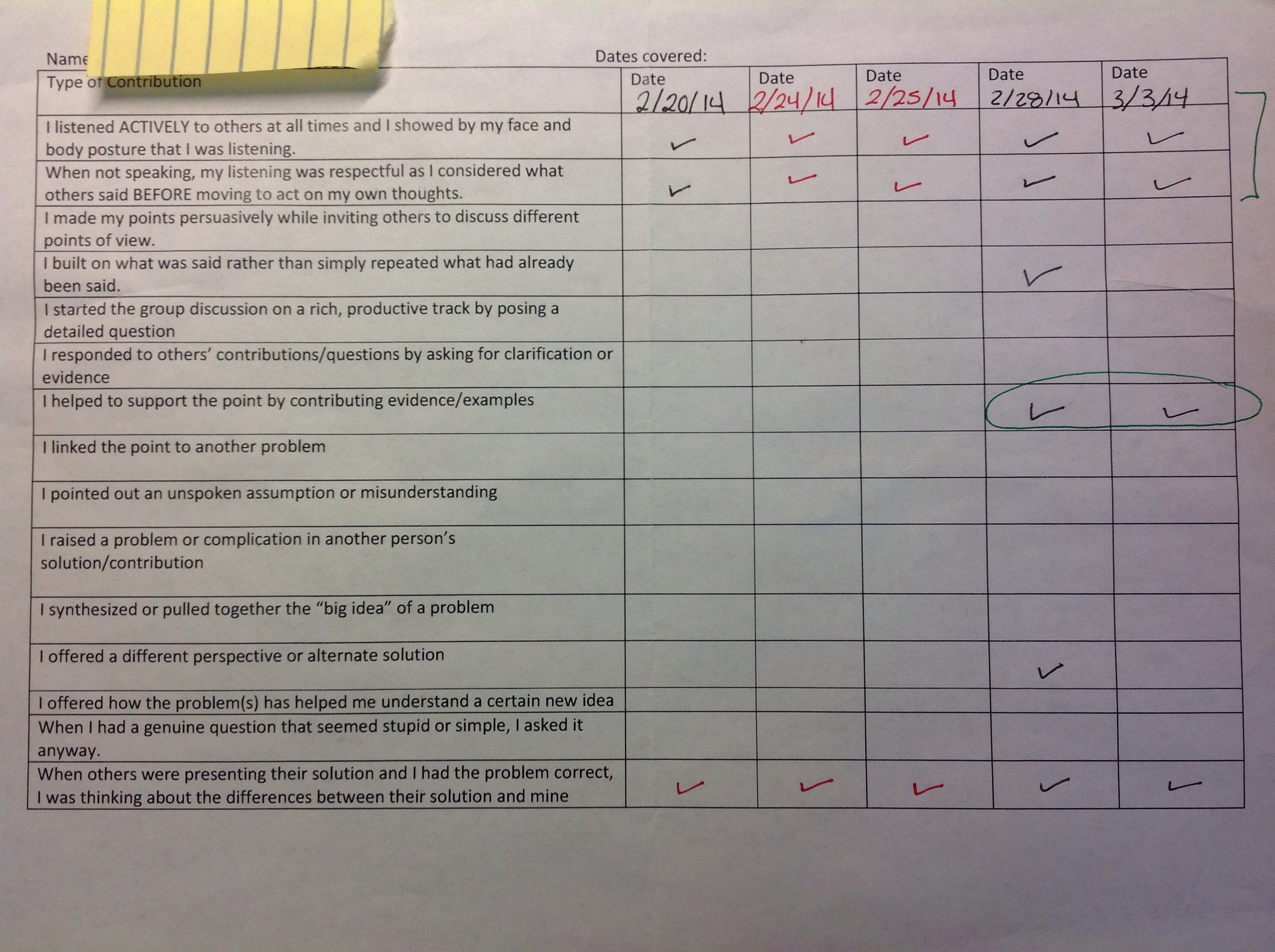
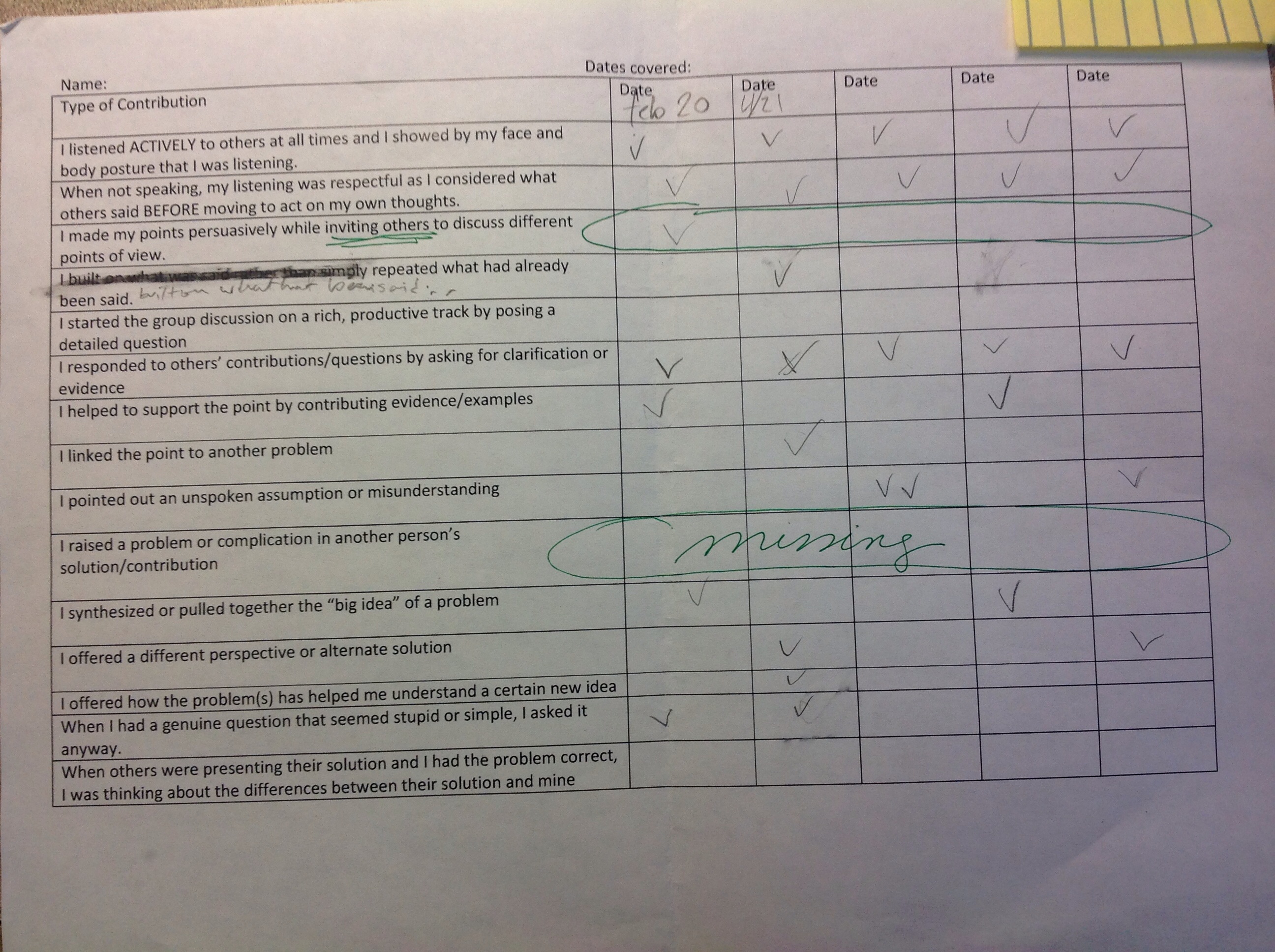
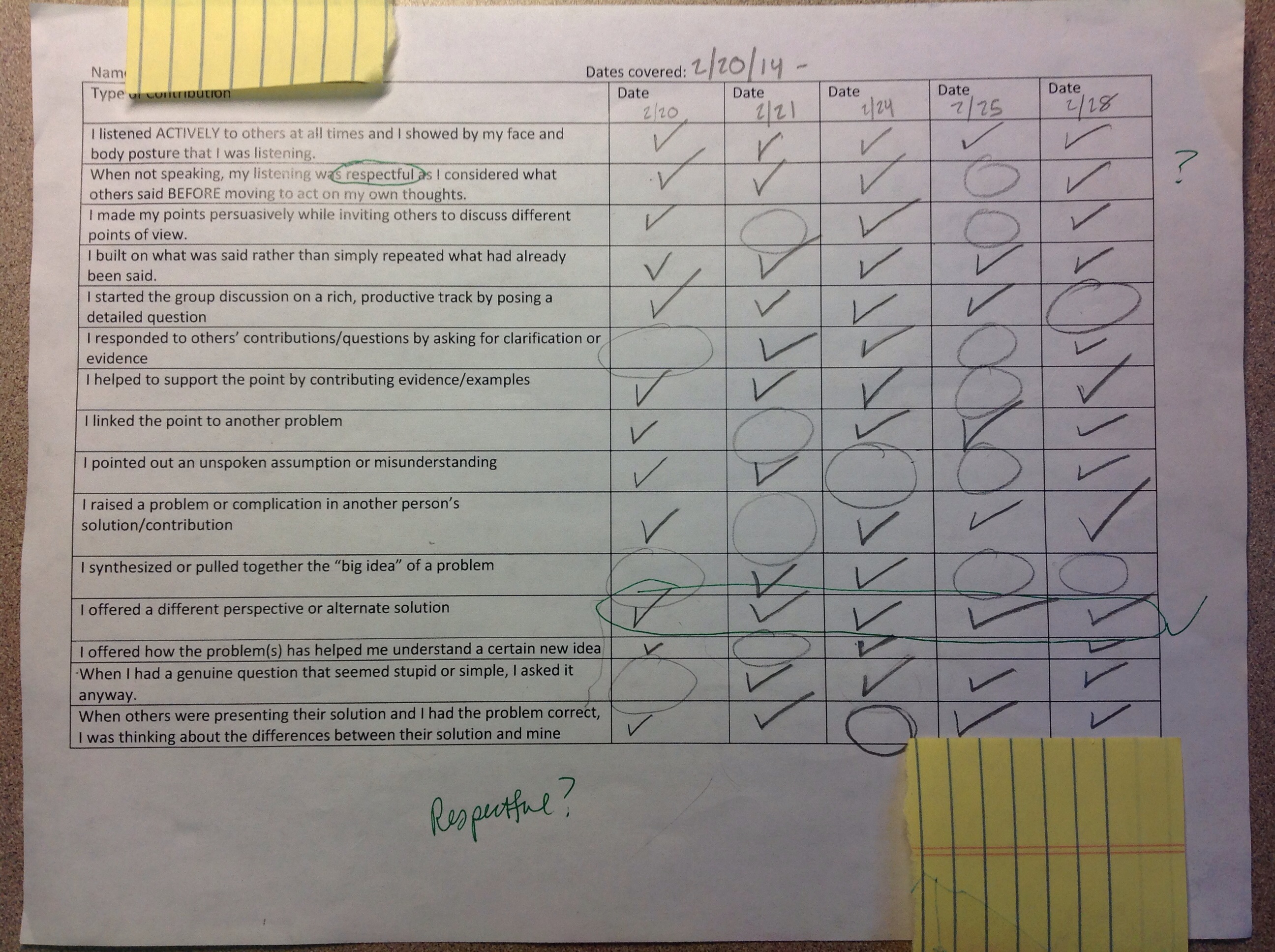
One of the things I do at the middle of the term to have students reflect on the way that they talk about mathematics in class, is have them evaluate their work with my Student Self-Report on Class Contribution and I give them detailed feedback on their rankings of each type of question and what I think about their work so far. But what I’ve found in the past is that it’s hard for them to remember specific examples of when they “helped to support the point by contributing evidence” or “raised a problem in another person’s solution” weeks or days after the fact. Students have so much to think about during a class period that it really needs to be “in the moment” for them to be deliberately thinking about what they are doing and saying to each other.
So I had this idea that I would actually have them keep track of the types of questions and comments they made to each other over a five day period at the end of the term and then hand it in to me. This way they would check off each category of question or comment at the moment when they did it. So I made copies of this table of Student Analysis of Contribution and had them keep it on their desks while we were discussing topics or problems in class. They had to have something to write with while they were talking and taking notes too.
Initially the students were very concerned about how they were going to tell the difference between each of the types of contributions. But little by little, it became easier. These categories were not arbitrary, they happened all the time, they just hadn’t really thought about it before. For example, when a student presented a problem but had made an error and didn’t know it, another student usually “raised a complication in another person’s soltuion” or “pointed out an unspoken assumption or misunderstanding.” These are important contributions that they were making every day about mathematics and are important critical thinking skills they didn’t even realize they were developing. I just wanted to help them be more specific about realizing it.
The first day we did this I heard some students say something like, “Ooh, I just…(brief pause while looking at the table)… ‘started the group discussion on a rich, productive track by posing a detailed question.” with pride and excitement (and maybe a little sarcasm). But after three days of doing it, and students seeing that they had places that they could check off, one student actually said, “I think that this table makes our conversations more interesting.”
Here are some samples of student feedback:
Quiet student who needs to work on all types of comments and questions
This first respondent is a student is very quiet, and she knows it. She rarely speaks in class, but is actively listening. I’ve spoken to her about why she does not ask questions or share her ideas in class and she says that she is afraid of being wrong in front of everyone. My hope all year has been that seeing everyone else be wrong regularly would eventually show her how acceptable it was in class. It was clear that using this table showed her that there are many different ways to contribute to class discussion. When she presented her problems in class (which she will do when asked) she is very capable and knows that she is contributing evidence or examples, but she rarely questions others’ work. I do remember the time when she “built on” what was said by asking a question about someone else’s solution. She also sometimes asks for clarification of her own understanding, but I know that she’s capable of more. I struggle with how to encourage her to get more out of class discussion, but at least now she knows how important a role she can play.
Outgoing student who lacks interaction from other kids
This is a really interesting student who is quite inquisitive and very comfortable with sharing his ideas. When he has a question or comment, it’s very easy to get him to go to the board and naturally start writing another idea or possible solution method. However, I noticed was missing in his table were checks in the two rows that had to do with “inviting others” into his thought process and also making comments on others’ solutions and ideas. It made me wonder how much time in class he spends listening to other students talking or if he is just listening to his own ideas in his own mind. I am working on trying to get him to collaborate more – with his creative mind it would behoove him to start interacting more with others.
Outgoing student who is unaware of his effect on others
This table belongs to a student who really has overestimated his contributions to class. He definitely spends a lot of time talking (and hence I spend a lot of time managing his unrelated talking unfortunately) and thinks that talking – any kind of talking – is useful and contributing to class discussion. One of the things I have talked to him about is the idea of active listening and how important not speaking can be. He has not yet caught onto the idea of being respectful while listening, and still is considering his next talking move while others are trying to make their points. It will be a difficult discussion, but a necessary one for this young man to grow in important ways. At least I now have this chart to refer to when I have that discussion.
So was this exercise everything I had hoped? Not really – but it definitely had some great highlights. Class discussion was very exciting and interesting while students were aware and deliberate knowing the different types of ways in which they could contribute. Knowing that they had to hand this table in to me in 5 days was putting the onus on them to show that they had or had not fulfilled what I had observed of them in class. I do believe they learned a lot about what they were capable of. I do believe I would do it again.
So I just read a great blogpost by Kevin Washburn of Clerestory Learning entitled “Teaching Resilience: Reflection” and it immediately made me think of the Metacognitive Journaling that I have students do in my classes. I never really thought of it the way that Washburn was describing the reflection and the conseuences of reflection, but it’s pretty clear that if his theory is right, that a by-product of journaling could easily be resilience.
Initially, Washburn talks about the process of reflection – right out of Dewey in a way – but he narrows it down to the steps in the process (but does mention the word metacognition – thinking about thinking). He defines reflection as “the ability to monitor one’s own thinking” which is what I tell my students the goal of writing in the journal is. Hopefully, by the end of the year, they will have realized the way they look at problems and how they’ve had those “lightbulb” or “ah-ha” moments enough after writing about them, that when they come across a new problem, the process of being aware of their own problem solving is much more natural.
Washburn’s three steps are as follows:
1. Asking yourself “what am I thinking now?”
2. What can I tell myself to redirect my thinking?
3. What can I do differently?
Most students in the beginning of the year, can easily do the first step – it begins very simply as them just redoing their work (usually the correct way), which can, unfortunately, just be them rewriting their notes from class. However, this has to be a place to start for them. This is where teacher feedback is key. I spend most of my time writing comments like ,”I want to hear what *you* did initially” or “is this what your first thoughts were?” It’s really hard for students to believe that you want a record of what they did wrong.
But somewhere during the year, kids grow in their understanding of WHY their initial idea didn’t work. This seems to be the most important part of the reflection. That gained insight gives them not only deeper understanding, but a sense of ownership and responsibility for their own learning that can’t be had with just seeing how many points they got off from the problem on an assessment.
I’ve written about this a few times (see other blog entries) and have seen kids grow in their understanding during the 18 years that I’ve been using journals in my classroom. However, what Washburn helped me see is how this skill of recognizing how their initial erroneous thinking has actually made them a stronger, more confident thinker. This is an amazing gift. As Washburn says,
“In life and in the classroom, the one doing the thinking is doing the learning. When thinking ceases and self-defeating messages crescendo, we can guide students to healthier states of mind and, in the process, equip them to make such cognitive turns on their own.”
James Henry Trotter: “When I had a problem, my mum and dad would tell me to look at it another way.” (Roald Dahl)
I’ve always thought that PBL fostered creative problem solving as opposed to memorization of pneumonic devices. One of my students today proved me right when I gave a “quick quiz” on the use of the idea of tangent. We had discussed tangent in class for only two days and in two ways – one as a slope of a line with a given angle and from that idea we discussed how it could be interpreted as the ratio of the sides of a right triangle (if you put a right triangle under the line).
Of course, during this conversation some student who had studies the ever popular SOHCAHTOA before mentioned this in class and told everyone that they had just memorized this and that’s how they knew it. I said that’s fine but I’d like them to try to think about the context of the problems and see if this helps make any sense of it for them.
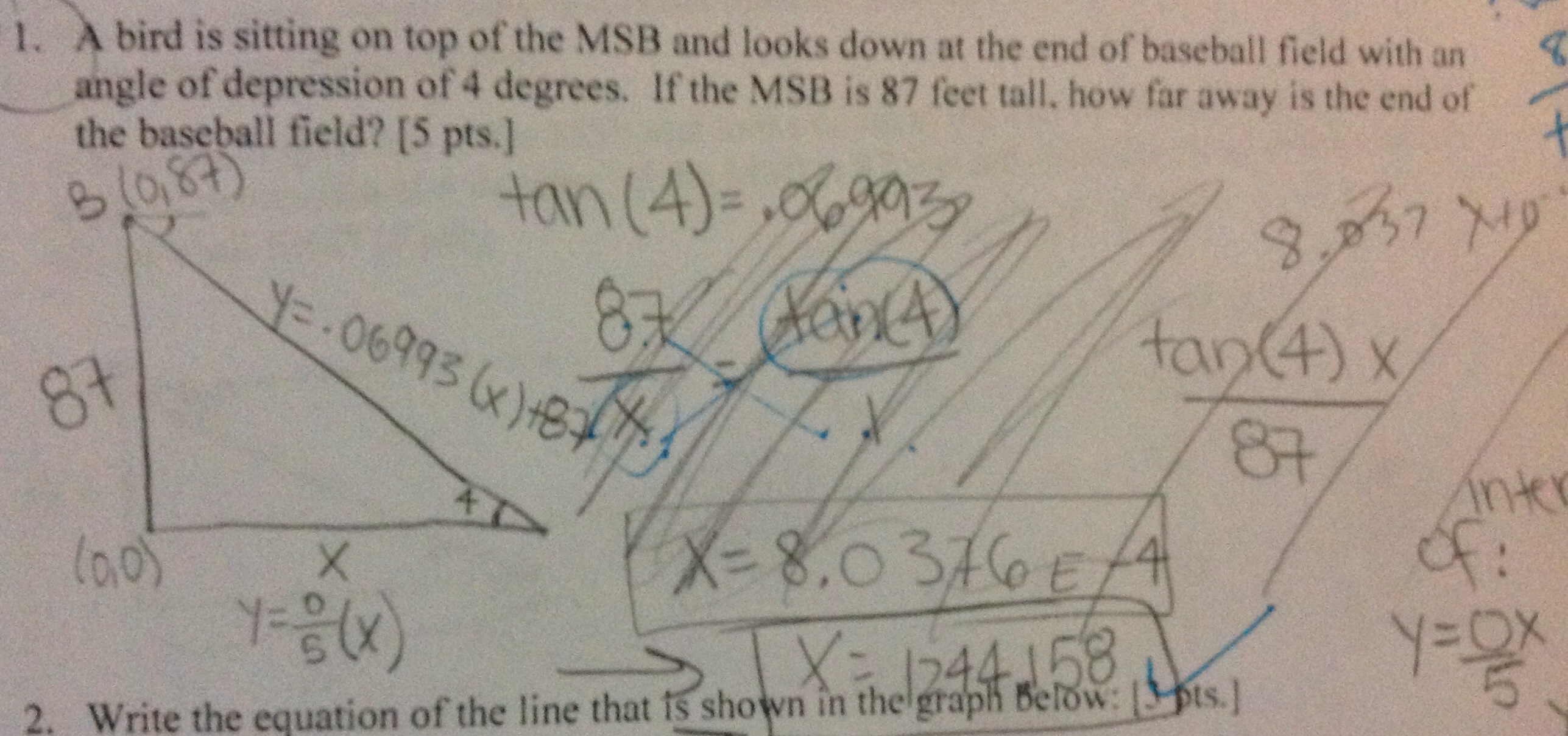
So today on the quiz one student was attempting this problem – very basic, very procedural, not at all something that I would call atypical of a textbook-like problem on tangent.
A bird is sitting on top of the Main School Building and looks down at the end of the baseball field with an angle of depression of 4 degrees. If the MSB is 87 feet tall, how far away is the end of the baseball field?
So the student attempts to create a ratio with the sides of the triangle and even sets it up correctly. However, because she does the algebra incorrectly, she gets an answer that is extremely small 8.037 x 10^-4. In fact, during the quiz, she calls me over and asks what it means, she doesn’t remember scientific notation and starts getting all anxious because we didn’t do anything like this in the problems in the previous two days? How can the answer be that small? I said well, you better go back and think of something else.
In most classes, a student in this situation might stress out, try to do the problem over again with the limited perspective of “TOA” or of just viewing the right triangle in one way. However, because this students had also learned other students’ perspectives of tangent as slope of a line what this girl did at this point was to see it from a different way. Interestingly, this is what she did. In an alternative, albeit confusing way of writing the equation of the x-axis, she wrote y=0x to represent the ground. Then she found the tangent of 4 degrees and used that as the slope of a line. She put the bird at the point (0,87)
She writes the equation y= – (tan4)x + 87 and explains that this is the equation of a line that makes a 4 degree angle with the x axis and has a y-intercept of 87. Then she realizes that if she finds the intersection of that line and the x-axis, she would find how far the building is from the baseball field. This is what she does and uses her graphing calculator to get the right answer.
When she hands in this quiz to me, I half expected that tiny little answer as her distance to the baseball field. But what I got was an amazingly inventive solution and a correct answer. With a problem that didn’t make sense, she looked at it a different way and ended up getting the right answer. It was amazing what changing your perspective could do and this was great evidence that even under pressure, the habits of creativity and connection were paying off.
I’d like to think of myself as a master teacher. I’ve always thought of myself as very aware of student perspectives in my classroom, but today after a weekend of being in bed with a bad cold, all I wanted to do was get through the problems and get back home – I admit it. I was not being very reflective and deliberate in my teaching. However, even with all that, something amazing happened today. Of course, I’d like to take all the credit, but I have to say I think the credit goes to the method of PBL, relational pedagogy and the students in my class. So here’s what happened.
We had gone through about half the problems and I think they could tell I was in a pretty bad mood. We got to one of my favorite geometry problems that starts an interesting strand of thinking that has to do with which polygons tessellate with others. One girl goes to the board (I’ll call her Robin) and she presents her solution to this problem:
The diagram at the right shows three regular pentagons that share a common vertex at P. The three pentagons do not quite surround P. Find the size of the uncovered acute angle at P.
So Robin does what I expect (and in my fuzzy state of mind I am just happy that someone knows what’s going on). She writes on the board:
Her argument being that the three angles in the pentagons were congruent since they were all regular and the leftover part would be the difference between those three and 360. So, I was ready to move on. She was right, after all? Let’s go and do the next problem. But no, Tye speaks up and says, “Hey that’s what I got but that’s not what I did. That’s so cool I got the right answer.” So, as tired and sick as I was, I said, “What did you do Tye?” He says all I did was do 108 divided by 3 and it worked!” He was so proud of himself. I sat there and was like, OK, this isn’t going to fly, but I was so exhausted that ….but wait, another student says, “Hey that’s cool. You just take the angle measure and divide it by how many polygons you have.” I’m thinking, oh no, this is gonna get out of hand fast….
Then another student says, “wait a minute, lets see if it works with hexagons: ” So before they know it they realize that it can’t work with hexagons and Helen says, “but that’s because there are too many, you need something with room left over, like a square. What if you only use 3 squares? Is the angle leftover 90 divided by 3?”
So they soon have disproved the theory that if they just take the number of interior angle of the regular polygon and divide by how many polygons there are and divide them, they’ll get the leftover angle. But Tye is still adamant that he’s all proud he got the right answer. I am, however, still struggling with the fact that he can’t justify to himself why it works. I say,”Listen, why don’t you think about it some more and we’ll come back to it?” but guess what, they don’t let it go.
Luke says, “Well, what I did was just draw a triangle down there.”
He says that he knew that empty space was really an Isosceles triangle and because the base angles were supplementary to the interior angles of the pentagon, he could find the angle at the top. At this point, I’m like “will this ever end? Will I be able to get some Tylenol?” (I know can you believe me? what a role model…) A few other kids really liked what Luke did and said they did that too and thought they had been wrong, but now see that it was a valid method. I mean, could I ask for more? This was awesome stuff going on!
So at this point, we move on and do a few more problems, but then towards the end of class, I notice there are about three kids who aren’t really paying attention to the problem at hand. I couldn’t figure out what was going on because they are usually right in the thick of our discussions. So finally, one girls practically yells (and I mean, with arms flailing and everything) “I got it!” Alanna had been working on a justification for Tye’s idea of dividing the interior angle by three the whole class period, as had two other students. It was so interesting a problem to them that they just couldn’t stop. Alanna said, “I knew they were vertical angles, but I just couldn’t see how they could be the same.” She and the two other students had been playing with some isosceles triangles and vertical angles and come up with this solution:
By finding that the base angles of the isosceles triangles on the sides were both 36, and that the one in the middle was also 36, they had seen the reason why Tye could just divide 108 by 3. They knew it wasn’t just pure luck that it worked and it made them all so happy. It was so satisfying and I could just feel the excitement in the room.
It was so funny to me because everything that I did to try to discourage them from going to that place of curiosity or demanding the reason didn’t help. They went there anyway. Their voices were heard – again and again. The culture that we had set was there and no matter what I did now, at this point in the year, they knew what was expected of them – asking questions, not giving up, being inquisitive & creative. This class helped me realize that even on my bad days I need to see each student for who they are and be just as excited for each of them to realize their own potential. And if I don’t have the energy or strength to push them through, maybe, just maybe, they will.
In early January, I had the good fortune to go down to the NCSSM Teaching Contemporary Mathematics Conference in Durham, NC. There were many wonderful speakers there including Dan Teague, Maria Hernandez, Gloria Barrett and the Key Note Speaker on Saturday morning, Gail Burrill. Gail spoke about making up tasks and lessons that actually allowed students to ask good questions that made them think mathematically. She gave many wonderful examples and talked a lot about the responsibility of the teacher to probe and use the following pedagogical strategies:
The tasks we give and questions we pose should ensure that students:
are actively involved in choosing and evaluating strategies, considering assumptions, and receiving feedback.
encounter contrasting cases- notice new features and identify important ones.
struggle with a concept before they are given a lecture
develop both conceptual understandings and procedural skills
(National Research Council, Adding it Up (2001) and How People Learn (1999) From Burrill’s Presentation)
She also gave this wonderful rubric for Inquiry Math Tasks
It made me realize that because I use a PBL curriculum very few of the problems that we look at are actually full inquiry (or student-generated). Although what happens in class is that students will create questions that I think are wonderful and a lot of discussion stems from those questions.
It will be a whole other blogpost for me to detail how problem-based learning fosters every one of those in a meaningful way. It really blew my mind when I was sitting there listening to her. I was thinking,”This is an amazing framework to describe to people what PBL is like.” In fact, at one point she said that she believe that all mathematical tasks should be done where students “work alone a bit, and then they share.” I thought that is exactly the pattern of grappling with problems for homework and then sharing ideas the next day in class. Gail never prescribed any methods or told anyone to follow any specific guidelines, but just stated these general ideas. It was a wonderful talk.
Later on that morning, I gave a talk on teaching BC Calculus with problem-based learning. Perhaps I made a comment too many about how I was against “teaching to the test” and a young man asked a question in defense of the AP Calculus exam itself. He felt that the multiple choice section allowed students to learn or develop intuition about questions and problem solving and that the benefits of practicing such repetitive type questions was to gain that type of intuition for those topics and those questions. Well, I hope I am remembering this question well enough, but I would argue that intuition for problem solving and intuition for problems is two different things. There have been many mathematicians and mathematics educators throughout time from Polya to Alan Schoenfeld who have attempted to structure problem solving or how to teach problem solving to anyone. From my readings, there is always a “reflection” step where you compare your ideas in the “novel” problem solving process (novel being the key word here, being something that you have not yet seen). My argument being that repeating the same type of problem definitely ensure that on a test with the same type of problems you may be able, under pressure, to answer those problems correctly. Does it show that you have developed an intuition on what to do in those types of problems? Perhaps. It might show that you have differentiated between the different types of outcomes of those problems. Does it show that you understand that concept or that you understand what the question is asking? I am not sure. I have worked with enough students who have mastered the art of eliminating answers in a multiple choice scenario to know that it does now show understanding, but intuition about answering the question.
However, I do think that having a student practice problem solving in a way where you are faced with a novel problem on a regular basis (perhaps nightly – along with other problems that they have seen before) where they are asked to try something new and reach into their prior knowledge and write down what they think they might be able to do allows them to practice creativity, risk-taking, connection and sharing those ideas. After a long period of time of doing this, it would seem that some type of intuition becomes habit and they develop more knowledge about mathematics overall. More importantly, “Students are thus engaged in the creation of mathematics, allowing them to see mathematics as a part of human activity, not apart from it.” I believe that’s why PBL in mathematics is even more important than in other disciplines and that we need to change the culture of the classroom before asking more from our teachers and students.
Over the years, especially in PBL with mathematics, I have found that students greatly appreciate the authorship and ownership that comes with keeping a journal in my classroom. In fact when I asked my students earlier this year, “When do you feel most confident in this class?” and here are some of the feedback responses they gave me:
“When I am about to hand in a journal.”
“When I am writing a journal entry because there are various concepts that initially don’t understand, and after discussions I make big discoveries and therefore it makes writing about it easier for me.”
There is something that I have come to appreciate about the way students grow to be able to show how they understand a concept. Recently, I read a student’s journal entry and thought it was so amazing that I asked him if I could blog about it. I thought that it really showed how he moved through his understanding of the concept and how he struggled with it to the end. In fact, he presented this problem in class thinking that he had gotten it right and wonderfully, kept going and learned something in the process.
The student – let’s call him Pete- was dealing with a problem that was towards the end of a thread that dealt with the concept of distance – distance between two points, distance between a point and a line, distance between two lines, etc. This question was asking students to think about two different types of distance. Here’s the problem:
“Plot all of the points that are 3 units away from the x axis and write an algebraic expression for those points. Then plot all the points that are 3 units away from the point (5,4) and write an algebraic expression for those points.”
Up until now all we had discussed was writing expressions for Pythagorean distance between two points and writing equations for equations of lines. We had also talked about the fact that the closest distance from a point to a line is the perpendicular distance. So Pete was easily able to answer the first part of the question seeing that the set of all points that were 3 units away from the x axis were both the line y=3 and the line y=-3. He drew a diagram discussing his concept of distance from a point to a line and how he visually (in his mind and physically on paper and at the board that day in class – connected them together).
However, in his journal he wrote about how the second part of the question seemed just as easy to him at first. “I assumed I needed to do a straight line. I then saw ‘three units’, so I put a point on (5,1), and drew the line y=1. If (5,1) was 3 away, I thought, shouldn’t all the points on the line be 3 away?” Here’s what his first diagram looked like:
Pete’s First attempt
Pete had tried to use his understanding of distance being “three units” away from a point in the same way that being “three units” away from a line in the previous problem. However, when he was at the board, another student told him they had thought of it another way and shared with Pete something Pete realized very soon…. “Only 1 point on each of the lines was actually 3. The rest of the points were actually all further than 3 units from the point.” Here’s his diagram of his realization of that:
Second attempt
So now Pete is discussing how he is using his knowledge of Pythagorean distance and seeing that only the vertical and horizontal points are actually the required 3 units away. Huh, how does he move forward now? At the moment when he was in class, it took another classmate to say that ALL the points were supposed to be 3 units away and that he (that classmate) thought it would look more like a circle. Pete was still determined to correct his own work (which I just love) then attempted this drawing:
Third attempt
Pete writes:
“This, I thought, would cause all points on the line to be 3 units away from point (5,4). However, I was again wrong. The blue line on the diagram shows a point on one of my lines that was more than 3 units from (5,4). The red line shows a point on one of the lines that is less than three units from (5,4) [it would’ve been great if he went into more detail, but at this point I’m so psyched that he’s going into this much detail!] The green lines are points that are 3 units away from point (5,4). I have effectively created a range of lengths from (5,4) opposed to what the question was asking for which was 3 units from (5,4).”
This is some of the most insightful journal writing I’ve ever seen from a high school student. Pete is moving through his understanding of what it means for a point to be 3 units away from another point (even when another student has imposed their understanding on him) and is trying to show me how he came to understand his classmate’s argument that it is a circle. Realizing that there are points that are more than 3 units away (farther out than this diamond shape), 3 away (at the vertices) and closer than 3 (along the sides of the diamond)….well, that there was a range and not all constantly 3, showed him that his ideas was not correct.
Pete then draws this diagram:
Getting the concept
After understanding this, Pete writes:
“It made perfect sense!…Any point from the centerpoint of a circle to any point on the circle was the same length (the radius). I immediately drew the connection. 3 was the radius and (5,4) was the center. the distance between the middle point and any point on the circle was 3!”
Although Pete didn’t write about the discussion that ensued about the algebraic expression, I still felt like the goals of metacognitive journaling were reached with this entry. Pete has articulated why he chose this problem to me, he started with his misunderstanding, how another student or the class discussion/experience had helped move him through his understanding and he could clearly write about how he now has a good understanding of the mathematical concept. I was so proud of Pete. Yes, it’s true, not every student gets to this point of writing mathematically by January of the school year, but the growth that occurs in each individual student is what is important – not necessarily the level of maturity in the writing. However, I have learned not to prejudge or dismiss any student who starts off at a lower level because I believe they are all capable of growth.
If you are interested in looking at my grading rubric for journals or asking me questions about how I use them in the course, don’t hesitate to get in touch. (If you are looking for the grading rubric, make sure you scroll to the third page of that pdf).