In spring 2024, when over 3,000 math teachers were asked “How frequently have you used AI in your mathematics teaching this school year?”, about 82% responded, “Never.” (see Dan Meyer’s article). Does this mean that math teachers are not interested in learning about how AI can help them in the classroom? Does it mean that the professional learning about AI for math teachers is not very good? Does it mean that other areas of research are more advanced technologically than math education? I would have to say the answer to these questions is that “it’s complicated.” The ways in which other fields may be embracing AI may seem more exciting and invested, but math teachers are definitely talking about AI. However, the considerations that math teachers need to contemplate are not necessarily the same types of considerations that other professionals need to be thinking about. Most educators think very seriously about the effects that any change will have on their students’ learning. What are the ramifications of making this huge change in students’ learning process? Teachers can be very set in their ways, yes. What has worked for them for years can be very difficult to adapt to new developments in educational practice. However, I believe they do this out of a desire to do right by their students. Changing something too quickly can have huge affects down the line for learners. In my mind, math teachers and administrators are just waiting until some of their big questions are answered. What are these big questions? Well, here are some that come to mind.
One of the issues of using AI that comes to mind most for people is the question of “cheating.” Because learning mathematics has been limited in most people’s minds to the processes and procedures of algebraic manipulation, a lot of teachers find it difficult not to quickly scrutinize AI use as the AI “doing the math” for students. Alternatively, we could look at math learning as different from these procedures and think more about how AI could be even more helpful. In order to move in this direction, some things must change to allow math teachers to be creative with AI.
Curriculum Review
Although Common Core Math Standards were published only 14 years ago, it is clear that there needs to be a revisiting of those standards with AI in mind. A review of the current K-12 math curriculum in any state must occur, especially our algebra-heavy high school curriculum. We need to make it so that what students are being asked to learn is not how to factor, but why you might factor a polynomial. Instead of focusing on how to graph trigonometric functions, questions should focus on what affects the graph and why. AI can give students examples from which they can generalize about ideas instead of practicing dozens of examples that they should be mastering. There is so much that AI can do for students (and eventually employees) that can now be removed from the curriculum to focus on more critical thinking and higher-order learning skills.
Classroom Assessment
AI should not be used as a teaching tool until teachers can find ways to authentically assess these new skills – perhaps even with AI. We can no longer assess by giving a traditional test, where the goal is for students to show mastery by doing 5-6 problems that they have already shown that they can do in class. Is mastery really what we are looking for in the age of AI? This is not to say that students should not have number sense and be able to do some calculations in their head. AI will soon replace the basic calculator and be on everyone’s phone. There is room for both a need for basic understanding and skills on how best to use AI.
Culture of Standardized Testing
What has been on my mind recently, is the fact that math teachers are expected to find ways to teach with AI in the classroom, while many external standardized assessments have not changed. It is not possible for math teachers to consider what is being done in the classroom and ignore the expectations of a test on which much of their future rides. I am the last educator to tote the benefits of focusing on standardized tests or “teaching to the test,” however we cannot overlook the dependence of college admissions teams on these scores. Until the college admissions process faces the effects of AI, the trickle-down effects to math teachers are huge.
If you don’t come from an education background, the concept of a student-centered or discussion-based classroom can be confusing to you, especially when it comes to math. Your idea of a “good” or “rigorous” math class might be one that is traditionally teacher-centered and requires a passive stance from students. Even many educators haven’t been exposed to the latest educational research, recent pedagogical initiatives, or the need to support greater neurodiversity. Every school should prepare to have, and to revisit regularly, the conversations about what best suits their school’s idea of an innovative mathematics program. Those conversations will form the foundation of curricular commitments and changes in teaching practices, in support of our shared values about the subject of mathematics.
The Innovative Math Classroom of 2024
What does today’s innovative math classroom look like? Is it an abundance of technology use, including AI for student learning? Is it students seated in groups doing explorations of traditional mathematics topics?
I would say that it can be seen from this perspective, but the innovation that needs to occur is even more basic than this. As AI becomes more and more normalized in student work, it will be more important than ever in the classroom to filter out the parts of mathematics that are redundant or procedure-based. Instead of factoring complex polynomials in an Algebra II class, students should understand the reasoning behind what factoring tells you about the polynomial and why it’s important. An innovative classroom will value the parts of mathematics that allow for higher order thinking – deciding on strategies, comparing, conjecturing and critiquing different processes.
Understanding the processes and procedures of what most people consider “math” today will be superseded by critical thinking and overarching reasoning skills. Mathematics will be the topic for the study of writing algorithms and engineering prompts for AI. It will become the discipline of study for scholarly communication with artificial intelligence.
As AI becomes more and more normalized in student work, it will be more important than ever to filter out the parts of mathematics that are redundant or procedure-based.
Leading Towards an Innovative Math Program
How do schools decide to innovate in their mathematics program? How do they identify where the program is in the transition to an effective, innovative math classroom?
First, teachers must be aware and supportive of making change – changes to what texts they use, their familiarity with support services for students, and incorporating updated pedagogical practices that enhance and value specific higher-order student thinking skills. Students need to be taught how to become better mathematical communicators, and how to present mathematical ideas in a clear and engaging way for their peers. Instead of a classroom where students sit passively – asking questions of the teacher that only relate to their individual understanding of a problem –students should be more actively doing mathematics, conjecturing with peers and judging for themselves which problem-solving methods are optimal in different circumstances.
Next, a deep and rigorous curriculum review of the mathematics program needs to be complete for all grades. Here, we seek to discover whether there is alignment between curricula for lower grades, middle grades and upper grades. Are learning outcomes and prerequisites clearly outlined for each course in the sequence? Are teaching practices aligned so students have similar experiences in their courses across the program? These are the types of questions that a department chair or academic dean should consider before attempting to make changes in innovation.
Evolve Your Math Programming
All change comes with trepidation and consequences in the community. Teachers will need professional learning, and students will need help accepting different methods of instruction. However, reinventing a school’s mathematics program is essential to remaining relevant and innovative. These ideas are the future of mathematics education and should be explored to keep a school’s mathematics program modern and creative.
It’s 1976 and I’m in Mrs. Gerber’s second grade classroom. After learning our times tables by heart (I was so proud), I’m sitting at my four-table group and Mrs. Gerber comes over handing out something small and square with buttons that looks really cool. She introduces us to the four-function calculator and while lots of other students are seeing what they can write with numbers upside down on the small screen, I am plugging in the biggest numbers I can think of and seeing what the product would be. When will it be too big for the screen? What will it tell me? Is there a pattern in the numbers?
I was able to come up with some questions that Mrs. Gerber hadn’t even thought of, and it was all because of this new toy that I was able to play with in class. Times have definitely changed since then and the “toys” that students play with in class currently, were probably unimaginable in 1976. However, one thing still rings true: that playing with those toys changes everything.
As a math teacher since 1990, I have seen many phases of technological change in education. I remember learning how to use the TI-83 calculator for the first time and thinking of the wonderful ways that this would change the way I taught. So many questions existed about what was important and what was not to change or retain in the curriculum.
We are once again at a crossroads – one that math education has seen a number of times – where we as a group (or often individuals) decide the importance of specific topics that are “covered” in our curriculum. This autonomy given to math teachers often varies from district to district, even school to school – especially in the independent school world. The eternal question that math teachers do not have enough time to “cover” the contents of the textbook has now come to another moment – What can we leave out and still call ourselves math teachers? Still call our learning outcomes mathematics? The advent of AI should make us all think about what we as mathematicians and educators, think teaching math should be about. AI can serve as tutor, assessor, colleague, student peer and many other roles. What is it we’d want to get out of that “relationship” with the AI?
Personally, I have been contemplating this for a long time and I still come back to the curriculum. There’s so much at this point in education that is extremely intertwined and hard to untangle:
• Working with digital natives for whom technology may not be the best of devices to be interacting with
• The risk-taking and being wrong that students today are mostly lacking
• College admissions dependency on an age-old tradition of racing to Calculus
• The phenomenon of the ‘snowplow’ parent who seeks to remove all obstacles and suffering from a student’ pathway
All these issues affect the way we look at curriculum for mathematics education. Many say that too much access to technology undoes all the skills that may have laid the foundation of students’ mathematical understanding. Others say that students will use the technology as a crutch and not truly “learn” the skills they need or learn from their own mistakes. Teachers will cite the necessity for certain traditional skills based on students’ need to be able to take Calculus by grade 12. Parents will create the obligation of the school to allow students to use AI for homework since the expectations of the school or teacher are “too high.”
It is always important at these crossroads to consider the skills that students learn through the curriculum. What are our goals for teaching factoring? Finding horizontal asymptotes for rational functions? Simplifying complex rational expressions by hand? Memorizing SOHCAHTOA? Why do we teach these skills? If the purpose or answer is so that students can do math “in their head” or “on their own”, my response to this is that eventually this will no longer be required. What we’ve wanted as math teachers as far back as 1990 (and probably further) and what mathematics researchers like Carpenter, Fennema and Schoenfeld have been promoting is “teaching for understanding” or “making sense” of mathematics.
We as a community need to grapple with the question of what is most important to understand and how what we as humans are capable of will be more than what an AI can “understand” for us. Creating a holistic view of teaching mathematics means to dive into the new world of AI and look at the understanding and skills students see as “mathematics” while at the same time considering the new possibilities of what math can be. Instead of factoring, solving, using, “plugging in”, perhaps we change the curriculum so that inquiring, critiquing, deciding and evaluating are the ideas that come to mind when students think of math with AI? Could empathy, discussion, collaboration and abstraction be the main learning outcomes of mathematics education since so much can be done with AI now?
Contemplating these possible futures takes courage, knowledge and experience. I am sure that as a community, we will eventually get there. We will continue to have students that will want to write “hello” upside-down on their calculator (or other words!), but we will also have that students that push the AI to see what they are capable of. We can change what we teach in the mathematics classroom to encourage all students to experiment with curiosity and to help us shape the future.
I have received some great inquiries since I wrote my last blogpost and I’ve spoken to many teachers who have ideas and questions about teaching online with PBL math. I thought I would share some of those ideas so that everyone can benefit from these great thoughts.
Collaboration
One of the aspects of the PBL classroom that can be missing or disappear altogether is the relational aspect of discussion or collaboration. It is difficult to have students interact, especially if your school has decided to not have synchronous classes (students in different time zones, allowing families to have their own schedules, etc.). Collaborating asynchronously is difficult, but can happen. Here are some tools where this is possible:
Voicethread: See my last post – I think Voicethread is the best app for asynchronous collaboration. It does take time to set up, but once it is, students can post the problem they have a question on and students can asynchronously post a video, audio, text or drawing question in response to each others’ comments. The thread keeps the order of the comments and the teachers can put their two cents in when necessary as well.
Flipgrid: Some teachers that I am working with are using Flipgrid to allow students to continue doing problem partial-solution presentations and then having other student post video responses. The responses are either in the form of feedback on the video or in the form of a question or clarification. Of course, this creates a great deal of work if you are going to watch all of these videos, so you must find a way to randomly watch videos every day so the students know that you will be looking at them.
Canvas Conferences: You might want to check whatever LMS you have, but I now that Canvas has a wonderful feature called “conferences” where you can set up a video of you chatting (it even has a whiteboard where you can write) and students can type questions. This can be recorded and posted on canvas for students that cannot be there synchronously. I guess is the same as using Zoom, but it is nice because there is communciation through the LMS automatically for the students the time and they don’t have to log onto another app.
Explain Everything Whiteboard: If you already have an account with Explain Everything, that allows you to make videos on your iPad (and I think on your laptop too), Explain Everything also has a web whiteboard where you can create an online lesson and invite people to watch as you talk. I have not used this before but iti’s kind of an interesting add-on.
Twiddla: This Free Online Public whiteboard is pretty cool, but it does have pop-up adds. You can make it private in the room settings and you don’t have to sign-up for an account. Of course their goal is for you to sign up for an account, so I’m sure there’s some thing in there about getting you to join, but if you just need something in a pinch, I think this is pretty great for synchronous collaboration. You can also leave anything that was written up and have kids go in later and see what was there. So it somewhat works for asynchronous as well.
Zoom Breakout Rooms: Boy, I wish I had bought stock in Zoom about six months ago. Zoom has become the most-used app, I believe for online and distance learning in the past three weeks. I hope you are all aware of the break-out rooms that you can do in Zoom, you can triage students by putting them in these break-out rooms in groups to work on topics or separate problems as well. Of course, this is also assuming you are using synchrous time for these classes, but it a really great way to have kids collaborating in smaller groups while you can jump in between the groups – sort of like in class.
“Lessons”
I know it seems weird to think about giving direct instruction during a PBL class, but I think at this time in a crisis, it is important to think about the stress, anxiety, isolation, and other emotions that these students are feeling. All of those feelings are exacerbated in a PBL classroom so whatever we can do to help ease any of those feelings without totally moving to a direct instruction or lecture based class I think is good for the students.
One thing I have done when I teach online, especially at the beginning of the year, is try to make small videos with an app like Educreations (which giving away free Pro Accounts right now) and Explain Everything, which I use a lot (and are also giving free accounts to closed schools). These are wonderful apps and I think easy to use. Here is a video below that is a quick tutorial on how to use Explain Everything on an iPad if it would help anyone.
https://youtu.be/F5_vCh0C8_I
When I make a video to help a student(s) move forward with a problem, I try to keep it the way I would motivate their thinking in class. If they are not seeing something that is holding them back from what is needed in the problem like visualizing moving from a cone to a sector as in this video:
https://youtu.be/ZoPIxjKHuu0
Another thing that I think is important is to remind students of prior knowledge that they may not see and cannot benefit from the discussion and ability of other students in the class who may have that prior knowledge more accessible to them. This is a great advantage in the face-to-face classroom that many PBL teachers rely on, is that there is usually at least one student who can say “Oh, yeah, I remember doing that before” and can give a short recall of what that prior knowledge is. Online, it is more difficult for students to access that prior knowledge that might be needed. So another type of video I make for students is a recap of prior knowledge that they might need for problems that are coming up:
https://youtu.be/n1sRGj7uLng
Now you might be saying, “I don’t have time to make all these videos, Carmel” and that may be true. You can feel free to search on YouTube, but what I’ve found is that many of the videos on YouTube are not what i want. They are either very much based on mneumonic devices or not the type of understanding I would want my students to have. So feel free to use any of mine or email me (cschettinophd@gmail.com and I will try to make a video for you if I have time and post it on my YouTube channel.
Assessment
So it is clear that giving tests with distance learning if very difficult. Parents are not really going to sit and proctor written tests or quizzes especially if they are working from home. The idea of test integrity is also quite difficult with different age groups that you are all working with. Many students are extremely trustworthy and some schools have honor codes which kids would probably adhere to even when at home. However, the stress of being online now with a new way of learning, would be enough to make any student crack under the pressure. So here are some of the ideas that you can use to be more formative in your assessment and then perhaps a bit summative as well.
LMS Quizzes: Many of the LMSs that schools use already have built in systems for making quick quizzes (Canvas, Schoology, Moodle, just to name a few). If one of your colleagues makes a quiz, it is very easy to share them among members of the same LMS. These quick quizzes can be open notebook and you can have 3 or 4 a week with only 3-4 questions, just to see how the students are keeping up with material. They could count towards a grade or not, but this is a wonderful way to check in. They can also be used as exit or entrance tickets.
Socrative App: When I was still in the classroom I used this app many times in order to have a quick quiz that was open notebook and gives students real-time feedback about whether they answered a question correctly or not. You can take the time to make your quizzes or you can use the many quizzes that are already in their data base at the Socrative Quiz Shop and use those.
Summary of Topic Arcs: I believe that writing is the best way for students to show their understanding of a topic, but writing online is very difficult. So it does make sense for students to make videos of themselves. I think a good summative assessment is for the teacher to assign to 2-3 students one of the topic arcs that has just been discussed in the recent 2-3 weeks. Students should work together synchronous or asynchronous (make a google doc perhaps) to :
review and research the problems that move through that arc
describe in the video how they understand those problems building up their understanding
each student needs to reflect on one or two problems each and talk about how that problem is connected to the overarching theme.
Use paper, a whiteboard or a virtual whiteboard to explain the problems and their understanding
The way these are graded should be up to the teacher, but what I would suggest is a collaborative grading system:
the 2-3 student group would get a grade based on a rubric for their own video
the whole class will get a single grade for the set of videos as a whole based on some basic requirements (deadlines, time limit, etc.)
individual students will get a grade for one feedback/question video posted for one other group’s summary video – again with a rubric so that it is clear what you are looking for
I will try to post some sample rubrics for this that I have used in the past
I do believe that a combination of these types of assessments will help students stress less about their grades before the end of the school year and will also help you see how much they have retained in terms of material. There is also daily contributions and completion of work that should be recorded, but I don’t think I need to tell teachers that!
I wish you all luck with this new venture and would love to hear any other ideas and your experiences with teaching PBL online.
About three years ago, I was invited to the great challenge of finding a way to teach Problem-Based Math online with a great school named Avenues: The World School, whose online school is called Avenues Online (AON). Little did I know then that COVID-19 would come in 2020 and the idea of online learning would be not only popular but necessary in this time of crisis.
Awhile ago, I wrote a blogpost about teaching with a relational pedagogy with technology, as it is something that has been on my mind for a long time. When we started the pilot of AON, one of my first challenges was to find a way for students to interact that somehow mimicked the classroom process and community of discourse and interaction that a Relational PBL classroom has. In the past, I had experimented with the wonderful app called Voicethread that allowed students to have threaded discussions about problems with video, audio, text and drawing. I had students try to have conversations before we came to class about some problems they were grappling with. Here is an example of one of those voicethreads:
Of course, this was always followed by a class the next day, so we could follow up on students’s questions and comments. After I did this small experiment, I did a survey of the students in my classes:
I think what I learned from this experiment was that using an app or interface that allowed for some type of interaction where students could hear, see and interact with each other helped them feel more heard, not judged, and more confident in their learning and discussion. They also did not feel like it was media overload, which was not surprising for this generation for sure.
This experiment helped inform the work I did with AON of course. There was no work that was F2F at all since this school is totally online. The coursework for other disciplines were split into World and STEAM, which are totally project-based (to learn more click the AON link above). But we kept math separate, in what we called the Math Inquiry Program, in order to make sure that the materials were consistently covered in a problem-based way.
The next question is, how do we get students in an online environment to have those relational interactions that were important to the students that used Voicethread? Clearly, it was seeing, hearing, interacting and being able to read each other’s work.
My ideas came to fruition with the amazing help of some exceptionally talented developers in our R&D team. We are lucky to have an interface now that allows for students to see, hear, write and watch each other write while discussing problems. The interface looks like this:
Each person in the class (cohort) as a “notebook” that shows up on a tab.
We have it to be very effective for interaction between students and teachers and to allow for collaborative problem solving. Is it perfect? Not quite, there is much that needs to be done, including teacher training and improvement in bandwidth needed for the video, audio and writing capabilities.
Here is a 5-minute video of a small cohort of 7th graders discussing a Mathalicious problem that you may be familiar with. It shows some of the ability of the interface and the ways in which students and teachers can interact in real-time.
https://youtu.be/XTgILagskro
The most important piece of teaching online with PBL is attempting to keep the relationships together – student-student, student-teacher and student-material. Keeping students involved in metcognitive activities – writing, making videos about their ideas, interacting with each other – this is what will pay off in the long run. It’s not something we are going to create in the next month or so, but if we keep in mind the relational aspects of learning, we may come out of this crisis with the strong connections we always had with our students.
“A self-compassionate attitude could help us feel comforted when we witness the fallibility of other humans.”
Newman, 9/4/19 Greater Good Magazine
This is the conclusion of a research study that was done by researchers at the University of Waterloo, when they asked 100 recruited students to record a video about themselves to be rated on a scale from 1-9 on how “great” they were (see study for more details).
Unbeknowst to them, there were no objective observers, the study actually began when students were shown peers’ scores sometimes mediocre and sometimes outstanding. The question really was “how do you react when you have a sense of failure in the face of others’ success?” Of course, the findings were interesting. It depended on the person. If they were the type of person that had a great sense of how life is wrought with failure and learning from our mistakes, they were more likely to have an adaptable, compassionate, and sympathetic reaction to others’ failure. However, if the student had the habit of being hard on themselves for failing, that is often what they reflected onto others and had a hard time being sympathetic.
As I read this research study, I could not help but put all of this into the context of the PBL classroom. I immediately thought “this is why whole-class discussion with sharing authority is so important.” In order for the failure of the presenter to be shared by the class and experienced as the shared experienced of failure, students should hear ideas, discuss the pros and cons and loopholes and catch the mistakes together. This could not have happened in isolation or in pairs (caveat: not to say that whole class discussion is the only way it can happen or is the only PBL should happen). The shared experience of confusion, being sympathetic to the confusion, the risk-taking of embarassment or being wrong, needs to happen for everyone to say “I know what that feels like.”
Of course, this needs to be done a classroom that fosters the idea that this is a good thing – we need to make mistakes and learn from them – in a safe, non-hierarchical environment where status and positioning are being closely reflected upon by the teacher. What this study shows is that the other mindset (e.g. fixed, as we’ve come to call it) won’t necessarily embrace the shared failure and could make the shared failure counterproductive. This is a hugely important part of the dynamics of a PBL classroom.
I can’t help but recall a student that I interviewed for my dissertation research and how she captured her feeling about shared failure, in that by contributing ideas, the failures or mistakes become a shared success:
You could kind of add in your own perspective, and kind of give you this sense like, “Ooooh, I helped with this problem” and then another person comes in and they helped with the problem, and by the end, no one knows who solved the problem. Like, everyone contributed their ideas to this problem and you can look at this problem on the board and you can maybe only see one person’s handwriting, but behind their handwriting is everyone’s ideas. So yeah, it’s a sense of “our problem.” It’s not just Karen’s problem, it’s not just whoever’s problem, it’s “our problem.”
I’ve always considered myself a rational person. I mean, I majored in math and then went on to get a masters in pure math. I really always loved the logic and thought that went into proof and how I could think rationally about so many things in life. Even when life threw me curve balls, I could find a way to rationalize most things and think them through in some way.
In 1996, my mother died of colon cancer at age 56 – probability of a female getting colon cancer at that age around that time was about .018%.
In 2015, my father succumbed to a number of cancers (but mainly breast cancer that metasticized in his brain) at the age of 83. He was quite a fighter – probability of a male getting breast cancer now is about .01%.
In November 2018, my son, at age 21 has been diagnosed with Acute Myeloid Leukemia – probability of this happening is 0.2%. (all from cancerstatisticscenter.cancer.org )
All of the doctors say that none of these are related to each other at all – independent events, right? So the probability of this happening in my life is 3.6 x 10^-5. Pretty crazy, huh? Next to impossible, probably isn’t supposed to happen to anyone.
After trying to deal with this rationally, I decided to deal with it irrationally. I wouldn’t talk to anyone about it. Clearly no one could help – what was the point of discussing it with anyone? Loss, grief and sadness were always a part of my life and this was nothing new. I just had to suck it up and get over it. Do my best and move on. Get through it, I always did.
My husband refused though. We deal with things differently. He wanted to tell the world. He writes emails giving people updates about how my son is doing – people I haven’t even met and I felt it was a huge invasion of our privacy. But something happened that totally surprised me. These people, some I knew and some I didn’t know, started sending us things – cards, notes, emails, gifts cards to Panera, cookies, offers to make us dinner, and many other things I never expected. I couldn’t fathom why they would do this. I would say to them, “I don’t know how to repay you.” And their response would always be, “You don’t have to, just pay it forward.”
180 degree turn to the world today – students in MAGA hats harrassing indigenous peoples at a protest rally, supreme court upholding the ban on transgender peoples in the armed forces, our bullying, self-absorbed president keeping federal workers from having their paychecks, Republican elected officials losing their integrity and concept of their job to look out for their constiuents – what is happening? Where is the kindness and care in the world today? I was losing it quite regularly.
In all of this confusion in my brain, I felt the need to let people know that I had to cancel some public speaking and courses that I had committed to this spring. I was nervous about tweeting about something so personal, but I know some folks who follow might have been trying to sign up for my course or looking forward to my NCTM talk.
That’s when it hit me. I received so much love, support and kindness from the virtual PLC of math teachers that I did not expect. I could not believe it. People I knew, people I knew virtually, people I’ve never met – all reaching out and telling me that they cared and wished us the best in this struggle. It was an interesting comfort at a time when my personal struggle was being exacerbated by the complex chaos of the world today.
I do believe that there is no balance between chaos and calmness. We just learn to take both as it comes. The peace that was given to me from the #MTBoS and #iteachmath community definitely allowed me the moment of calm that I needed and I will always remember that. You all are surely paying it forward from someone who did something for you and I hope that I can do the same someday. I do think that teaching has something to do with paying it forward as we do every day, honestly. People say they teach because they love it. But in some way, the relationality that it takes to be a good teacher, be open with people and understand our students is the way in which we pay it forward every day.
Thank you so much for giving me this moment of calm at this time in my life.
In a traditional Geometry text, there is a chapter on circles – usually around 8 or 9 – right? Where they introduce a definition, the equation in a big blue box and students learn how to write equations, find the area, circumference and do some interesting problems negative space if they are lucky. The question then is how are circles connected to the rest of the geometry curriculum? There is so much more that students could be able to see that goes unseen when circles are compartmentalized like this. Circles are often introduced in middle school mathematics classes and by the time they get to high school geometry students have seen area and circumference and perhaps even understand a little bit of the irrationality of pi. What then can a PBL curriculum do to help students understand circle concepts more deeply and in a more connected way?
One of the first types of problems that students are asked to do in the curriculum that I have adapted goes like this:
Find two lattice points that are 5 units away from each other that are not horizontal nor vertical.
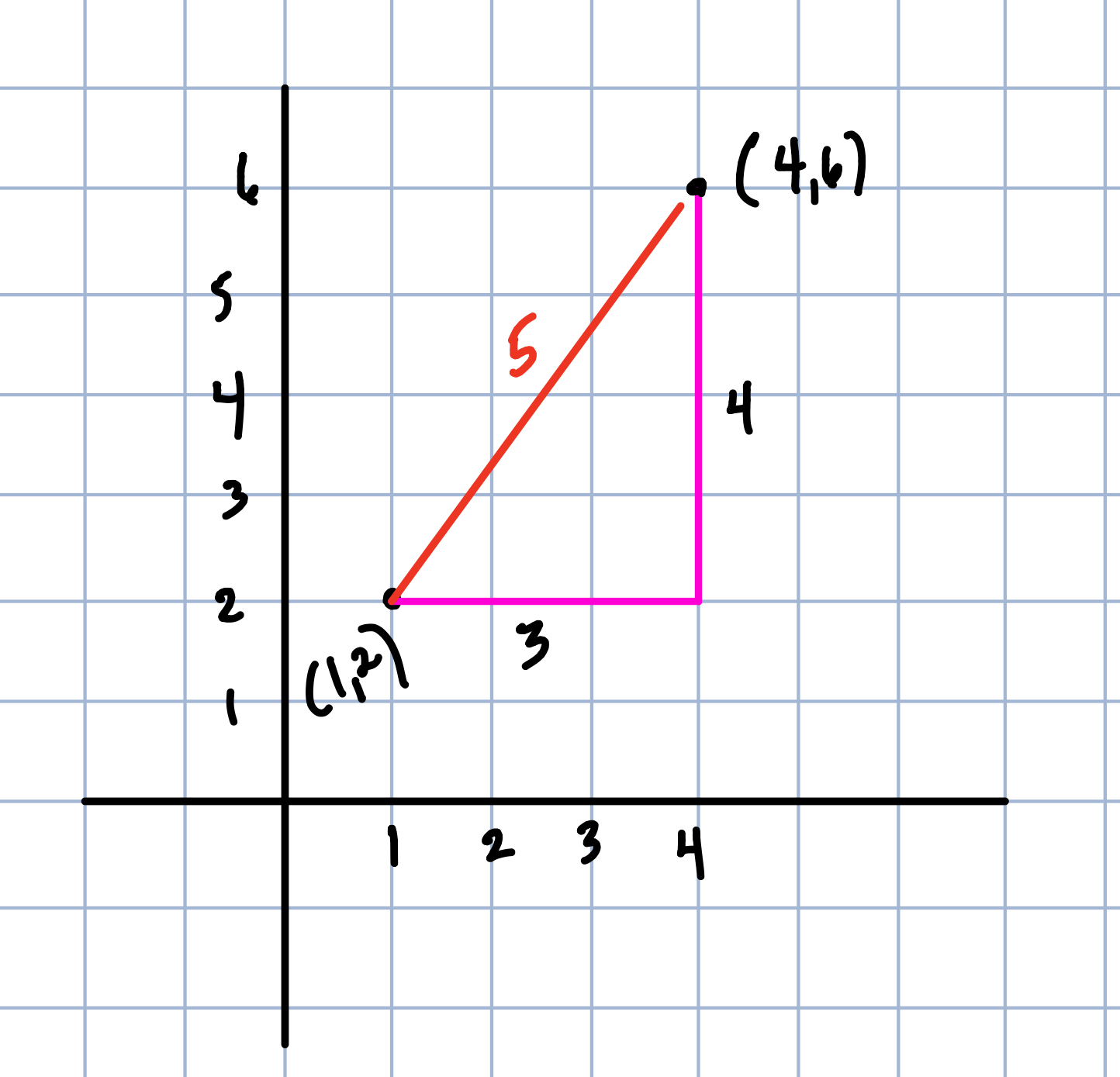
This question is clearly asking for two integer-values points on the coordinate plane that are 5 units from each other but students can’t just count them since the distance is diagonal. This is often a difficult idea for students at first who are not comfortable with the idea of Pythagorean distance (see previous post about Pythagorean distance). However, since the beginning of the Math 2 book has so much work with the Pythagorean Theorem, it may be that students are thinking of the distance as the hypotenuse of a right triangle and can think of the 3-4-5 that has shown up in many other problems. It does take some time for students to be able to think of two points like (1,2) and (4,6) as 5 units away from each other.
Students are asked other questions about the configuration of points that meet certain criteria and how it would be represented algebraically. For example:
Describe the set of points that are all 3 units away from the x-axis. How would you describe this configuration in an equation?
This is trying to get students used to visualizing ALL points that satisyfing a given distance condition and when other conic sections are discussed in later courses, they are prepared to be thinking of configurations as a set of points. So finally when they are asked to
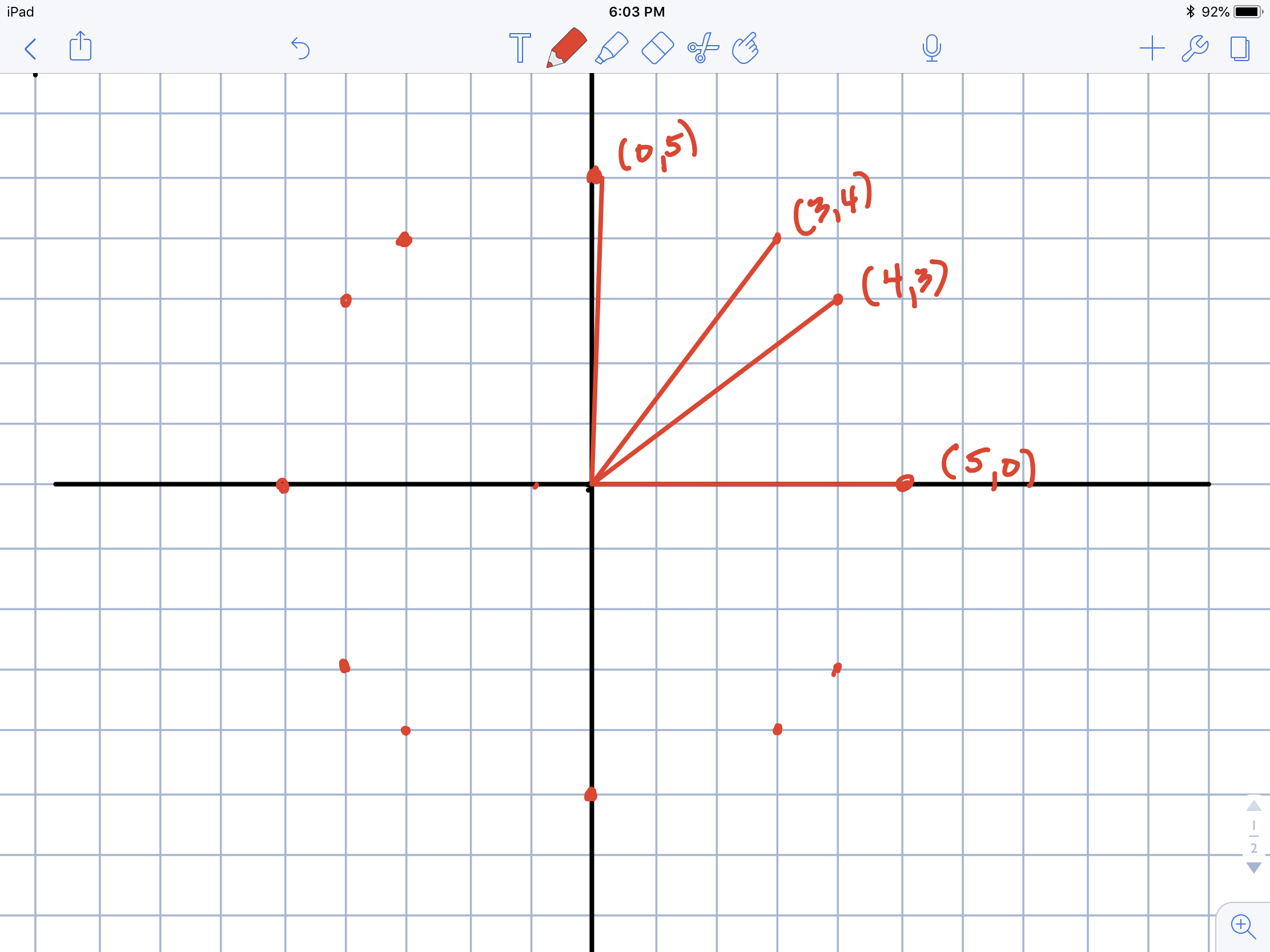
Write an equation using the distance formula that says that P=(x,y) is 5 units from (0,0). Plot several such points. What is the configuration of all such points called? How many are lattice points? [See here for a wonderful journal entry by a student on this question].
This question is the first time that circles are actually introduced and the word “circle” isn’t even in the problem. The discussion that occurs can be very deep and interesting (as is what happened when the student who wrote that journal entry presented this problem) or it could be very straightforward and benign. I have been impressed over the year with how well some students understand that a circle must contain points that are all the same distance from the point that is the center. It is introduced with the distance formula because so much of their work to the point has been based on the distance formula.
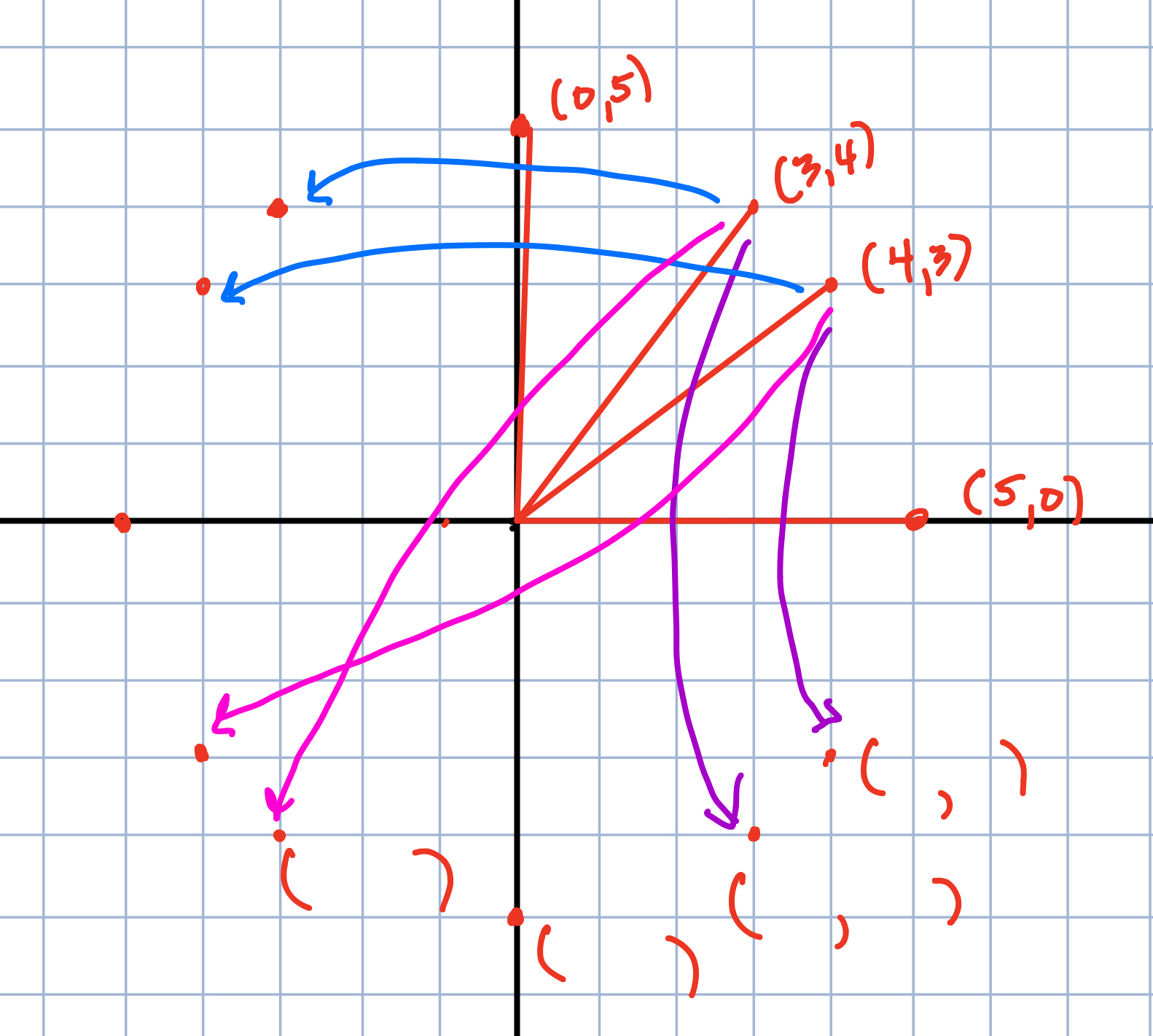
Students have a great time discussing the number of lattice points that lie on the circle and where they are. If they can harken back to the earlier problem about points that are 5 units apart, they recall the 3-4-5 right triangle easily and get the lattice points in the first quadrant.
Most students can then use their knowledge of transformations and the symmetry that the circle has and find the coordinates of the of the other lattice points. This is also a wonderful conversation about reflection over the axes or origin.
If the student presenting this problem leaves the equation in the distance formula form without simplifying, that’s even better and sets up the next question:
Explain how you could use the Pythagorean Theorem to obtain the same result.
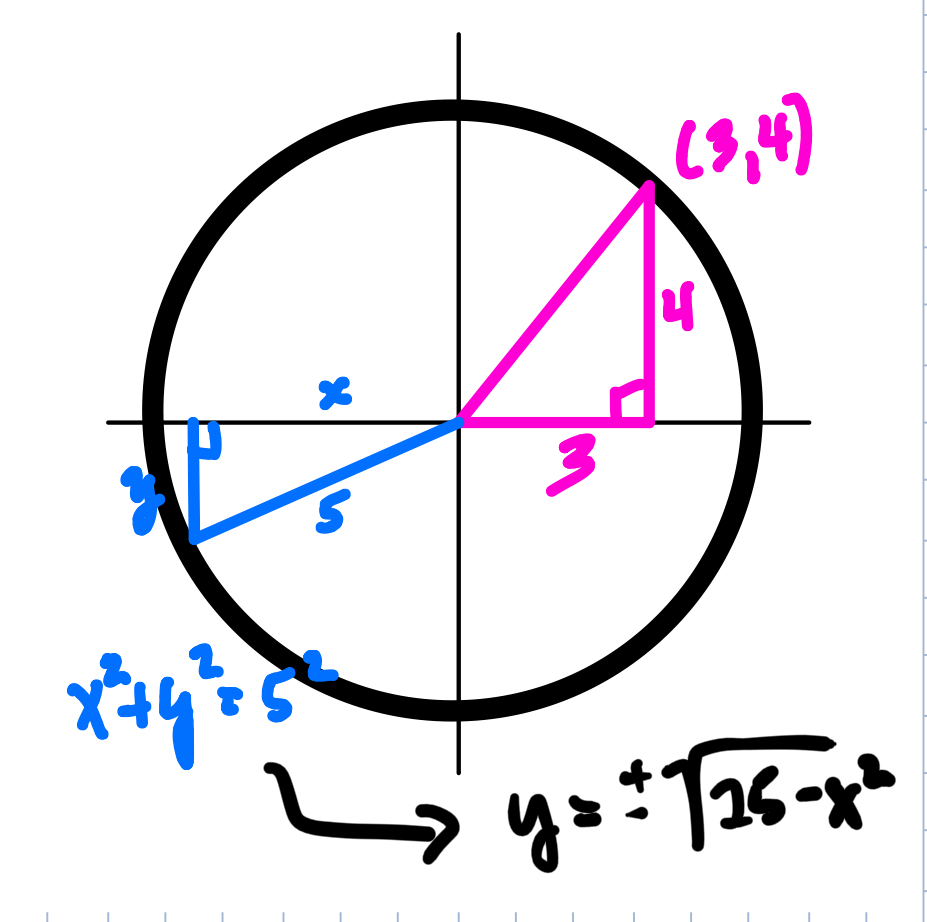
At this point, it is important to connect the distance of five units, the center of the origin and the idea of the radius being a hypotenuse of a right triange with the coordinates the students just found. This will be so important later on when students work with the unit circle in trigonometry for thefirst time.
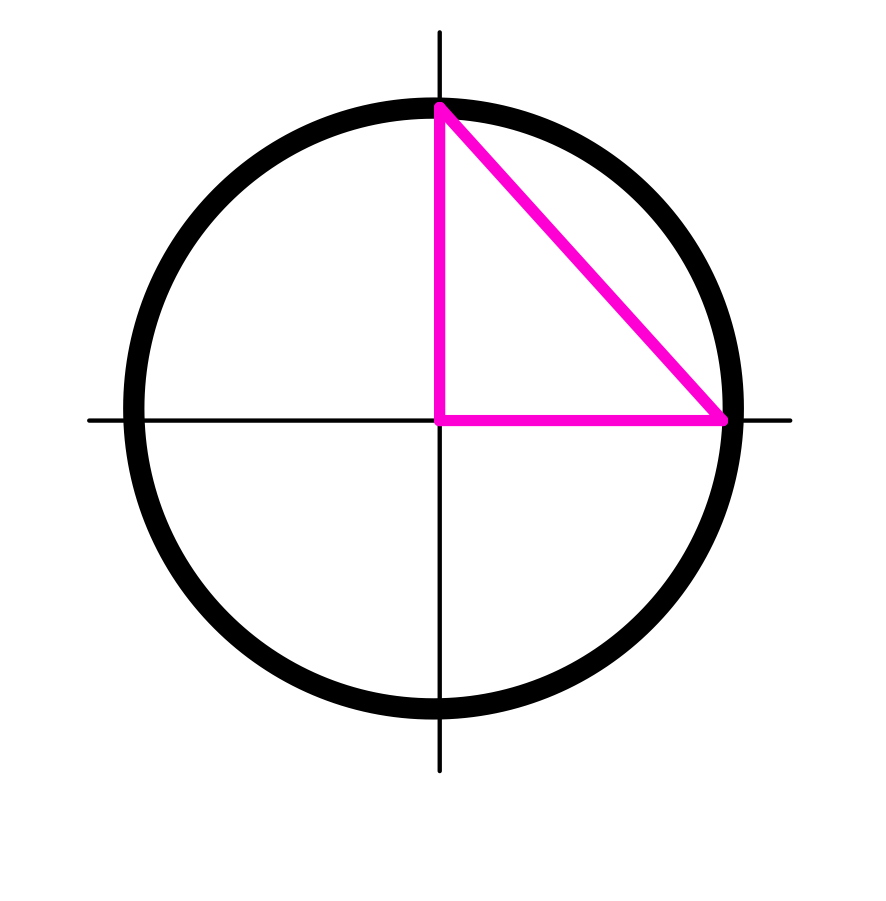
Ask students to start by drawing right triangles where they think they might be in the circle. Interestingly (and maybe obviously) many of them try to draw it like this (see below) where the right angle is at the origin. This is a great time for a conversation about where the points are that are “5 units away from the origin,” where that distance is, and which point are they saying is on the circle with the right triangle. If some student can connect the idea that the radius is supposed to be the hypotenuse and let another student come up to the board and make an attempt at the drawing, it is much better than the teacher drawing it for them. As the discussion moves forward and a student can draw the correct right triangle, I have always tried to get other students to draw other triangles. The first that usually happens is that students generally draw the right triangles that have the lattice points as the point on the circle. It takes some time for students to think about the idea that (x, y) can be any point such that x²+y²=25. This takes some time and discussion.
With a group that is ready, I have also asked students to find the y-coordinates that corresponds to the point on the circle that has the x coordinate that is equal to 1 or 2 and see what they come up with. This is a great time to see if they truly understand what the equation is telling them.
There are many more problems that come after this – some ask for what circles have in common from their equations, some ask for lengths of chords, some are area and circumference problems. I will write another post on how inscribed angles and arcs are introduced but the idea that circles are all connected to the distance formula and the Pythagorean Theorem is a deep one that runs through the whole curriculum and is important for students to see the connections between the right triangles and the circle itself.