Blog

  • How do you use empathy to teach math?

    This post is part of the Virtual Conference on Mathematical Flavors, and is part of a group thinking about different cultures within mathematics, and how those relate to teaching. Our group draws its initial inspiration from writing by mathematicians that describe different camps and cultures — from problem solvers and theorists, musicians and artists, explorers, alchemists and wrestlers, to “makers of patterns.” Are each of these cultures represented in the math curriculum? Do different teachers emphasize different aspects of mathematics? Are all of these ways of thinking about math useful when thinking about teaching, or are some of them harmful? These are the sorts of questions our group is asking.


    One of the things that is interesting about teaching with PBL is how students often describe enjoying this type of math class more than others they have had in the past. It’s hard for students to paint a picture of what it is that produced their enjoyment.  The interesting thing is that it is often not the mathematics they enjoy, but the class itself – the interactions and relationships between the people in the class, and should they be solving some interesting problems that pertain to mathematics, that’s pretty great, too.

    What one girl, Isabelle, described enjoying about my class once, was the way in which she saw mathematics as no longer black and white – with only the teacher’s information as what counts.  In a research interview, I asked her to describe for me what that was like:

    Isabelle:  Like it’s, if you have a question you can just ask it and then that can lead into, like, some conversation or [the teacher] can ask a question and then kind of leaves it out there for us, the kids, to answer it, so…

    Ms. S:  OK, and why do, why do you like that better?

    Isabelle:  Um, because it’s not so uptight and [laughs], like it’s not like focused, “memorize all of this stuff…”

    Ms. S:  Hmm

    Isabelle:  It’s more relaxed, and that helps me learn better I think.

    Isabelle’s more traditional view of the mathematics classroom with its “uptight” and rigid nature reminds her of memorizing facts and formulas and she stated that she responds better to a classroom that, in her eyes, is more “relaxed” and interactive allowing her views and responses to matter.  This is extremely consistent with Frances Maher and Mary Kay Thompson’s (2001) view of the feminist classroom’s responsibility to “deliberately position students as academic authorities” in order to allow them the input for the feeling that their responses matter, but so that that they do not “dismiss their own emerging sense of themselves.”  Also, Isabelle’s feelings are consistent with what Fox Keller (1985) once called “dynamic objectivity” which she defined in terms of how we might be inclined to think about the idea of integrating student input with factual mathematical knowledge.

    Dynamic objectivity is a form of knowledge that grants to the world around us its independent integrity but does so in a way that remains cognizant of, indeed relies on, our connectivity with that world.  In this, dynamic objectivity is not unlike empathy, a form of knowledge of other persons that draws explicitly on the commonality of feelings and experience in order to enrich ones’ understanding of another in his or her own right (Fox Keller, p.117).

    We can view this more flexible way of viewing knowledge as necessary for including students like Isabelle who find the more rigid mathematics classroom not conducive to learning.  She would rather remain connected to the material and the persons in the classroom with her in order to facilitate learning for herself.  Many students truly enjoy the fact that students are the contributors to the knowledge and part of the authority presence in the classroom.  Because of the openness to the dynamic objectivity of the knowledge, the students are able to accept that their input is valuable.  When I asked Isabelle why she thought the students felt so compelled to participate in a PBL classroom, she had this to say:

    Ms. S:  Yeah, there’s almost a guarantee that people will… I wonder why? I wonder what guarantees that everyone will have something to say.

    Isabelle:  Well [both laugh] it’s probably just because geometry has like twenty… like a lot of different ways to do certain problems so there’s a lot of variations in the way that people do them, so…

    Ms. S:  Hmm.

    Isabelle:  That might be it, or it might just be that people feel comfortable in the situation they’re in to participate and it’s not like, “OK nobody ask questions so we can leave now.”

    Ms. S: [laughs]  Yeah. Ok. So there’s a certain amount of like motivation to want to talk about it?

    Isabelle:  Yeah.

    Ms. S:  because it’s like interesting to hear what other people did? [pause] Um, yeah, I can’t figure that out.

    Isabelle:  I think everybody like shares the same curiosity level and like when somebody… like I know in our physics class he never tells us the answer to questions and it drives everybody crazy…

    Ms. S:  Huh…

    Isabelle:  And then we all start talking about it to try and figure out if like we can find out the answer ourselves so and the same thing happens in my math class so…

    Ms. S:  Yeah?

    Isabelle:  I think it’s just the motivation to find the right answer and like, because I know everybody in my class wants to understand.

    Isabelle had described a mathematics classsroom culture with a tacit understanding of the dynamic objectivity of the part that students play in the formation of knowledge.  When presented with a problem where the solution is unknown and the teacher presumes a certain lower level of authority than the students, the students take on a higher level of responsibility and curiosity in finding solutions and methods for those solutions.  Being open to a view of dynamic objectivity and the empathy that it needs, allows many students to have their comfort in this type of learning environment and fosters more equity in learning for students who have previously been disenfranchised in mathematics and science classes.


    Fox Keller, Evelyn, (1985). Gender and Science. New Have: Yale University Press.

    Maher, F. A., & Thompson Tetreault, M. K. (2001). The Feminist Classroom. New York: Rowman & Littlefield Publishers, Inc.

  • Earning Your Status…and Eating it too.

    When I was in elementary school, I was lucky enough to have a teacher named Mrs. Bayles who believed that what it meant to be “cool” was enjoy solving really interesting problems. I remember one time she gave everyone in class a piece of pie and asked us all “What’s the best way to start eating this piece of pie?” and everyone else in the classroom immediately took their fork and stabbed it right in that pointy corner, where, they argued, they would get the most of the juicy center of whatever type of pie they had. I was sitting with my group of friends (mostly girls) who were self-defined math “geeks” (although I think back in 1976, that’s not what they were called). We all kept thinking about that and eventually came to the conclusion that we wanted to start with the crust because thought saving the middle for last was a great idea.

    Mrs. Bayles thought that was so awesome and asked the four us to come up to the front of the room, draw a diagram on the board and give evidence as to why eating pie from the back of the piece of pie was somehow better than eating it from the tip.  We thought we were the Albert Einsteins of pie-eating.  We just loved it. Even though the other kids in the class thought it was kind of weird, since we could justify our choice with a good argument, we stood together and most importantly, Mrs. Bayles respected our evidence and let us have our authority in our say.

    One of the things in recent years that has become a passion of mine in the mathematics classroom, and more precisely, the mathematics probem-based learning classroom, is the idea of status and positioning of students in the discourse and learning that occurs.  This has become such an important issue that I invited one of our keynote speakers this year at the PBL Math Teaching Summit to speak on this very subject.  After many, many years of hearing teachers’ concerns about how to handle a student who tends to dominate a conversation, or who doesn’t speak enough, or what happens when kids get off on the wrong the track when discussing a problem – it is about time that this socio-emotional topic (which includes race, gender, privilege, equity, and all things relational that made me start studying this pedagogy in the first place years ago) be moved to forefront of the mathematics classroom once and for all. (Aside – huge thank you to Teresa Dunleavy who gave an awesome talk on this BTW!)

    I have shared this specific story with so many people at this point in time, but I find it so important that I want to repeat it here for Sam Shah’s “How does your class move the needle on what your kids think about …. who can do math?” prompt for this “Virtual Conference on Mathematical Flavors.” I feel it is something I’ve worked on for almost twenty or so years and I still don’t have it down to a science, I just know that I can’t let it go anymore.

    In my classroom, I allow students to use dynamic geometry apps or technology as much as they want to justify their answers or as evidence for their thinking, as long as it doesn’t go awry (and of course, as long as it is correct and they can describe their thinking).  Two years ago, I had a student (for whom I will use a pseudonym here because I’ve used his real name in the story, but not on the Internet), I’ll call Ernie.  Ernie was one of those kids who could do no wrong – very popular in his current class, very successful academically, which made him very outspoken in his ideas, very good-looking in our white, hetero-normative, social class acceptable way and to top it off – (what Dr. Dunleavy says is usually one of the highest privileges in white schooling) – an exceptional athlete.  Mix all of these privileges together and what automatically came with him into this class? Mathematical status.

    Mathematical status doesn’t mean that he was not a good math student, that’s for sure.  Ernie worked very hard and had excellent intuition, as well as good retention from his past math courses (–hmm, I feel like I’m writing comments from the fall term here..) These were neither here nor there however to the rest of the class.  When students bring their own thoughts and impressions of a student into the class with them, its the class itself that priveleges that other student (in this case Ernie) the high mathematical status that he had.  There might have been other students in the class who should have had higher status but because they were not as outspoken, had different relationships with others, were messy or not as articulate about their ideas, asked “stupid” questions (you know that’s not what I mean) or whatever the behavior that was exhibited – the other students in the class would assign a low mathematical status to other students by the things they say, brushing aside questions or simply by just not listening.

    So one day we were discussing a question about the congruence of two triangles that were in the different orientation, plotted with coordinates.  Students were supposed to come up with some triangle congruence criteria (I believe it was supposed to be SSS) for why the two triangles were congruent – this was at the very beginning of the concept of Triangle Congruence.  Ernie had plotted the triangles on GeoGebra and simply said, “These two triangles are not congruent because all of the correponding sides are not equal” stepped back, matter-of-factly with pride in a job well done.

    There was thoughtful silence in the room as the class looked at this diagram up on the board projected from his laptop.  There was no arguing with the fact that the sides of his triangles were not all the same.  However, there was still confusion I could see in some of the students’ faces.  Some kids asked him to find the lengths of the sides.  “That’s what I got,” “Oh I see what I did wrong,” and “Thanks for clarifying” were some of the comments that Ernie received.  Under her breath, I heard one girl just whipsering to herself, “That doesn’t make sense” and I tried to follow up on the comment, but she would have none of it.  We spent maybe 5 more minutes of me trying to get anyone else to make a comment. It got to the point where I even got out my solutions because even I was doubting myself (the power of Ernie’s status) because I had sworn that those two triangles were supposed to come out congruent.  I knew some of those kids knew it too.  Why weren’t they all saying something?  It was as simple as a misplaced point.  Not a huge problem, why couldn’t anyone call him on it?  I decided to do a little experiment.  “OK, well let’s move on then, but I really think there’s a way to show that these two triangles are congruent.”  Ernie was intrigued.  He couldn’t be wrong so tried to start finding his error, but couldn’t.  I said, “no, no, I want everyone to go home tonight and try to see if we can find a way to show that these triangles are congruent.”

    Jump to the next day in class and kids are sharing their solutions from the previous nights struggle problems.  Before we start discussing them, I say, “Did anyone think about the problem that Ernie presented yesterday?” Radio silence….I wasn’t sure that anyone would actually do it, so I had come prepared with a geogebra diagram of my own.  I projected it on the whiteboard and asked if they noticed anything.  Still no one said anything (outloud so everyone could hear, but I could tell that some students were at least talking to each other).  Suddenly, Ernie says, “Oh my gosh, I plotted the wrong point! It was supposed to be (6,1).” There was this huge metaphorical sigh of relief from the whole class at this moment that could be felt by everyone.  I just coudn’t understand it.  Although no one was willing to speak up that they knew Ernie had been wrong, they were all relieved that that he realized his own error.

    I expressed my concern with this dynamic in my classroom.  Simply asking them why didn’t anyone help Ernie with the problem yesterday in class? or what kept anyone from speaking up when they thought the triangles were congruent? wasn’t getting us anywhere.  So what I did was tried to let them know how much I wanted to hear their ideas – similar to what Mrs. Bayles did with the pie.  If students can see and hear evidence that the teacher values all voices equally, not just those that the students have given high status, can truly make a difference in how they start placing their status beliefs.

    What I saw change in the class slowly, wasn’t the status that the kids all gave Ernie.  In fact, if anything he got even more from finding his own error – but what happened was that girl who had spoken under her breath, spoke a little more loudly.  Students who presumed that Ernie was correct, asked an interesting question that Ernie had to justify.  These other students were growing in the status that the others were giving them. I believe that it is very hard for us as teachers to control what the students come into the classroom believing about each other, but we can have an impact on what they believe is valuable and meaningful about what they do in the classroom.


  • Teaching the “Distance Formula” with PBL

    As I write curriculum, I am constantly scouring the Internet for ideas and ways to improve my own work, as we all do.  I was just on the NCTM resources page the other day at their “Reasoning and Sense Making Task Library” and found this description of a task called “As the Crow Flies”:

    “The distance formula is often presented as a “rule” for students to memorize. This task is designed to help students develop an understanding of the meaning of the formula.”

    OK, wait – shouldn’t this just say, we shouldn’t be presenting the distance formula as a rule for students to memorize?  Instead we should be teaching it for understanding from the conceptual level and allowing students to realize the connection between the Pythagorean idea of distance and how it allows a student to find the distance between two points?  Why should we have a specific task designed to create the understanding after learning the formula when the formula is actually secondary?

    There is a series of questions in the problems I have written/edited that allow students to come to this realization on their own.

    First, a few basic Pythagorean Theorem problems to practice the format, remind themselves of simplifying radicals, Pythagorean Triples, etc.  Second, some coordinate plane review such as:

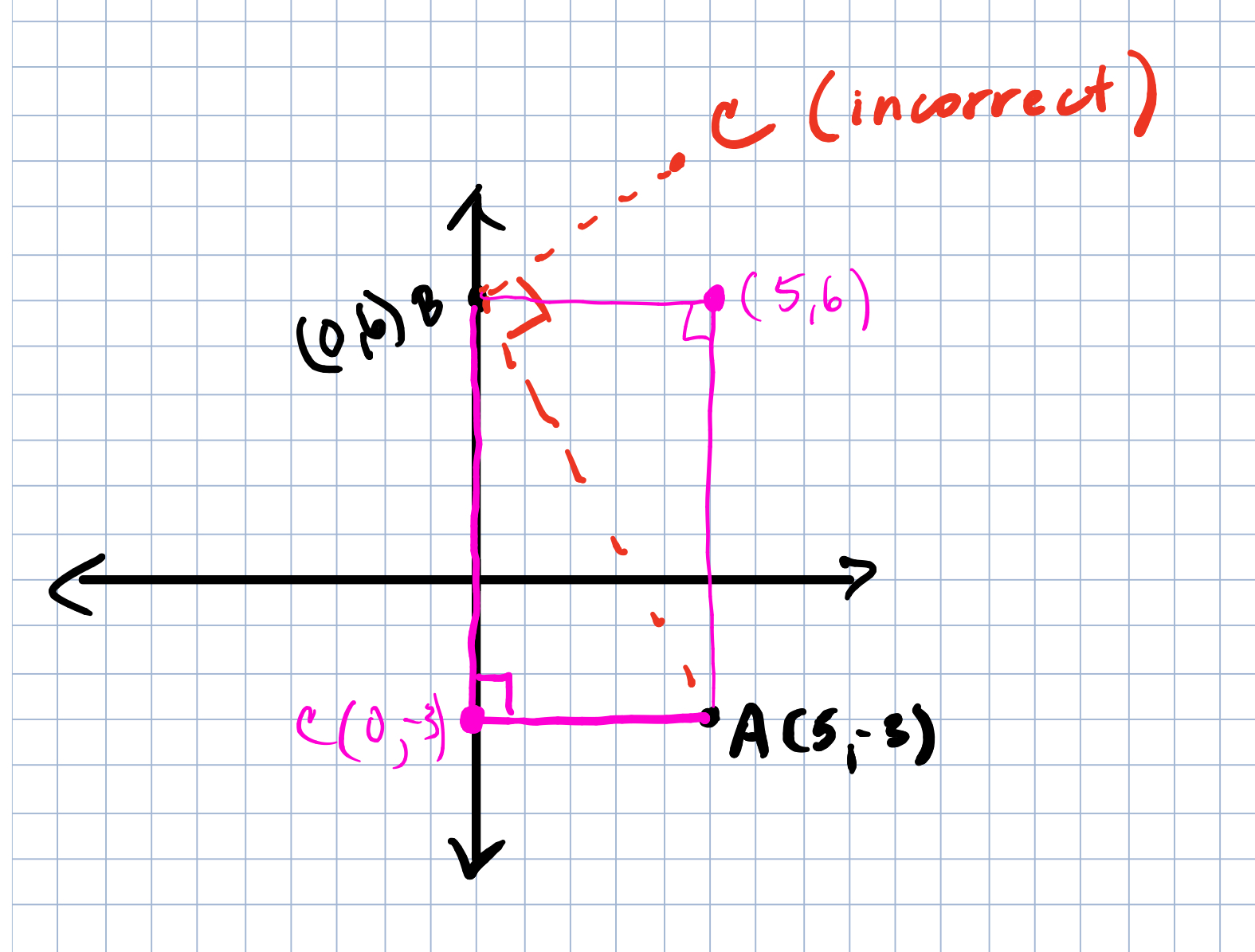
    1. Given A=(5,-3) and B=(0.6). Find the coordinates of a point C that makes angle ACB a right angle.

    This is really an interesting discussion question for many reasons.  First many students have trouble understanding where the right angle is supposed to be. If they incorrectly read that the angle that should be right is ABC, then they are picturing a different right angle (and also doing a harder problem that we’ll get to soon!) but if they are reading ACB, it’s still an interesting question because there is more than one answer.

    Students can sometimes visualize where the right angle can be (even both of the points) but may not be able to get the coordinates.  This discussion is important however because in order to come up with the distance formula later in general (with the x’s, y’s and subscripts – whoa, way confusing!) they need to realize what’s so special about that vertex’s coordinates. So if there is a student who is confused I usually ask the student presenting this problem, “Can you describe the way you found the coordinates for C?” Their answer usually goes something like this: “You just take the x of the one it’s below and y of the one it’s next to.” and other kids are either totally on board, or totally confused.  So then they need to make it a little more mathemtical so every else is on board.  Other kids often chime in with words like horizontal and vertical, x-coordinate and y-coordinate.  This is a really fun, useful and fruitful mathematical discussion in my experience.

    We can then move to a problem like this:

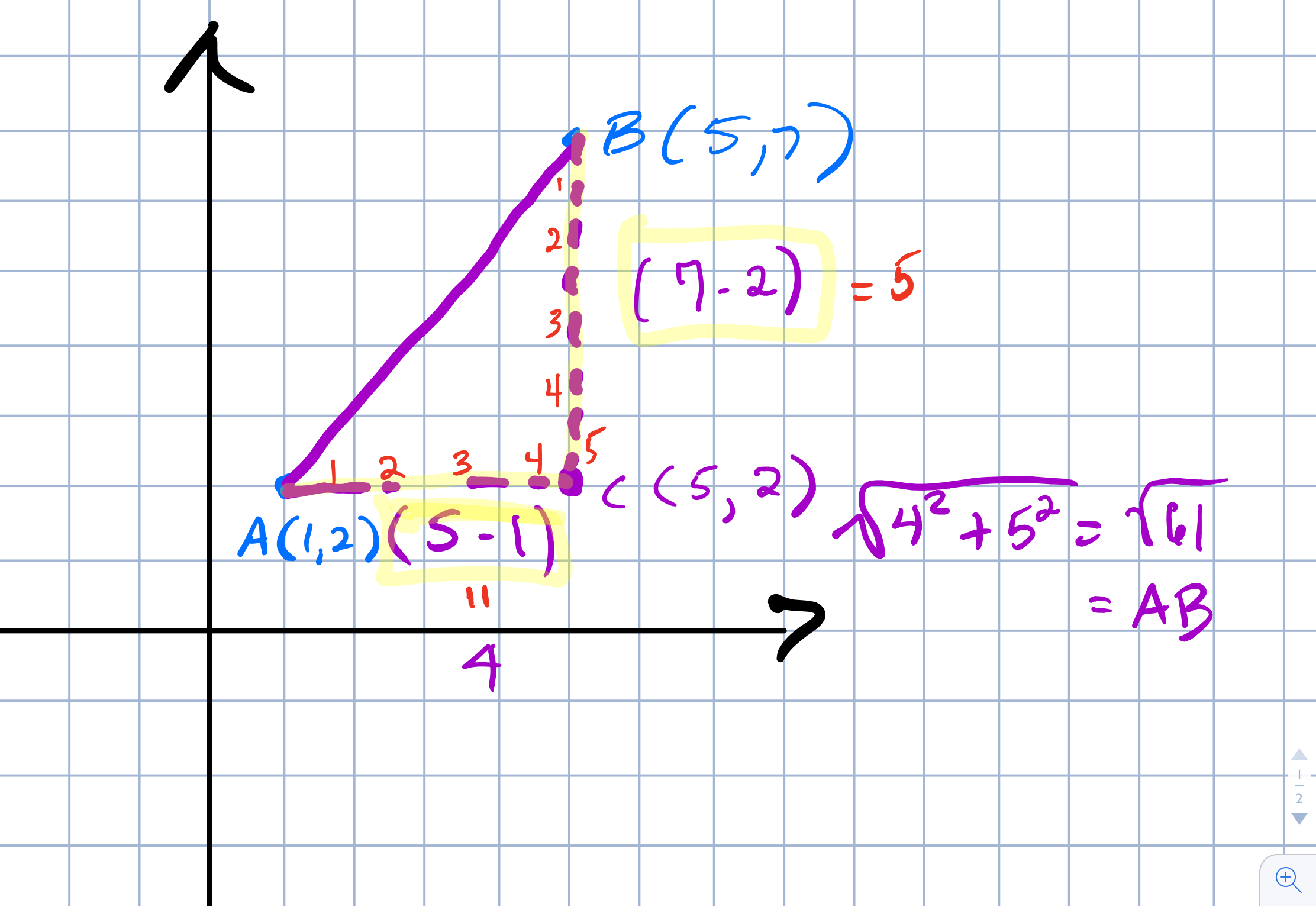
    2. Find the length of the hypotenuse of a right triangle ABC, where A = (1,2) and B = (5, 7). Give your answer is simplest radical form.

    This is generally a problem that is given to students individually to grapple with for homework or in class in groups at the board.  After doing the one discussed above, they at least are prepared to find the vertex of the right triangle and see where it should be.

    It’s honestly rare that a student can’t even draw the diagram – especially if they can make the connection with the previous problem. (Connection is one of the four pillars of the PBL Classroom).  One of the things that is often difficult for students is the idea of subtraction of the coordinates.  The can easily count the units to get the sizes of the legs in order to do the Pythagorean Theorem, but in order to generalize, for a later purpose…sorry, don’t want to steal the thunder…subtraction would be an interesting alternate solution method if someone comes up with it – and they usually do.

    At this point if someone does come up with it, I usually do ask why can you subtract the coordinates like that to get the lengths of the sides and (you guessed it) there was an earlier problem that had student finding distance on a number line, so, many kids make that connection.

    So finally we get to this, maybe a couple of problems later:

    Again, students are asked to use their prior knowledge and contemplate a way that they might be able to describe of finding a way to express the distance between two points in a plane.  This is after discussing notation, discussing how to visualize that distance, discussing subscripts, and discussing the purposes (in other problems) of why we might actually need to find the distances between two points. Because the Pythagorean Theorem squares the lengths of the sides (BC and AC) I’ve never had a kid get all upset about the fact that we don’t put the absolute value signs around the difference for the sides – we’re gonna square it anyway, so who cares if it’s negative?  Kids usually say, “if it’s negative, let’s just subtract the other way and it’s be positive.” We just get right to the point that all we are finding is the hypotenuse of a right triangle which has been the Pythagorean Theorem all along.

    I generally have students write a journal entry about this amazing revelation for them at the beginning of the year and voila!  It’s right there for them, in their journal for the whole year – no memorization needed.  They understand the concept, know how to use it and actually love the idea because now they can just see a right triangle every time they need a distance.  It’s how so many of my students say that have “never learned the distance formla” – they just use the Pythagorean theorem to find distance.  I love it.

  • Teaching Pythagorean Distance with PBL

    This is going to be the first of a series of commentary posts on the types of problems that I help teachers learn to use to teach math with problem-based learning.  The type of PBL that I am a supporter of is what I call Relational Problem-Based Learning in which the construction of knowledge comes from the discussion of scaffolded problems.  I’ll give specific examples of the problems that the students and teacher discuss and the ways in which the discussion builds on prior knowledge.

    A great example of this is the way that the Pythagorean Theorem and the concept of Pythagorean Distace are connected so nicely. The prior knowledge that is assumed (and triggered with basic problems of finding legs, hypotenuses, simplifying radicals, etc.) is basic use of the Pythagorean Theorem.

    Number 9 in the Avenues Math 2 book (adapted from the PEA Materials) says:

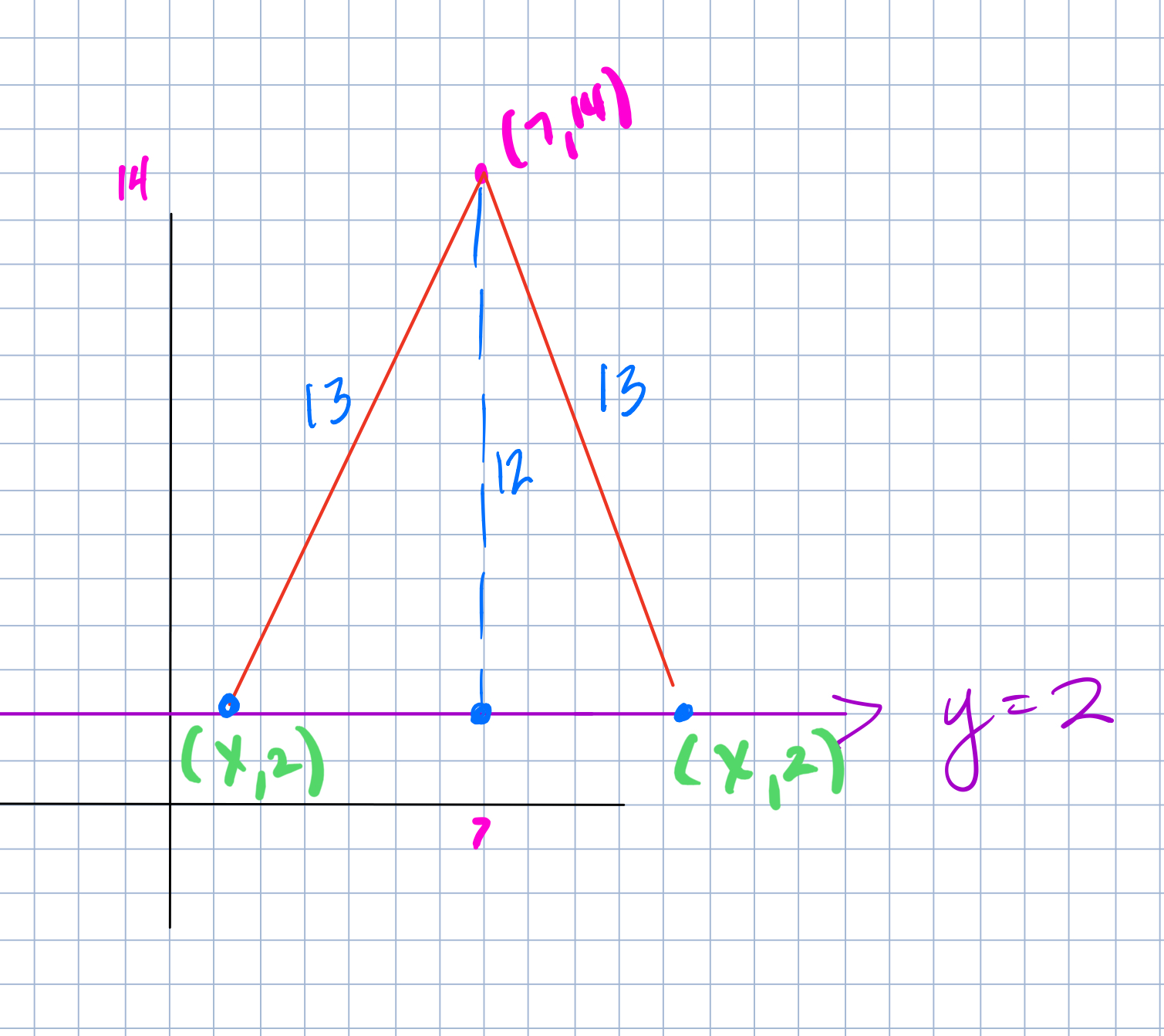
    Two different points on the line y = 2 are each exactly 13 units from the point (7, 14). Draw a picture of this situation, and then find the coordinates of these points.

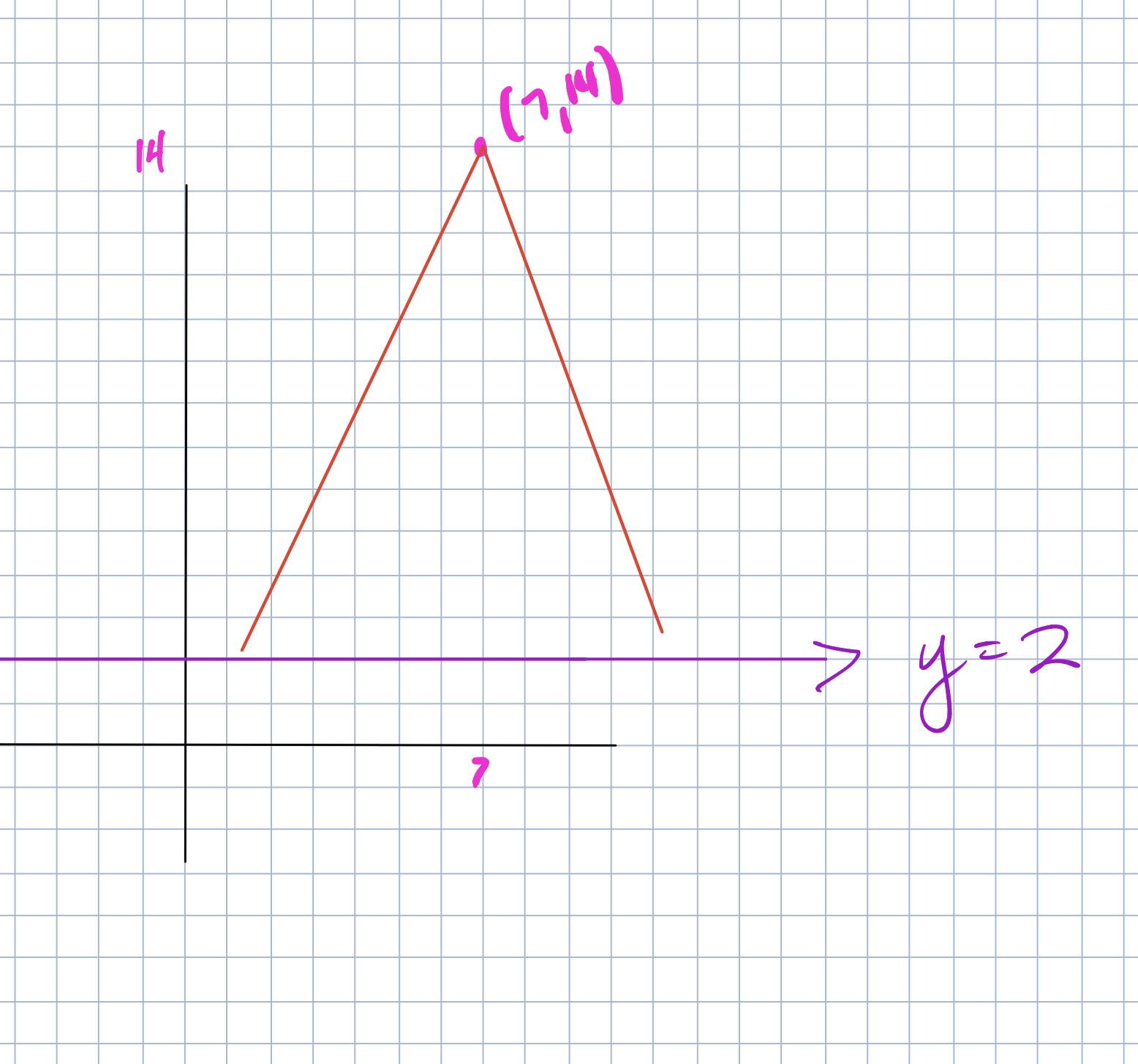
    This problem is usually done within the first week or so of school. When doing this problem for homework without having previously discussed something like this in class, many students are capalble of graphing the line y=2 (although you can probably guess the most common error!) and the point (7,14).  However, many students often are still confused about what the distance “13 units” means. Many student come to class with something like this, which is a totally acceptable attempt actually.

    This first attempt is a great conversation starter about what Pythagorean distance in the geometry that we are studying means.  In fact for any kids who live in a city, it’s a great opportunity to talk about “Taxi-Cab” Geometry and how that is a different way of measuring distance.  The interesting thing is that many students who come to class with this type of inital definition of distance oftentimes live in a city.  I find it really important to validate their idea of distance but just to say that it’s just not the Pythagorean Definition of distance and if they want to learn more about Taxi-Cab Distance, I have readings on it. (see here and here).  This is consistent with Chris Emdin’s opening talk at the NCTM annual this year about privileging all students intuition about math.

    Generally, the discussion that follows is that some other students says that they did not think of the distance that way.  They saw it “straight” there.  If not other students says this, which is usually rare, but could happen, Then it is the teachers responsibility to bring up the idea of a more direct distance.  What I usually do is ask “What other ways are there to think about distance?” Some student usually says something like “as the crow flies” or “straight there” – which is really funny.  They have the idea but don’t really know how to say what they mean.

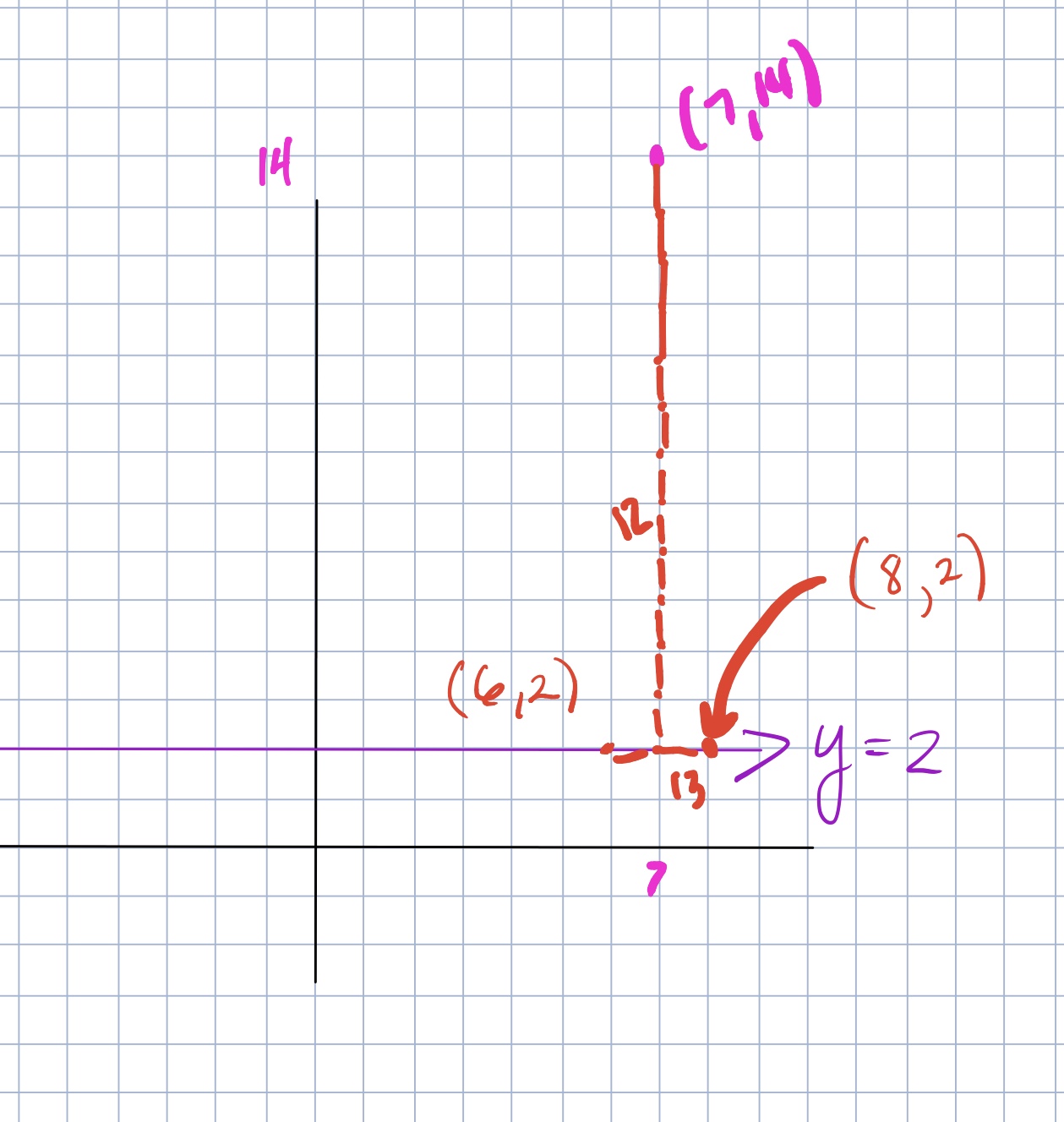
    They can sometimes draw a picture like this:

    But the idea that they need to figure out the coordinates that are on the line y=2 is very difficult.  The students don’t know where to put the points there on the line y=2, so it’s hard for them to label them – what do they do?  At this point, if a student can’t say that the distance is supposed to be 13.  They need a question that is leading them to the right direction.  A few different directions can be taken:

    1. Ask the students if the fact that the vertical direction was 12 is helpful at all – that was something that a student realized and is actually important to the solution of the problem.
    2. Ask the students where the distance that is supposed to be 13 is represented in the diagram they’ve drawn now
    3. have the students turn and talk to each other to think about ways in which they might visualize the “two different points that are 13 units away”

    In my experience, what follows from these teacher actions is some productive struggle, as long as you are patient.  When students get to this point:

    The next difficulty is figuring out the coordinates.  This is where the Pythagorean Theorem comes in.  Even if the students can see the 12 and the 13, it might be difficult for them to get to the point where they realize that there is a right triangle in the diagram.  This should be a whole class conversation in order to optimize the likelihood of a student seeing the right angle.  Finding the missing side, does not even guarantee being able to find the coordinates.

    So in order to have students to be able to add and subtract 5 from 7, students need to be able to have the coordinates of the point that is directly below (7,14) on the line y=2, which is (7,2).  I always try my hardest not to just come out and ask “What are the coordiantes of the point right below (7,14) becasue that is just basically telling them what they need to find.  I try to ask them what do they need to know in order to find the coordinates.

    It is very satisfying when students finally see that it is really just an application of the Pythagorean Theorem.  I wrote a blogpost about one conversation with a student about just this problem a while ago.

    Just another note on alternate perspectives:  I have had students do this by looking at this problem as a circle intersecting the line y=2.  Of coruse, they don’t know how to do that right now, but students who are technologically savvy end up doing in on geogebra and having stuch a great concept of what 13 units away means that they get the right answers without using the Pythagorean theorem.. It is a great way to try to get students to even see that the “radius” they are using is the hypotenuse of a right triangle.

  • Resources for my NCTM Conference Talk Washington 2018

    I hope there’s lots of interest in the lessons that I’ve learned from my years of having students journal. Here are some resources that you could use if you are interested in trying journals in your math classes.

    Handout for NCTM Session Handout Schettino NCTM 2018

    Blogposts about Journaling:

    journals-paper-vs-digital-the-pros-and-cons/

    what-i-get-out-of-student-writing/

    revisiting-journals-getting-kids-to-look-back/

    does-journaling-in-pbl-promote-resilience/

    using-journal-writing-in-pbl/

    Page: metacognitive-journaling/

    Slides for Talk: Slides from Journal Presentation

  • PBL: High Expectations or Learning to be Self-Directed?

    One issue that seems to arise after teachers have been teaching with PBL for some time is the question of how students can remain active learners while listening, taking notes, comparing solutions, being engaged in discussion, etc.  All student-centered mathematics classrooms now have this issue don’t they?  Can a student learn well when they are being active in their learning? How do you allow them to both have agency by being part of the construction of knowledge but also have ownership by taking responsibility for the active part of learning.

    Here’s a scenario: Grade 8 class has a student at the board presenting a method of factoring that is obviously confusing everyone – you know, they learned “the box method” somewhere else and are presenting it like it’s just a given that you are supposed to know this.  I’m observing this and I’m seeing at least 5-7 looks of confusion, maybe 1-2 students who are following the student and at least 3-4 who have checked out totally – maybe drawing a tree in their notebook.

    How do you maximize this moment?  It is imperative that the teacher move in and ask questions that get at the student presenter’s understanding, especially if the other students are not asking questions.  There may be an air of “oh god, I’m supposed to understand what this kid is talking about” and others will not be asking good questions.

    The teacher can ask questions like:

    “OK, good work that you have a method that works for you.  Can you back up and explain how this method is showing what the factors of the quadratic are?”

    “Let’s slow down a minute and see if there are any questions.”

    “Why don’t you explain why you chose the number and variable you did for each box and what those boxes represent?”

    “Can everyone else write down a question for …. and then we’ll share out.” (this can include making up a problem for those who do understand and seeing the presenter do another example)

    These will bring the moment back to the group, wake them up to the fact that it’s OK to have questions and maybe an alternate method as well.  The kids who have checked out might feel validated in checking out.  But at the same time, checking out shouldn’t be an option. . How can we teach students to remain connected even when they really feel like all is lost?  In PBL, it is most important for student to have the tools in order to do this.

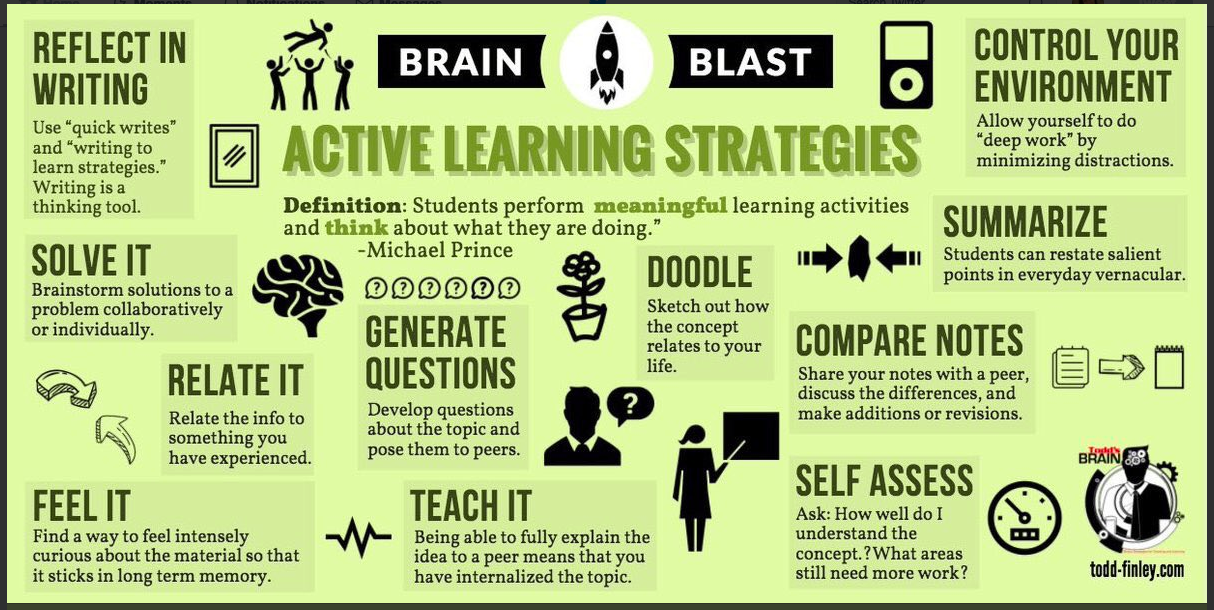
    Today I saw this infographic tweeted by Brian Aspinall (@mraspinall) that does an excellent job of summing up ways to have students remain engaged when they want to check out.

    Screen Shot 2018-02-23 at 2.59.57 PM

    So many of these relate to the expectations for students in the PBL classroom.  Some of my favorites are

    1. Reflect in writing – hugely important for the introverts in the PBL classroom and to share the floor and authority.

    2. Relate it – not only to “something” you’ve experienced but another problem that you might have done that is connected to it!

    3. Control your environment – How engaged you are is really your decision – How can students minimize their own distractions?  Of course day-to-day this will vary, and is developmentally different from grade 8-12 of course, but students, when aware of being distracted, can often find ways to get back into the work.

    4. Self-Assess – this is one of my favorites – it keeps them engaged, makes them think critically and thinking ahead.

    Allowing kids to know that doing all of these different behaviors in the math classroom is not only OK, but expected and encouraged, is part of teaching with PBL and encouraging the “active” in active learning.

  • Update on Online Journal Course

    I’ve heard from a few people who are interested in my online journal course – so sorry that I took it down.  What was happening is I wasn’t getting enough income to support the course on the platform that I had created it on.  So right now I am working on an alternative approach.  Hang tight and I’ll get the word out as soon as it’s up and running!

  • Online Journal Course PreSale Going on Now

    OK, so my online course for math teachers who are interested in learning about using meta cognitive journals is all ready to go. The official start day is next Friday Dec. 1, but if you register during this week prior, you get $50 off the full registration fee.

    Click here for information on registering: Registration with Coupon

    Here’s a description of the course if you are interested:
    This course is an on-demand course geared towards middle and high school mathematics teachers who want to learn about journal writing in math classes. There are four main course lessons that range from the reasoning of using journals to how to assess them. Interaction can occur between participants in this course via the discussion forums with as much or as little time committment as participants desire.

    Please share with anyone you might think is interested in learning about using journals in math class. Thanks so much!

  • The “Wounded Healer” Archetype in the PBL Teacher

    I have been doing a lot more work with teachers this year as I am not in the classroom.  I love watching people teach and talking to them about their teaching.  It is clearly a passion for so many people and the modeling of lifelong learning has been so inspirational for me and their students.

    One issue that seems to arise in all PBL classrooms, no matter how progressive the teacher, is this feeling that they need to somehow, someday really just not allow the students to be frustrated.  Even those who buy into the whole PBL, student-centered, productive struggle pedagogy – deep inside they understand the belief from their own education, that math is black-and-white there needs to be some resolution that is acknolwedged and /or provided by the teacher.

    I was talking to a friend about this dilemma a while ago (thanks @phiggiston!) and saying how interesting it is to me that a teacher’s belief from their past can, in the moment, while teaching, often override their beliefs in the current pedagogy.  In other words, if a teacher has not experienced independent learning as needed in PBL, it is extremely difficult to not give into the impulse to “save” the students from that feeling of struggle or unease.

    Well, coincidentally, @phiggiston has a background in both religious work and in psychotherapy training, so the first the he says to me is, “it’s kind of like the patient-therapist relationship in a way.” And I’m thinking, my teaching is nothing like being a therapist, but of course, I listened intently.  I guess there is a Jungian theory that says that “sometimes a disease is the best training for a physician.”  In fact, Jung goes as far as to say that

    “a good half of every treatment that probes at all deeply consists in the doctor examining himself, for only what he can put right in himself can he hope to put right in the patient.”

    _____________________________________________________________________________

    So what does this mean for PBL teaching?  I had to think of this for a while and also read some Jung as I am not up on the psychological theories that connect to education.  I wasn’t quite sure that this “Wounded Healter” achetype paralleled the PBL teacher as much as I originally thought.  Here are some points:

    • Jung says that for the wounded healer the therapeutic encounter should be regarded as a dialectical process  It’s not just I’m going to the doctor and she’s going to tell me what wrong with me.  There needs to be some kind of dialogue in order for a real healing to happen.  In the classroom, I would argue that this is true about the teacher-student relationship.  Traditionally, it has been that not having dialogue would result in learning that was not as long-lasting, effective and/or connected to the students own ideas.  It is pretty clear that the PBL teacher needs to create the dilectical process in order for the best learning to happen.
    • Jung argues that the physician must help create a safe space where the “patient’s “inner healer” is made available to her unconsciously.” At the same time the physician, should let go of the way she is activiated by the same wounds. This idea is extremely relevant in the PBL classroom.  Why do we want to make students comfortable and relieve their anxiety about mathematical learning?  My take would be because we hate the way it makes us feel. Knowing that struggle is all to close in our memory can actually help us hand over the power to “heal themselves.”  If we can get over that feeling, it will become more of the norm in the classroom.
    • There are risks to this type of teaching – the risk of being vulnerable because you are looking at your own wounds, and also looking fragile to the patient (or student).  This is a very common concern of teachers who are beginning PBL teaching.

    “The experience of being wounded does not make him/her less capable of taking care of the patient’s disease; on the contrary, it makes him/her a companion to the patient, no longer acting as his/her superior.”

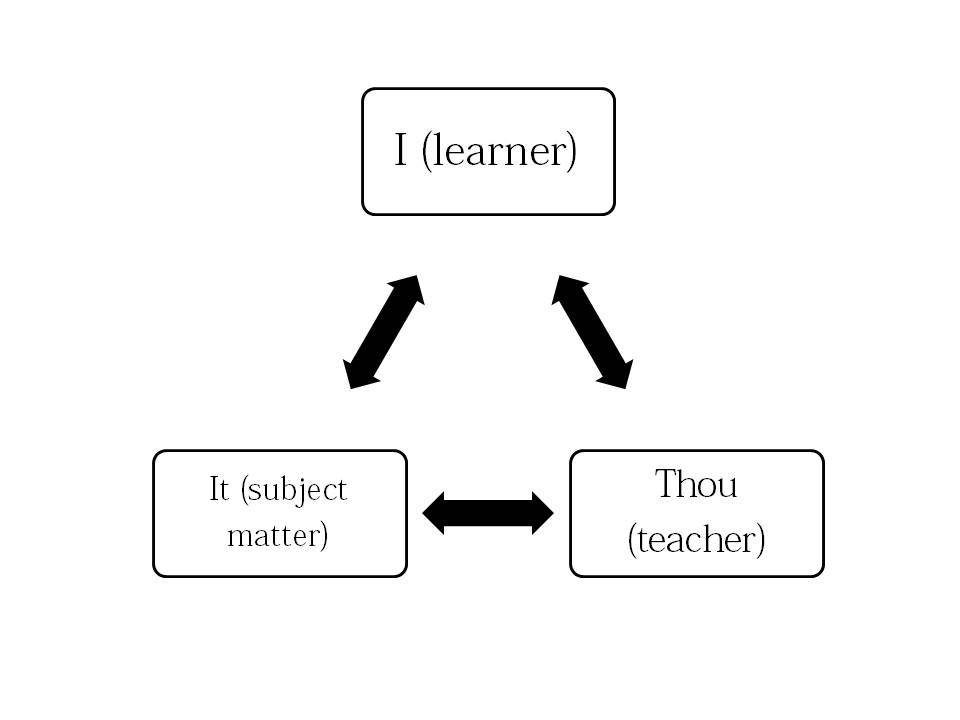
    In other words, it is worth the experience of creating that open relationship.  I go back to Hawkins’ theory of learning (I-thou-It) in which the relationships that exist form a triangle between teacher-student-material.

    Hawkins (1974)
    Hawkins (1974)

    All of these relationships must be nurtured in order for the best learning environment to exist. (For more on this check out Carol Rodgers presentation slides here.)

    _____________________________________________________________________________

    So does this mean if you did not have this type of experience learning math that you can’t learn to empower your own students in this way?  I think not.  When I ilook back on my own mathematical experiences many of them were extremely traditionally taught.  However, I think what you need to have inside you is both the belief that students are capable of owning and constructing their own knowledge and the ability to create a space that allows them to remain uncomfortable.  You have to be willing to let go of your own insecurities and anxieties about learning math and realize that the more you do that, the more the students will feel it as well.

    I am currently working on a quasi-research project about this and when/how PBL teachers choose to intervene in class discussion.  If there is anyone who is interested in helping me out with this, I’d really appreciate it.

  • Reducing Cognitive Load in PBL

    One of the things that I have been thinking about for a very long time is the idea of those who oppose PBL.  Namely those who prescribe to behaviorist and cognitive scientist theories of learning, which I know a great deal about because of my doctoral work.  So many teachers, parents and others have asked me about this over the past 25 years that you’d think I would have an answer.  I know I have thoughts but I do want to do more research in this area.

    I do not pay lip-service to the ideas of cognitive load theory for sure and definitely respect those who follow these ideas.  I do think there is a place for thinking about this theory in PBL, but not an argument for why NOT to do it.  At its heart though, I believe the learning outcomes that are important in the different types of theory (CLT vs. constructivist learning for example) is what ends up differentiating them and also the way the knowledge is constructed.  I do believe in the importance of reducing the Cognitive Load for students so that their long-term memory can be triggered and practiced.

    So I do believe there is a place for this in PBL – it just hasn’t been discussed a great deal.  There is always this us vs. them notion that one is right and the other is wrong – it comes from very strong belief systems and I totally understand where they are coming from.  However, if PBL is done well in a scaffolded, structured way, I believe that you can both reduce cognitive load and also ask students to think creatively.

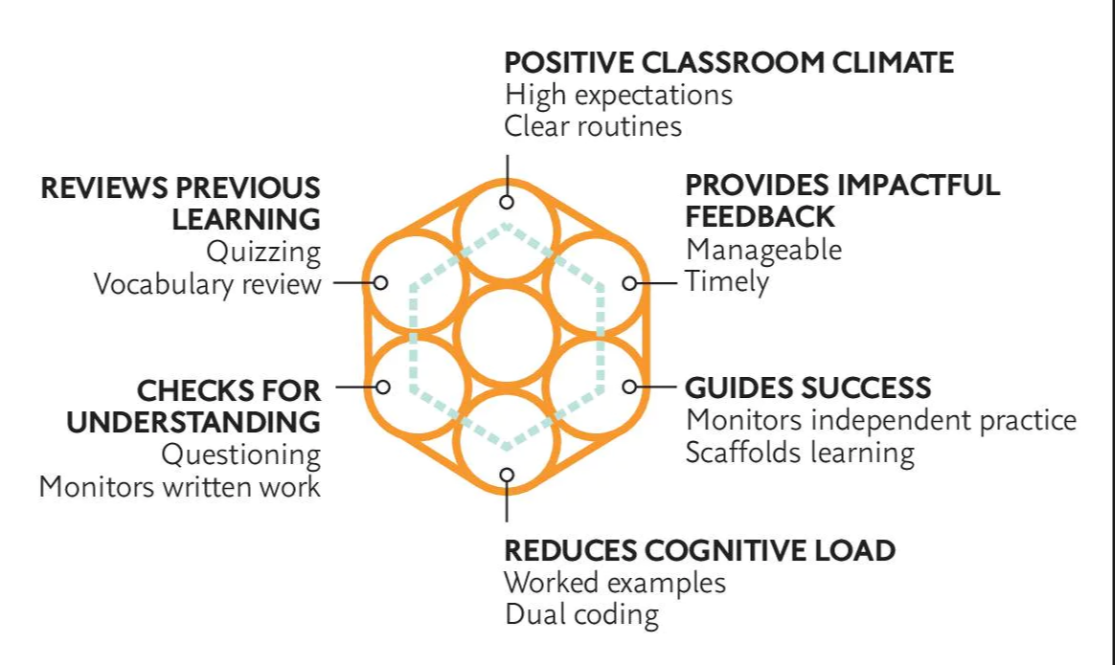
    Here is an image I saw from an article in the Guardian recently entitled Teachers: Your Guide to Learning Strategies that Really Work by Carl Hendrick. This graphic is describing the six ways to make your classroom best-ready for learning.


    Positive Class room climate


    When I was looking at this, the first thing I thought of is “This is my PBL classroom.”  However, I could tell there would have to be some discussion of the “reducing cognitive load” part.  All the other aspects, I believe you can find in some other blogpost of mine somewhere.  In a PBL classroom, the way that students get timely feedback is in so many ways (see my rubrics, journals, etc.).  The nightly homework is the scaffolding of learning and monitoring of independent practice – again when done well.  I won’t go through every one of these, but would love your takes (in the comments below) on each of them.

    So then, how can we talk about reducing cognitive load in PBL – where is lecture and worked problems that the teacher does?  I would argue that the cognitive load is reduced by the scaffolding of the problems in the curriculum.  In other words, by triggering students’ prior knowledge the cognitive load is reduced in such a way that they are remembering something they have learned from the past, and then being asked to look at something new.  The “something new” goes through many phases of problems – concrete, multiple representations, all the way through to abstract – in order to slightly build up the cognitive load.  Again, this is all if it is done well and very deliberately with the idea of not to overload students’ thinking but to help to build the schemas that are needed for constructing knowledge both individually and socially.

    The problems are worked by the students, yes – I will give you that.  But it is the teacher’s responsibility to make sure that the steps are correct, students get feedback on their thoughts and ideas, that on the board at the end of the discussion is a correct solution and so much more.  What this type of teaching does, in my view is both reduce cognitive load to a point, yet also allow students to gain agency and ownership of the material through their prior knowledge and experience.

    Something else that Mr. Hendrick says in his article is:

    “Getting students to a place where they can work independently is a hugely desired outcome, but perhaps not the best vehicle to get there. Providing worked examples and scaffolding in the short-term is a vital part of enabling students to succeed in the long-term.”

    And I would ask, what does students’ success mean in this framework?  Some studies have shown that worked examples are beneficial in only some cases for student learning.  Others have shown that students that are taught with worked examples out-perform those who received individual instruction.  I could go on and on with the studies contradicting each other.  But what if they weren’t in contradiction?  What if there was a way that they could work together – both reducing cognitive load and also giving students agency and voice in the classroom?  Allowing students the freedom to become independent problem solvers but also scaffolding the learning in such a way that their cognition was not overloaded?  Maybe I’m an optimist, but I do believe there is a way to do both.