Blog

  • The Downside of Naming “Feminine” Traits

    I recently read this article from the Harvard Business Review stating that “Feminine” Values Can Give Tomorrow’s Leaders an Edge.   A study was done asking 64,000 people from over 13 countries all over the world for the traits, skills and competencies that were perceived to be appreciated in leaders in the world of business and leadership.  The conclusions (from statistical modeling) that the analysts came to were that tomorrow’s leaders must overwhelmingly learn to have what our culture has defined to be “feminine” traits.  Here’s the list of the survey said were the top 10 desired traits for modern leaders:
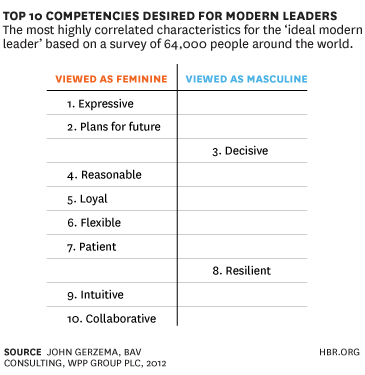
     

    I don’t disagree with these traits, honestly, and as a feminist it actually excites me that the values that I work to foster in the classroom are being valued in the boardroom and society in general (Dewey would be proud too).  However, something that is troubling me is the ever-popular dichotomy that is being set up here that seems to always be at the heart of many issues that rise in our society.  Something I wrote about in my dissertation and any time I talk about Relational Pedagogy is the idea of breaking down this concept of masculine vs. feminine thinking, not only in mathematics or education, but in human relations altogether.

    I will be the first person to motivate and encourage young women in the STEM fields or take a young boy who likes cooking and say, “you, go guy” and hand him an apron – but that is about individualism and allowing young people to be who they want to be and feel empowered.  In my classroom, allowing students to see multiple perspectives and have their voice heard whether they are male or female is entirely my top priority because they are individuals and their relationship with mathematics is unique.  For a long time in math education, the ideas in this study were how young girls were viewed – researchers thought that if we just saw how girls were different from boys that we could see why they weren’t “doing as well” as boys.  However, we saw that they were doing just as well.

    So my problem with this study is not the fact that women will be empowered to become leaders in business – no, that’s really exciting to me.  In fact, maybe some men will see the potential in women and decide to hire more women in the future and this will create more jobs for women and this will in turn, create a more equitable workplace and more favorable working conditions, which will then create more exciting options for business situations because of the fact that different perspectives are being looked at with such different views being taken in problem solving in business.  That is extremely exciting to me!

    However, my problem with this study is this.  In order to make such radical changes in how people view gender differences in our society we really need to stop making such huge oppositional statements.  In support of this view, Mendick (2005) stated

    By aligning separate-ness with masculinity and connected-ness with femininity, these approaches feed the oppositional binary patterning of our thinking and in the final analysis reiterate it (p 163).

    If we just continue to point out how “unfeminine” men are because they are less expressive and how “unmasculine” women because they can be undecisive all we are doing is perpetuating the oppositions that separate us instead of our humanness that can bring us together as learners and our vulnerability that can help us problem solve with our strengths and weaknesses that will make us stronger if we work together.

    There was an article published in 2010, about how if you put more women in a group of people the “collective intelligence” increases – the group works better together.  I’m sure there’s some tipping point though that if the group has all women there are diminishing returns for this measure.  There has to come a time when we value the relationships in our learning, our work and our classrooms and as teachers foster all of these traits to the best of our abilities.

  • Teaching Students to Become Better “Dancers”

    So the other day I read a tweet by Justin Lanier that really sparked my interest.

     We all know the scenario in classroom discourse where a student asks a question – a really great question – and you know the answer, but you hedge and you say something like, “That’s a great question! I wonder what would happen if…”  So you reflect it back to the students so that they have something to think about for a little while longer, or maybe even ask a question like “Why would it be that way?” or “Why did you think or it like that?”  to try to get the student to think a bit more.  But what Justin, and the person who coined the phrase “authentic unhelpfulness” Jasmine Walker (@jaz_math), I believe were talking about was hedging because you really don’t know the answer – sincere interest in the uniqueness of the question – not because you’re so excited that student has helped you move the conversation forward, but because of your own excitement about the possibilities of the problem solving or the extension of the mathematics.

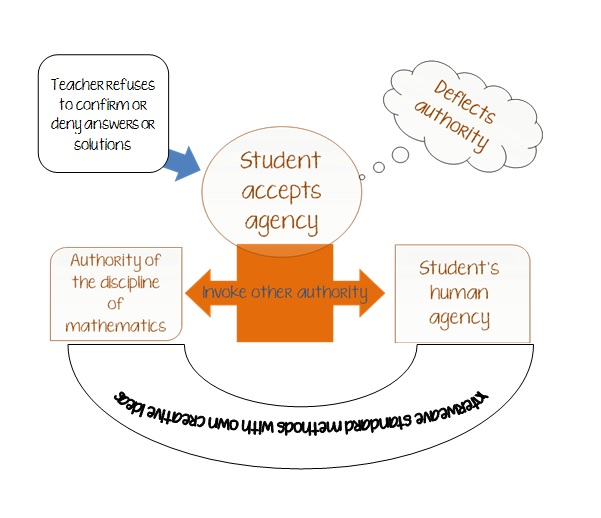
    I think what got me so excited about this idea was how it connected to something that I was discussing earlier this summer with a group of teachers in my scaffolding in PBL workshop in late June.  In a PBL curriculum, the need to make sure that students have the right balance of scaffolded problems and their own agency is part of what Jo Boaler called the “Dance of Agency” in a paper she wrote in 2005 (see reference).  My understanding of this balance goes something like this:

    (c) Schettino 2013

    So initially, the student is confused (or frustrated) that the teacher refuses to answer the question although you are giving lots of support, advice and encouragement to follow their instincts.  The student has no choice but to accept the agency for his or her learning at that point because the teacher is not moving forward with any information.  But at that point usually what happens is that a student doesn’t feel like she has the authority (mathematical or otherwise) to be the agent of her own learning, so she deflects the authority to some other place.  She looks around in the classroom and uses her resources to invoke some other form of authority in problem solving.  What are her choices?

    She’s got the discipline of mathematics – all of her prior knowledge from past experiences, she’s got textbooks, the Internet, her peers who know some math, other problems that the class has just done perhaps that she might be able to connect to the question at hand with previous methods that she might or might know how they work or when they were relevant – that discipline has had ways in which it has worked for her in the past and lots of resources that can help even if it may not be immediately obvious.

    But she’s also got her own human agency which is most often expressed in the form of asking questions, seeing connections, drawing conclusions, thinking of new ideas, finding similarities and differences between experiences and thinking about what is relevant and what is not.  These pieces of the puzzle are not only important but a truly necessary function of the “dance of agency” and imperative to problem solving.

    Interweaving both of these types of agency (and teaching kids to do this) have become more important than ever.  Yes, being able to use mathematical procedures is still important, but more important is the skill for students to be able to apply their own human agency to problem and know how and when to use which mathematical procedure, right?  This “dance” is so much more important to have every day in the classroom and if what initiates it is that deflection of authority then by all means deflect away – but the more we can “dance” with them, with “authentic unhelpfulness” and sincere deflection because we need to practice our own human agency, the more we are creating a true community of practice.

    Boaler, J. (2005). Studying and Capturing the complexity of practice – the Case of the ‘Dance of Agency’

  • So How Do We Shift Gears?

    OK, OK, I get the idea – not everything on the Internet is true and, for sure, not everything on the Internet is meaningful or helpful.  Since April of this year I have started following a bunch of people on Twitter (before that I really didn’t even know what it was or care) and thought that there were so many people out there that I wanted to learn from.  I would read other people’s blogs and try my best to think about what I had to learn from others. Mind you, I know I am definitely not the god of teaching, that’s for sure, but many of the things that are written out there – should I guess – with the hope of being “inspirational” or meaningful to others, I find less than helpful.

    One site that I have really enjoyed reading which often has some great links and blogposts is Mindshift.  But they just tweeted this blog entry that cited an article about creating a business that fosters creativity.  OK, I see the connection to education, but honestly, it is a very different machine.  Kids and adolescents have a very different mindset than adults who are out there making money.  Not to mention the consequences of risk-taking in the classroom vs. risk-taking in the office have the potential for being very different.  (Assessment for grades has a different meaning possibly for a 13-year-old mind than brainstorming on the job, vs. assessment for a salary raise, etc for an adult who we hope can handle the pressure a little more.)

    Then the blogger writes two short paragraphs at the end about how schools are just “incurious and risk averse” places.  Basically stating that schools don’t ever allow students to practice risk-taking or mistake making at all:

    “Too few schools are incubators of curious and creative learners given their cultures of standardization, fear, and tradition. No doubt, external pressures exist that drive that culture. But if there ever was a time to shift gears, this is it. “

    No doubt…sadly, our blogger, Will Richardson doesn’t really give us any advice on what to do about it….except, to do something about it. (Admittedly, he may have written something someplace else that I missed.)  And I don’t want to single out Mr. Richardson – I find tweets and blogs like this all day long – “Exploration, inquiry & problem solving are powerful learning mechanisms…” or “asking good questions and promoting discourse is an integral part of teaching and learning”…. Hmmm, well let me think about ways in which we can talk to teachers  in terms of mistake making and risk-taking:

    • Blogpost on making mistakes and classroom activity tied to Kathryn Schultz’ TED talk On Being Wrong
    • Discussion about article “Wrong is not always bad” with teachers
    • Modeling risk-taking in Problem-Solving in my course at ASG conference in June
    • Discussion of Relational Pedagogy to foster Risk-taking
    • Using a PBL curriculum to foster mistake-making and communication

    I found that many teachers that I work with and who contact me are entirely dedicated to changing the culture of the mathematics classroom in the U.S. and making it (as Mr. Richardson writes) an “incubator of curious and creative learners.”  We need to make changes to our curriculum, our classroom relationships, our classroom culture and the authoritarian hierarchy that traditionally is prevalent in our mathematics classroom.  Students need to be able to feel safe enough, from judgment, alienation and failure to make those mistakes while learning.  We, as teachers, need to begin the discussion with each other about how to move forward with these initiatives and make sure that student voice is heard in the mathematics classroom as they question each other and us, the teachers, with true questions – ones we may not be able to answer.  These are the important aspects of creating curious learners who make mistakes and learn from them.  But we, as the adults in the room have a responsibility to let them feel safe in doing that.

    I think teachers are aware of the fact that it’s time to “shift gears” – to make the classroom more conducive to students working together and taking chances.  There are so many subtleties to making this shift, however.  Students who need to shift, parents who are not used to that, assessment changes to be made – the list goes on and on.  I am doing what I can to help people with this conversation.  The pedagogy of relation (I believe) is at the heart of all of this – keeping in mind that in order for people to be vulnerable and make mistakes, we need to consider the interhuman aspect of learning.  In a classroom where this connection has for too long been typically so acceptably removed, it will take a lot of work to make this big “gear shift” but I’m up to it – bring it on!

  • Be the Change You Want to See

    I just finished listening to a great “blogcast” that Tony Wagner gave as an interview for Blogtalkradio about his new book “Creating Innovators:The Making of Young People Who Will Change the World.” Kind of a neat idea for a book in which he has done some great research looking into how some new ideas got started by young people, how their creativity was fostered in their childhood, parenting and education, etc.  Definitely worth taking a listen to.

    Listen to internet radio with Steve and Mary Alice on BlogTalkRadio

    One of the things that Prof. Wagner talks about in his interview is the idea of fostering the creativity that leads to innovation.  As he spoke to these great innovators that he interviewed, they could all name at least one teacher in their career who had a “significant impact” on their learning.  Interestingly, the characteristics of that teacher were often very similar, Wagner said.  They were known for encouraging collaboration and often assessing it, creating a classroom that was often interdisciplinary and problem-based (of course) and empowered his or her students to be creative in their problem-solving and make mistakes.  Why is this not surprising?  To all of us who strive to foster the practice of creativity and hope to allow our students to become innovative and original thinkers, we have known that these are the values that we should uphold in the classroom. I’m so glad that Wagner did this great research and wrote this wonderful book.

    However, we also know the realities of the limitations that many of us teachers have that come with the system within which we teach.  I have spoken to so many teachers from around the country who, with all good intentions are striving to make their classrooms more problem-based and encourage creativity.  They are truly trying to be the change they want to see in mathematics education today.  But the fear of standardized testing that is not assessing these values, affecting their evaluations or public awareness of parental or administrative dissatisfaction or vocal disagreement with these goals, needs to be balanced with a teacher’s desire to move ahead.  Limitations of a teacher’s time, energy and their own creativity keep them from being able to proceed without support from like-minded colleagues and leaders in their district.

    At the end of the interview, Prof. Wagner talks about his move from the Harvard GSE to his new position in the Technology and Entrepreneurship Center at Harvard.  He says something like he’s found that he doesn’t belong in a school of education because he’d like to be somewhere where the focus is “explicitly on innovation.”  My question is why can’t that be a school of education? or a school at all?  Why can’t learning be explicitly innovative and thought about as innovation in general? I believe all of us are capable of thinking of our schools as places of learning where students are being innovative as they learn.  Every day I ask my students in my classroom to attempt to think of something new to them.  It may not be innovative to me, but as long as it is in their eyes and their brain is attempting to see something in a new way on their own, I believe they are being innovative.

    I would encourage us all to continue to be the change that we want to see in schools and not try to find other places where we think we belong.  It’s so important that we continue to make these changes no matter how small and I hope to continue to be a resource in your own classroom innovation!

  • A Total Win…with lots of understanding

    Before I left for the Anjs S. Greer Math Conference last week, I read an amazing blog entry at the Math Ed Matters website by Dana Ernst and Angie Hodge that was talking about Inquiry-Based Learning and the mantra “Try, Fail, Understand, Win.”  The idea came from one of Prof. Ernst’s student course evaluations this past spring as his student summed up his learning experience in such an IBL course.  This blog post was so meaningful to me because for each of these four words, the authors wrote how we as teachers (and teacher educators) can take this student’s perspective towards our own work.  I decided to attempt to take this attitude going off to my own conference with two courses to give and three smaller talks.  It was sure to be a busy week.

    And in fact, it really was.  I had very little time to sit and listen to others’ work, which I really was quite sad about.  However, in my own classes I was so impressed with the amount of enthusiasm and excitement my participants had for PBL and their own learning.  As I sat in front of my computer this morning reading the course evaluations and their tremendously helpful input, it finally occurred to me how truly powerful the experience had been for my participants.  Many of them became independent thinkers and knowers about PBL and feel so much more knowledgeable and prepared for the fall.    Part of the class time is spent in “mock PBL class” where I am the teacher/facilitator and they are the students doing problem presentations.  We then sit and talk about specific pedagogical questions and distinctions in classroom practice.  Some of the class time is spent in challenging problem solving which is where I also learn so much from the participant’s different perspectives. “We win when we realize there’s always something we can do better in the classroom” – as Ernst and Hodge write.

    The now Infamous ‘French Garden’ Problem

    I want to give a huge shout out to all of my participants from last week and encourage them to keep in touch with me.  Many of you wrote in your evaluations that you still have many questions about your practice and how to integrate your vision of PBL in your classroom.  I will always be only an email away and hope that you continue to question your practice throughout the year.

    My plan is to try to write some blog posts at the end of the summer/beginning of the year in order to respond to some of the remaining questioning while you plan for the beginning of the school year such as:

    1. How to plan for week one – writing up a syllabus, creating acceptable rules
    2. Helping students who are new to PBL transition to it
    3. Assessment options – when to do what?
    4. Working hard to engage students who might not have the natural curiosity we assume

    If you can think of anything else that you might find helpful, please post a comment or send me a message and I’d be happy to write about it too!  Thanks again for all of your feedback from the week and I look forward to further intellectual conversation about teaching and PBL.

  • Anja S. Greer Conference 2013

    What a great time we had this week in my courses!  I am so excited by all of the folks that I met and the CwiC sessions of other leaders that I went to.  Pretty awesome stuff presented by Maria Hernandez from NCSSM, my great colleague Nils Ahbel, Tom Reardon, Ian Winokur, Dan Teague, Ken Collins and many others.  I was so busy that I didn’t get to see many other people’s sessions so I feel somewhat “out of it” unfortunately.

    I want to thank everyone that came to my CwiC’s and remind them to be sure to go and pick up my materials on the server before they leave.

    For my participants – here are the links to the course evaluations:

    Moving Forward with PBL: Course Evaluation

    Scaffolding and Developing a PBL Course:  Course Evaluation

  • Linking Theory to Practice: A Shout-Out to ‘savedabol’

    This past January, I gave a key-note address at the ISOMA conference in Toronto and posted my slides from that talk on my academia.edu site that I thought would be a good place for me to easily give other people access to my work. (along with my website).  Academia.edu is great because it gives you lots of information about the stats of surfers who come and look at your information.  All of a sudden I saw that this powerpoint had more than something like 400 views and I couldn’t believe it.  I had to see who was searching and looking at this slideshow.

    I quickly realized that someone had seen it, liked it and posted something about it on reddit.  There were only a few comments but one of them went something like this:

    “I think the single worst part of being a teacher is sitting through PowerPoints like this, while some earnest non-classroom pedagogue tells us the bleeding obvious.”

    Whooo – that one stung…my first instinct was to try and find out who that person was and defend myself to the ends of the earth.  Anyone who calls me a non-classroom pedagogue deserves to be righted…but then I kept reading…and someone with the alias ‘savedabol’ wrote this:

    ‘Carmel Schettino (the author) led a seminar I took at the Exeter math conference last summer. She is incredible. I can assure you that she is not a non-classroom pedagogue. She has been in the classroom nonstop for at least 20 years (that I know of). She is particularly scholarly when it comes to PBL and other ed topics, but that doesn’t make her irrelevant to what we do every day. Near the end she gives some great resources.’

    I can’t tell you how affirmed I felt by ‘savedabol’ and I want to just let them know how nice that was of them to share their thoughts about my work with them.  I have been in the classroom non-stop since 1990 (except for two terms of maternity leave and one term of a sabbatical when I was a full-time student myself) and I pride myself in researching as much as possible about what I do.

    I do wish that the first poster had had the chance to hear me speak instead of jumping to the conclusions they had – and it definitely got me thinking about something that was discussed last year at the PME-NA conference in October 2012.  I was one of maybe just a few people in the special category of math teacher/educator/researcher/doctoral students at this research conference where many of the math research folks were talking about ways in which they could breach the great divide of the theory people (them) and the practice people (us).

    For many years I have lived this double life of both theory and practice and I have to say, I love it.  Having just finished up my Ph.D. and teaching full time was probably one of the toughest things I’ve had to do in my life, but having my mind constantly in both arenas has only helped me be a better teacher and a better researcher.

    Jo Boaler is a great researcher at Stanford University who is doing great work in outreach between theory and practice this summer by offering a free online course called “How to Learn Math.”  It’s a course for k-12 teachers that is grounded in the most recent research in math education.  What a great idea!  She is sharing some of her wisdom freely online with k-12 teachers who want to spend some time learning about new ideas themselves.  I know I’m in.

    In August 2008, the NCTM put together a special Research Agenda Project to work on recommendations for just this cause and you can see their report here.  One of the major recommendations that came out of their work was to not only emphasize the need for communication between researchers and practitioners, but in my view to help them realize that this communication would benefit both parties equally.  We all have something to share with each other and I know that I appreciate every classroom practitioners’ experiences.  I learn something from every teacher that ends up in my workshop every summer and often end up using many of their ideas as they do mine.

    So let’s keep supporting each other both in real life and virtually, and realize that often times, the “bleeding obvious” is something that needs to be stated and discussed over and over again to be sure that we are still talking about it with the right people.

  • PBL – Students making Mathematical Connections

    As someone who has used Problem-Based Learning for almost 20 years and sad to say has never been part of a full-fledged Project-Based Learning curriculum, what I know best is what I call PBL (Problem-Based Learning).  I know there is a lot of confusion out there is the blogosphere about what is what, and with which acronyms people use for each type of curriculum.  I did see that some people have been trying to use PrBL for one and PBL for the other, but I guess I don’t see how that clarifies – sorry.

    So when I use the acronym PBL in my writing I mean Problem-Based Learning and my definition of Problem-Based Learning is very specific because it not only implies a type of curriculum but an intentional relational pedagogy that I believe is needed to support learning:

    Problem-Based Learning (Schettino, 2011) – An approach to curriculum and pedagogy where student learning and content material are (co)-constructed by students and teachers through mostly contextually-based problems in a discussion-based classroom where student voice, experience, and prior knowledge are valued in a non-hierarchical environment utilizing a relational pedagogy.

    Educational Psychologist and Cognitive Psychologists like Hmelo-Silver at Rutgers University have done a lot of research on how students learn through this type of scaffolded problem-based curriculum dependent on tapping into and accessing prior knowledge in order to move on and construct new knowledge.  There was a great pair of articles back in 2006/2007 where Kirschner, Sweller & Clark spoke out against problem- and inquiry-based methods of instruction and Hmelo, Duncan and Chinn responded in favor.  I highly recommend reading these research reports for anyone who is thinking of using PBL or any type of inquiry-based instruction (in math or any discipline).  It really helps you to understand the pros and cons and parent and administrator concerns.

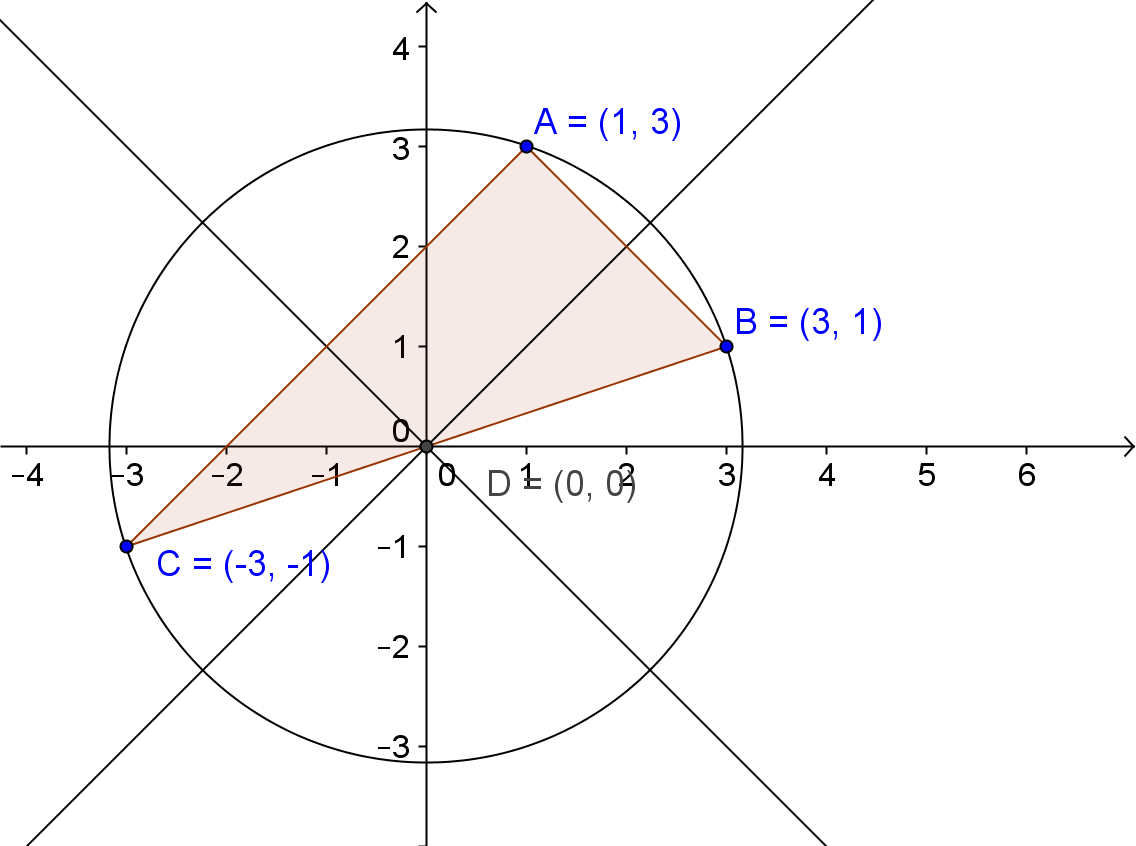
    However, after you are prepared and know the score, teachers always go back to their gut and know what works for their intuitive feeling on student learning as well.  For me, in PBL, I look at how their prior knowledge connects with how, why and what they are currently learning.  One of the best examples of this for me is a sequence of problems in the curriculum that I use which is an adaption from the Phillips Exeter Academy Math 2 materials.  I’ve added a few more scaffolding problems (see revised materials) in there in order to make some of the topics a bit fuller, but they did a wonderful job (which I was lucky enough to help with)and keep adding and editing every year. The sequence starts with a problem that could be any circumcenter problem in any textbook where students use their prior knowledge of how to find a circumcenter using perpendicular bisectors.

    “Find the center of the circumscribed circle of the triangle with vertices (3,1), (1,3) and (-1,-3).”

    Students can actually use any method they like – they can use the old reliable algebra by finding midpoints, opposite reciprocal slopes and write equations of lines and find the intersection points.  However, I’ve had some students just plot the points on GeoGebra and use the circumcenter tool.  The point of this problem is for them to just review the idea and recall what makes it the circumcenter.  In the discussion of this problem at least one students (usually more than one) notices that the triangle is a right triangle and says something like “oh yeah, when we did this before we said that when it’s an acute triangle the circumcenter is inside and when it’s an obtuse triangle the circumcenter is outside.  But when it’s a right triangle, the circumcenter is on the hypotenuse.”

    Of course then the kid of did the problem on geogebra will say something like, “well it’s not just on the hypotenuse it’s at the midpoint.”


    Dicussion will ensue about how we proved that the circumcenter of a right triangle has to be at the midpoint of the hypotenuse.

    A day or so later, maybe on the next page there will be a problem that says something like

    “Find the radius of the smallest circle that surrounds a 5 by 12 rectangle?”

    Here the kids are puzzled because there is no mention of a circumcenter or triangle or coordinates, but many kids start by drawing a picture and thinking out loud about putting a circle around the rectangle and seeing they can find out how small a circle they can make and where the radius would be.  When working together oftentimes a student see a right triangle in the rectangle and makes the connection with the circumcenter.

    A further scaffolded problem then follows:

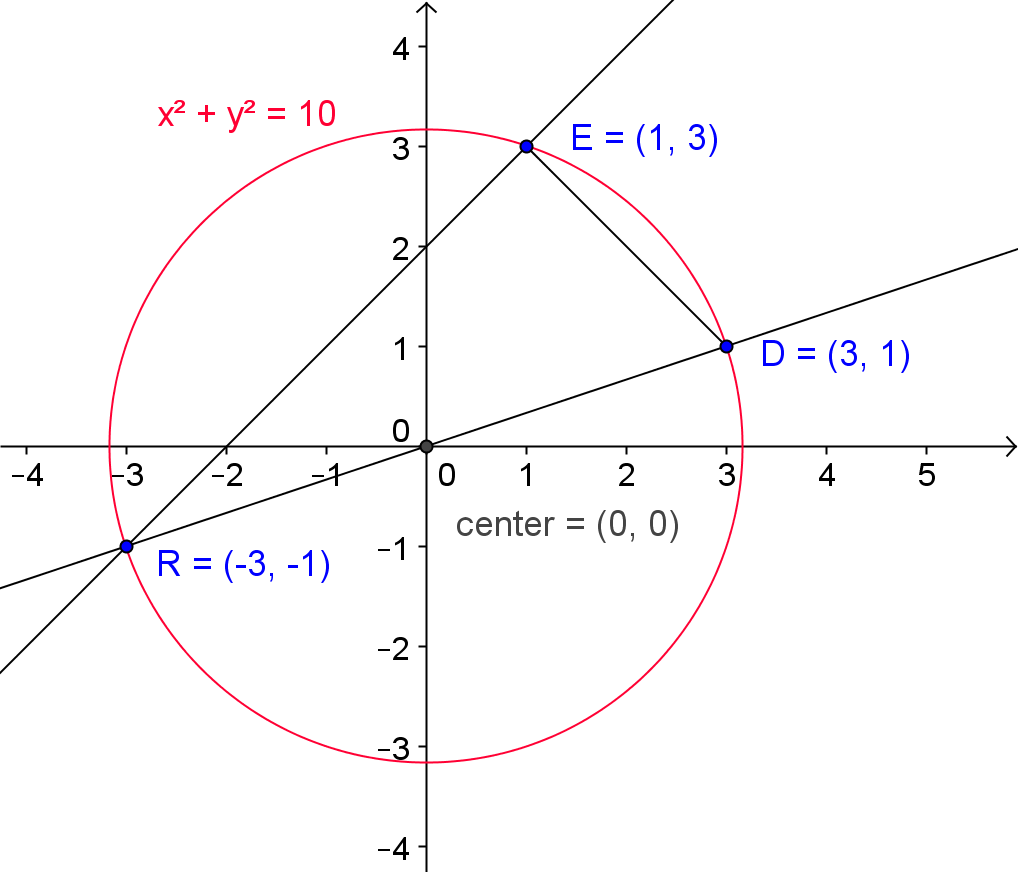
    “The line y=x+2 intersects the circle  in two points.  Call the third quadrant point R and the first quadrant point E and find their coordinates.  Let D be the point where the line through R and the center of the circle intersects the circle again.  The chord DR is an example of a diameter.   Show that RED is a right triangle.”

    Inevitably students use their prior knowledge of opposite reciprocal slope or the Pythagorean theorem.  However, there may be one or two students who remember the circumcenter concept and say, “Hey the center of the circle is on one of the sides of the triangle.  Doesn’t that mean that it has to be a right triangle?”  and the creates quite a stir (and an awesome “light bulb” affect if I may say so myself).

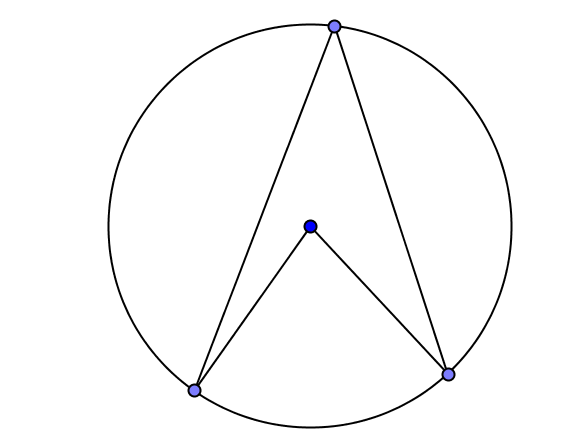
    A few pages later, we discuss what I like to call the “Star Trek Theorem” a.k.a. the Inscribed angle theorem (I have a little extra affection for those kids who know right away why I call it the Star Trek Theorem…)

    I will always attempt to revisit the “RED” triangle problem after we discuss this theorem.  If I’m lucky a student will notice and say, “Hey that’s another reason it’s a right triangle – that angle opens up to a 180 degree arc, so it has to be 90.”  and then some kid will say “whoa, there’s so many reasons why that triangle has to be a right triangle”  and I will usually ask something like, “yeah, which one do you like the best?” and we’ll have a great debate about which of the justifications of why a triangle inscribed in a circle with a side that’s a diameter has to be right.  So who are the bigger geeks, their teacher who names a theorem after Star Trek or them?

    References:

    Kirschner, P. A., Sweller, J., & Clark, R. E. (2006). Why minimal guidance during instruction does not work: An analysis of the failure of constructivist, discovery, problem-based, experiential and inquiry-based teaching. Educational Psychologist, 41(2), 75-86.


    Hmelo, C. E., Duncan., R.G., & Chinn, C. A. (2007). Scaffolding and achievement in problem-based and inquiry learning: A response to Kirschner, Sweller and Clark (2006). Educational Psychologist, 42(2), 99-107.


  • Affirming the “Un-fixing” of the roles in Mathematics

    So after nine, long hard years, I am finally at a point where I am proud to say, “I’m finished!”  Woo-hoo and hurrah, tonight I will submit my dissertation electronically and you can call me Dr.  Reading over my work has been probably one of the most fulfilling acts of my professional life, as was defending my dissertation last week.  I can’t believe how fun it actually was – too true.  When you are passionate about a topic, it never gets old. Then, just today my advisor sends me an article that was published in the Harvard Education Letter titled, “Changing the Face of Math”which strangely sounds so much like what I’ve been working on for so long.  It talks about the current state of the way students create identities in mathematics in the U.S. and how this is detrimental to their beliefs about what they can do and be in the mathematics classroom and beyond.  Sadly, as high school teachers, half of our job is undoing the mathematical identity that the system has put in place all the years before they have come to us. In my dissertation, I wrote about not only this identity question but the difficulty in how American society has such a gendered, dichotomous view of mathematics that even those of us who attempt to move past the stereotypes because of our love of mathematics end up with difficult situations to work against.  For some, it is so difficult that we end up giving up and choosing the easier path – the girl who loves physics but choose biological engineering because she feels like she belongs there.  Or the young woman who goes to college to be a math major, but ends up in International communications because the classes were not taught in a way that worked for her learning style.  Or the weak female mathematics student who doesn’t even consider taking another math class in college because of the negative view of her abilities years ago. In this article they say,

    “Math education experts say we’re in crisis and that traditional approaches of treating math like a cold-blooded subject amid the warm and engaging world of K–12 schooling are a big part of the problem. Narrow cultural beliefs about what math success looks like, who can be good at it, and what it’s used for are driving students to approach the subject with timidity—or not at all.”

    Which was so affirming because it was the major educational research question that motivated my dissertation!  I love it.  Allowing all underrepresented students, not just girls to find ways to change the way they view themselves as math students by changing the way we teach mathematics would be revolutionary, and so many people are doing it.  I am proud to be a part of this movement to “unfix” the gendered, dominant, presumed ways of mathematics learning and open it up to more subjective, creative and collaborative thinking processes. It’s a great time to be a revolutionary!

  • Creating a Conspiracy in the PBL Classroom

    Any Mad Men fans out there?  I just love some of the characters and the struggles they put themselves through.  In one episode from season 5, called “Signal 30,” Lane Pryce needs to take some clients out to dinner and Roger Sterling is giving him some advice on how to woo them to sign a contract with Sterling Cooper Draper Pryce.  Since he is not an account man, Lane is nervous about landing the account.

    Roger:  And then it’s kind of like being on a date.

    Lane:  Flattery, I suppose…

    Roger:  Within reason, but I find it best to smile and sit there like you’ve got no place to go and just let ‘em talk.  Somewhere in the middle of the entrée, they’ll throw out something revealing and you want to wait ‘til dessert to pounce on it. You know, let him know you’ve got the same problem he has.  Whatever it is, and then you’re in a conspiracy – the basis of a quote “friendship”.  Then you whip out the form.

    Lane:  What if I don’t have the same problem?

    Roger:  It’ll probably be something like he drinks too much, he gambles…I once went on a five minute tear about how my mother loved my father more than me and I can assure you, that’s impossible.

    Lane:  Very good then, and if for some reason he’s more reserved?

    Roger:  You just reverse it – feed him your own personal morsel.

    Lane:  Oh I see.

    Roger: (getting up to leave) That’s it, get your answers, be nice to the waiter and don’t let him near the check.

    My husband and I watched this episode about the same time I was having a great deal of resistance in my class to PBL.  I was talking to my husband about how to get students to buy into the notion of learning for the sake of learning where everywhere else in their lives what measures their learning are their grades.  Why would I expect anything different from them if this is the culture they were brought up in?  They depend on their grades to get them into a good college and if their grades are not up to a certain standard, they will not “measure up.”

    I get this question all the time from other teachers – about  how to motivate students to find the love of learning and the interest in problems when they do not necessary know the solution methods to find them.  I usually tell them the same things – talking about the values of the class, grading class contribution with a viewable rubric,  grading their metacognitive journal writing, rewarding them with an interesting relationship with a great teacher…OK that might be pushing it.

    However, this year is different.  I am having the hardest time trying to let them know what I want from them.  They do the homework, try their best, write down notes, but for some reason it feels different.  It’s almost as if there’s this wall between them and me and I don’t know how to get them to see my side.  I have had this problem with students in the past, but usually with a whole class.  Some of them blatantly are interrupting each other and others are obviously ignoring each other.

    Then my husband says, “Maybe it’s like the conspiracy.”  I said, “What?” He said,” You know, what Roger was talking about on Mad Men.  Now, Roger Sterling is no saint (those of you who watch the show know this all too well) and I usually take what he says with a grain of salt.  I also would not ever consider taking advice from him, especially about teaching, but I allowed my husband to continue.  He said maybe what I had to do was build up the conspiracy that Roger was talking about.  I had a real problem with that because I am so committed to relational pedagogy that there’s no way I could lie to or mislead a student about their learning.  But that’s not what he really meant.

    I suddenly realized that what had happened was I was teaching a curriculum that I didn’t even buy into.  I had just finished teaching them matrices and matrix operations with some problems that I had written, and it went very well.  However, in the end I did have to do Cramer’s Rule and determinants.  I tried motivating the problems about determinants with the area of a parallelogram, which kept them interested for a while, but in the end, with a 3×3 it was just here’s the way to do it.  I’m not sure that I could’ve expected them to have enough prior knowledge to derive the formula for finding a determinant of a 3×3.  As much as I tried to cover it up with problem-based learning, it was still a curriculum that is antiquated and not necessarily what I felt they should be doing and learning.  I couldn’t hide it any longer.

    But we’re caught aren’t we?  Do we change the whole system – college prep curriculum, SAT required math, college expectations – and if so how do we do that? (see ahbel.com for a great article on this and a keynote address called Reflections on a 119 year old curricullum!)  Do we move beyond the required standardized testing material and allow our students to see mathematics the way we see it?  Yes, that’s the conspiracy – that’s what my husband was talking about.  When kids complain to me, I will “smile and sit there while they talk” knowing that I’m going to try to get something that we have in common.  “Do you hate solving a system of three equations with three unknowns with a determinant? Oh yeah, I did too in high school.  Wouldn’t it be great if we could do something else?  What else should we do?  Let me find some other problems that might be interesting.”  We have the same problem (literally and figuratively), now we’re on the same playing field having similar motivating factors.

    And you know what?  I don’t think it would be the end of the world if they’re not revealing and you reversed it.  We are allowed to say to them that we don’t understand why we are still teaching this and these would be my reasons for taking it out of the curriculum – part of your own personal morsel.  It might actually bring you closer as a class and have you talking about how your hands are tied and we have to get through this “together.”

    Yeah, there are little tricks that can be learned and carrots that can be used to get students to do what you want them to do, but in PBL, that’s not the point.  There is very little for them to mimic because it is based on their prior knowledge.  They are the ones who need to move the curriculum forward.  So in a nutshell,

    1. Take action – Get to problems in order for students to start feeling empowered and active in class.  Once they see that they are capable of a great deal on their own, it is amazing what they can accomplish.
    2. Create relationships – be sure that you are being reciprocal in your attempts at problems and valuing theirs.  The concept of Relational Trust and Authority are huge parts of a PBL pedagogy (Boaler, Bingham)
    3. But make sure that you are at least somewhat in control in the end because we are, at least for now, still responsible for making sure that some understanding of what we might consider unnecessary skills, for their next courses or future use.

    As Roger said, “Get your answers, be nice to the waiter and don’t let ‘em near the check.”  Create that conspiracy.