Blog

  • Defying Gravity as a Means to Learning from Mistakes

    There’s a lot of blogging, writing and research (and anecdotal stories) out there these days about trying to foster the value in students for the appreciation in failing.   I even wrote a blog entry two years ago entitled “modeling proper mistake-making” way before I read anything or watched any videos on the Internet.  From teaching with PBL for over 17 years, I am a pro at making mistakes and watching students struggle with the concept of accepting the idea of learning from their mistakes.  This is so much easier said than done, but it is clearly something that grow to love even if only for a short time.

    Last April, I had the pleasure of hearing Ed Burger at the NCTM national conference where he spoke about having students in his college-level classes required to fail before they could earn an A in his class.  In his August 2012 essay “Teaching to Fail” from Inside Higher Ed (posted at 3:00 am, which I thought was kind of funny), he talks about attempting to make a rubric for the “quality of failure” on how well a student had failed at a task.  I thought this was an interesting concept.  I mean, in order to fail well, can’t you just really screw up, like not do it at all?  Prof. Burger states that allowing students to freely reflect on their “false starts and fruitful iterations” as well as how their understanding “evolved through the failures” can be extremely beneficial.  He also states:

    “To my skeptical colleagues who wonder if this grading scheme can be exploited as a loophole to reward unprepared students, I remind them that we should not create policies in the academy that police students, instead we should create policies that add pedagogical value and create educational opportunity.”

    Last year for the first time, I tried a similar experiment wherein I gave students an assignment to write a paper in my honors geometry class.  They had to choose from three theorems that we were not going to prove in class.  However, it was clear that they could obviously just look up the proof on the Internet or in a textbook or somewhere, since they clearly have been proven before.  The proof was only 10 or 20% of their grade.  The majority of the paper’s grade was writing up the trials and failures in writing the proof themselves.  This proved to be one of the most exciting projects of the year and the students ate it up.  I even told them that I didn’t care if they looked up the proof as long as they cited it, but I still had kids coming to me to show my how they were failing because they wanted a hint in order to figure it out themselves.  It was amazing.

    This past week I showed my classes Kathryn Schultz’ TED talk entitled “On Being Wrong” in which she talked about the ever popular dilemma of the Coyote who chases the Road Runner, usually off a cliff.

    My students loved her analogy of the “feeling of being wrong” to when the Coyote runs off the cliff and then looks down and of course, has to fall in order to be in agreement with the laws of gravity.  However, I proposed a different imaginary circumstance.  Wouldn’t it be great if we could run off the cliff, i.e. take that risk, and before looking down and realizing that vulnerability and scariness, just run right back on and do something else?  No falling, no one gets hurt, no one looks stupid because you get flattened when you hit the ground?  Maybe that’s not the “feeling of being wrong” but it’s the “feeling of learning.”

    Next blog entry on creating the classroom culture for “defying gravity.”
  • Why I disagree with Mr. Kahn

    I have to say that I am not usually a controversial blogger – I’ll just put that out there right away.  However, I am so frustrated with the conversations, blog posts and articles that are zipping around the blogosphere about online learning, MOOCs and Khan Academy that I have to say something about it as a teacher, teacher educator and responsible learner, myself, about education theory.  I have taught online classes, taken online classes, used open source materials for my classes and definitely promote the idea of equal “world-class education for anyone, anywhere.”  However, I have yet to see how that quality education occurs online and especially the way that it is promoted in Salman Khan’s book, The One World Schoolhouse: Education Reimagined.

    Now let’s just put something else out there right away – it might be that I am frustrated by the fact that he has no background experience in education (which he admits – “I had no teacher training”) and I am offended that he is speaking out of turn speaking as if he does.  For example, he says “There’s an old saying that ‘life is school.’”  Hmmm, I wonder who said that? And I’m not sure that’s really the right saying.  Or it could be that he is attacking the very discipline that I am working so hard to change – mathematics.  I totally agree that there is a lot that is wrong with the way mathematics is taught in the U.S.  But NOT going all “rogue” and working against the people who have already done some research on the subject and know a little about which they talk, might be a good place to start.  There are many things that Mr. Kahn discusses in his book that he seems to purport as novel ideas like Mastery Learning, Flipping the Classroom, etc. that are not his ideas.  So let’s pretend that the fact that he wrote a book of concepts that seem to be a compilation of educational reform ideas that have been around for a while is not what really annoys me.

    What really gets my goat, if I seem to have his idea right, is that he is advocating for “a free world-class education, for anyone anywhere” but I’m not really seeing how this is going to happen.  He advocates for the use of the Khan Academy for mastery learning in the classroom (in a school system) where the students watch the videos and then come to class and do “projects” with each other in the “one room schoolhouse.”  I actually agree that this is a wonderful learning scenario that promotes creativity, independence in learning and individualized lessons for students of all ability levels.  Besides the huge government and system-wide testing restrictions that are currently in place and teachers’ current use of assessment, it would be very difficult (but not impossible) to change this system.  Kahn very naively writes a 5-page chapter on Tests and Testing, which again is nothing new, on the evils of standardized testing and why they don’t really tell you anything about students’ knowledge.  His “one room schoolhouse” is an idealistic utopia of learning for someone who has never been in the classroom and dealt with classroom management, assessment, review or planning of these open-ended projects.  I do believe that a great deal of teacher training would need to be reformed and reviewed in order for something like this to happen and before any school thinks of moving to a model like this they should think wisely about the ways in which teachers are ready to handle the change of the classroom culture and how they are ready to deal with it.  Students will still have questions about the material and will all be at different places in the content and the projects, which will probably demand more planning from the teachers (which again, is not a reason not to flip the classroom, but a necessity of which to be aware). I found what he put forth as the ideal classroom short-sighted and with many limitations.

    Secondly, what about the “anyone, anywhere” Idea? Even if children in third-world countries have access to internet-ready computer to watch these videos, where are the teachers and schools to have them do the “world-class” learning with these group projects?  Where is their utopian learning environment?  I am confused about how watching videos online is giving them a “world-class” education (although I could see how it was free if Mr. Gates donated a bunch of computers and Internet access, etc.).  Mr. Kahn also realized that “teaching is a …skill – in fact, an art that is creative, intuitive, and highly personal…[which] had the very real potential to empower someone I cared about.”  Yes, Mr. Kahn, that’s what teaching is all about.  Teaching is about, as you said, “genuinely [sharing  your] thinking and express[ing] it in a conversational style, as if I was speaking to an equal who was fundamentally smart but just didn’t fully understand the material at hand.”  How is that supposed to happen for someone sitting alone watching a video?

    In the NY Times article, The Trouble with Online Learning, Mark Edmunson wrote:

    “Learning at its best is a collective enterprise, something we’ve known since Socrates. You can get knowledge from an Internet course if you’re highly motivated to learn. But in real courses the students and teachers come together and create an immediate and vital community of learning. A real course creates intellectual joy, at least in some. I don’t think an Internet course ever will. Internet learning promises to make intellectual life more sterile and abstract than it already is — and also, for teachers and for students alike, far more lonely.”

    This is the heart of Relational Pedagogy, that the interhuman connection between people is what constructs knowledge and the trust, authority, and value of perspective that is shared and given to each other is just as important as the content that is exchanged – most especially in mathematics, it’s just taking us a lot longer to figure this out, Mr. Kahn.

  • The Role of Technology in Relational Pedagogy?

    So I’ve been thinking a lot lately about technology and learning.  There’s so much in the news about MOOCs, using iPads, schools using technology, etc.  I am even part of a pilot program at my school right now where all of my students have iPads in my honors geometry class and we are trying to communicate at night using Voicethread and the iPads.  My hope was that having a way to share ideas during the evening would lessen the stress of homework problems that students are asked to grapple with in the PBL curriculum would give them more opportunities to throw out problem-solving ideas with each other before class starts so that we would spend less time in class debating different methods of solving the problem (although that’s what I love about class, right?).

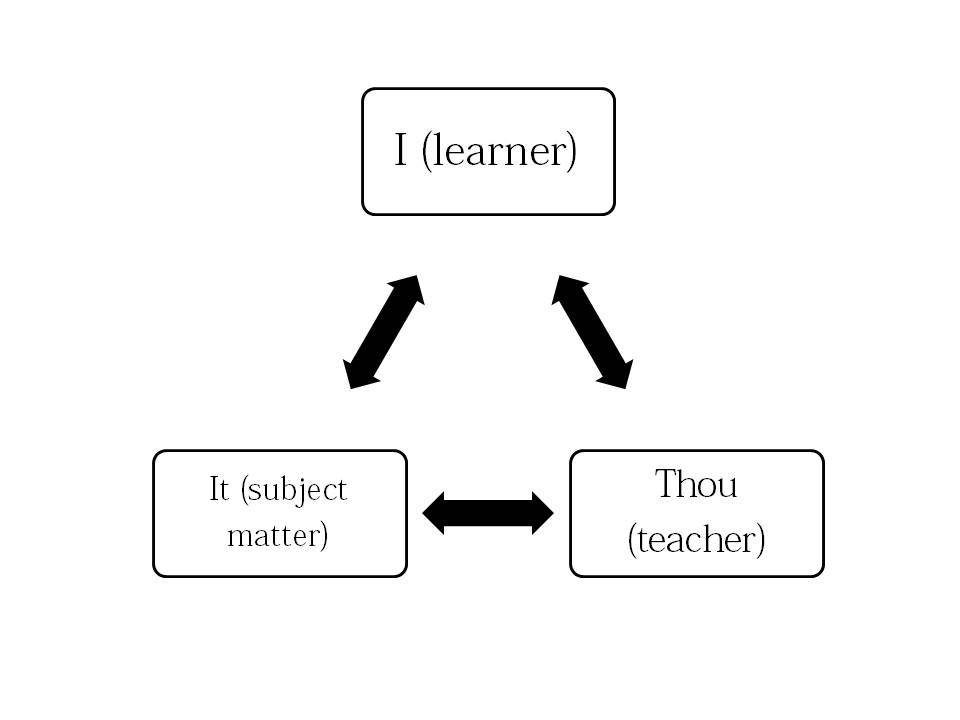
    But I’m asked as a teacher to find ways to integrate technology into my classroom – but to what end?  I want to find ways to use technology to solve problems, to explore ideas and to help improve students’ understanding of the mathematics.  Not necessarily help them communicate with each other, which is what I’m finding most of the apps out there are for right now – which I am open to – but they are removing a huge part of the learning triangle.  In fact, David Hawkins (1974) wrote about the I-thou-it reciprocal relationships in learning that simply must exist between the learner, the teacher and the subject matter.  He said that if one of the relationships is hindered or dysfunctional in some way, that learning is not optimal.

    Hawkins (1974)

    So if I interrupt that relational triangle between the students’ communication with the material (and with each other) and with me, using technology instead of discussion and the connection with all three, my fear is that learning is not optimal.  Perhaps the technology could enhance it, but for now I see that it is not truly happening.  My guess is that it has to take time for the students maybe to want for that to happen.

    I also just read an article on Edutopia by a guy named Matt Levinson that was entitled “Where MOOCs Miss the Mark: The Student-Teacher Relationship” where it was stated that a lack of mentorship, close guidance or meaningful relationship between teachers and students is what is really lacking in these online courses. Even students who use Khan Academy lectures for “learning” sometimes comment that even though they don’t like sitting and listening to lectures in math class, they would “much [prefer] listening to her math teacher explain the same concepts because she likes this teacher and feels comfortable asking questions and going for extra help outside of class.”

    Carol Rodgers (one of my most favorite people on earth) writes about teacher presence and the importance of it in the classroom.  I believe in mathematics class and especially the problem-based mathematics class it is truly essential because in order for students to take a risk with a method, they need to feel supported and safe in order to be open to new ideas and to discuss them with others.  With the open presence of a teacher and mentor, students are not “receiving knowledge” but creating it with others – creating it within those relationships that Hawkins was talking about – maybe with technology or without it.  But  for someone who just spent two years writing about the importance of relational pedagogy in PBL, I find it extremely difficult to assume that without those relationship the same exceptional amount of learning would go on.

  • Doing What You Can

    I just got back from a great visit to Toronto (which was also my first visit to that wonderful city.)  I spoke at a conference and also did some work at beautiful girls’ school there that was interested in PBL.  It was the first time where two of my research interests intersected (Gender and PBL) and it was fascinating for all that were involved – quite wonderful and so much fun.

    Many teachers talked to me there (and it comes up everywhere I go) about the fact that they are the only teacher, or one of the few, at their school that is interested in  trying out this different method of teaching, but need to keep up with the syllabus that their colleagues are using in order for students to be prepared for the common exam either at the end of the term, the end of the semester or even on a monthly basis.

    This can be problematic when there are school districts that dictate down to the homework assignment or classroom activity that you need to be doing on a daily basis.  The free that classroom practitioners need to make decisions about what is best for the learning of their students is quite important.  However, it is still possible to integrate problem solving or methods of PBL into your classroom when you can get.

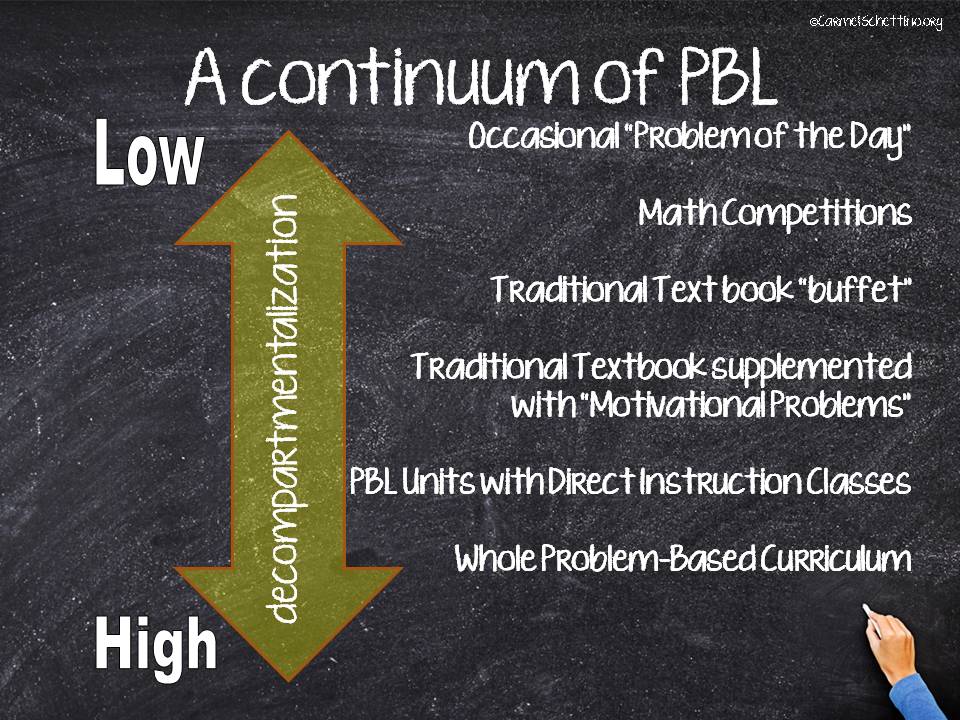
    I talk about the Continuum of PBL when I give workshops to let people know that you don’t have to dive in head first if you want to try your hand at classroom discourse a little at a time.  Learning to facilitate discussion as a long-time direct instruction teacher is actually quite difficult to allowing students to have more authority can be tricky.  Here is the visual aid that I use when I discuss it:

    “A Continuum of PBL” cschettino 2013

    The arrow tells you the level of decompartmentalization of topics – in other words how the topics are blended together or not.  In a traditional mathematics curriculum, a textbook artificially separates mathematics into what I like to think of a “compartments” that in a very linear order and most students learn to believe that mathematics must be taught in that order.  Yes, some operations and skills must come before others, but conceptually a great deal of mathematics can be learned or thought about in no particular order.  It is all extremely and equally fascinating.  In a whole problem-based curriculum such as what the faculty at Phillips Exeter Academy has written there are no chapters that mark the ending of the content and the beginning of another since there truly no time when that content is no longer applicable to the new material that is being learned (yes, of course that is true in a text book as well, but the chapter alone have come to imply that to students).

    Decompartmentalization can come at different levels.  At the lowest level,many  teachers use “Problems of the Day” that challenge students at the beginning of class with logic puzzles, topics they are not seeing regularly or interesting tidbits like soduku or other fun activities to get students’ minds working.  These create discussion and allow them to see problem solving in action.  However, there is little connection to the mathematics that is being learned in the class proper.

    I won’t discuss every type of PBL on the continuum or this will turn into one of my hour long talks, but I will say that if you are interested in attempting to keep up with your colleagues who are following a traditional syllabus but you might want to use less direct instruction I have a link to my “Motivational Problems” page in order for you to have them start the conversation based on their prior knowledge of material.  The problems are listed by topic and you can have them move forward in class by presenting problems and then have them practice with problems in the textbook.  Anyone who tries this – I’d love to hear from you!

    This was how I first started at my last school and it worked well for me.  You can read my article from 2003 in the Mathematics Teacher to learn what it was like.  But it definitely moved me in the right direction.  Keep pushing on!

  • An infinite amount of thanks…

    Everyone has those mentors in their life who have impacted their work or career in ways that have truly changed who they are.  In my instance, the person I am going to write about not only has impacted my life and career, but because he taught me so much about great teaching, in particular PBL, he has impacted all of the students and teachers I have worked over my twenty year career so far.  So I feel justified in taking a short break from writing strictly about professional educational work musings and just finding a moment to say thanks for the life and work of Rick Parris.

    Even if you never met Rick in his time teaching at Phillips Exeter Academy, or used his wonderful opensource Peanut software for windows machines, or downloaded the faculty-authored materials that he was integral in writing by the mathematics department at PEA – if you have worked with me at all, you have been affected by Rick’s work.  Rick Parris had to be one of the most brilliant, efficient, insightful  mathematicians I’ve ever been lucky enough to work with.  He saw things in a problem that I definitely never would be able to see in a million years.  I was so extremely intimidated by him when I first started working in the same department that I would go for days confused about a problem instead of go up and ask him.  But what I soon found was that not only was he one of the most brilliant mathematicians, I’ve ever met, but he was one of the best teachers too.  Now, there is a rare combination – finding someone who has the insightful intelligence to be able to have a Ph.D. in mathematics but to also be so sensitive to others’ understanding of the subject and the patience and passion to want them to love it as much as he did.

    I remember finally having the courage to go and ask him a question about a problem in the 41C materials on fall afternoon (mostly because I knew I had to understand it) and he looked at me, with what I thought was a look of disdain or horror that one of his colleagues wouldn’t understand a problem that he wrote.  And just as I was going to run in shame, he said something like, “that is such an interesting way to look at that” and I was amazed at how good that felt.  He entertained my ideas and although I felt like he was initially just appeasing me, I soon realized that he was truly and sincerely intrigued.  Our relationship as colleagues and interested problem solvers grew, even after I left PEA.  He allowed me to keep in touch constantly asking him questions and posing them over email.  He taught me so much about writing great problems, encouraging students to ask great questions and making sure that they always felt like they were they most interesting questions ever.

    This past summer, the last time I saw Rick, we were talking about the game of Set (you know that really fun card game with the colors, shapes and numbers).  We were just posing really fun questions like “What’s the maximum number of sets you can get in a 12 card deal?”  We found these types of questions intriguing and even after we parted company we continued emailing with email subject lines like “a baker’s dozen of sets”, “set lore” and “the game of set redux.”  He always treated me like a real mathematician even though he was the one who I saw as my inspiration and motivation in that area.

    Rick taught me about how to scaffold problems (not too much) so that students would see their way through a topic and find out exciting ideas of mathematics on their own.  I loved to watch him teach, probably observing his classes three or four times a year in order to gain insight into his questioning methods.  He made a point of trying to hear from every student in the class at least once a class.  I don’t know if he ever knew how much of an impact he had on my teaching and philosophy of learning.  I am so grateful.

    So how do you say thank you to someone who pushed you in a direction that changed your life?  I guess I have just to recommit myself to learning about and researching the best practices of inquiry and problem-based learning in secondary mathematics education.  I do believe that the world needs to know about the contributions of this man and the department at PEA because without them and the model that they have created, I’m not sure that many of the schools today that utilize their curriculum would be where they are.  I give thanks to Rick and consider myself extremely lucky to have worked with him and shared his enthusiasm for problems.

  • A New Year: Setting Up the Dialogue

    As the new school year approaches, I’m re-editing, once again, my PBL text that has been a “work in progress” for about seven years now. Every year my colleagues and I at my old school would take the input from our department and the students in the course and improve upon the work. This is what the teachers at Phillips Exeter do every year to their original materials as well. I think the idea of the problem sets being organic and dynamic is really the only way to think about problem-based learning – to believe that you can learn as much from the students and how they view the problem as they can learn from the problems themselves. In fact, while cleaning out some old folders this summer I ran across this quote, which I believe, is from Freire:

    “The problem-posing method does not dichotomize the activity of the teacher-student: she is not ‘cognitive’ at one point and ‘narrative’ at another. She is always ‘cognitive,’ whether preparing a project or engaging in dialogue with the students. He does not regard cognizable objects as his private property, but as the object of reflection by himself and the students. The students – no longer docile listeners – are now critical co-investigators in dialogue with the teacher. The teacher presents the material to the students for their consideration, and re-considers his earlier considerations as the students express their own. “

    Pretty amazing the way he’s got it right there, I think. That once you put that problem out there, it is no longer yours, but everyone’s to work with and the students need to be part of the responsibility for the learning. It is presented to them “for their consideration” you must reconsider your earlier consideration once they express theirs. That’s the deal you make when you use PBL – that you will do those reconsiderations. It’s part of the pact.

    However, the kids need to be part of the pact too. Wait, let me back up. So, I’m sitting at my computer typing and my son, who is going into ninth grade geometry this fall, asks me what I’m doing. I tell him and editing my geometry textbook for my class for the fall. He asks me if he’ll be using a book like that – that’s not a “normal” textbook. I tell him, I don’t think so – I think his school uses a traditional geometry textbook that pretty much will give him direct instruction in the classroom much to my dismay. And he says to me with a sigh of relief, “Phew…well, that’s just fine with me.”

    Of course, I’m thinking…whoa, hold the phone. Have I failed as a parent? Have I not instilled any intellectual curiosity in my son at all that he wouldn’t want to have some type of investigation going on in his mathematics classroom? I also had a very interesting experience starting at a new school this past year that traditionally had mathematics classrooms that were taught with direct instruction. It definitely took some time for students to get used to the idea of a teacher that did things a little differently. Student expectations for being “given” knowledge were extremely high and my expectations for them to construct knowledge were extremely high. It was an interesting situation.

    Anderson (2005) found that many teachers who taught with PBL-type pedagogies found reluctance and resistance in students for lots of reasons. Even though they enjoyed the classroom more and even learned better in the long run, there a few downsides. Because of the habits of mind that students have formed in traditional classrooms they do not feel they are being “successful” unless the known authority figure (a.k.a. the teacher) is telling them they are right or wrong. The typical “received knower” that many students are in American classrooms today have “grown accustomed to learning in a classroom that required little from [them] in terms of engagement with mathematics” and they find it difficult for themselves to take responsibility and control for their learning in the way PBL asks them to. What can even happen sometimes is that these kids who are resistant can glom onto a student that seems to take on the attributes of the teacher or authority figure (in their perception) and a small group can become a microcosm of the traditional classroom if a teacher is not careful.

    However, from working with teachers for many years and my own personal experience, students are actually very adaptable. Spending time in the classroom with this type of learning, students learn to adjust their own expectations and realize how much of a give and take there is – how much support to expect and learn that they are pleasantly surprised by what they can accomplish on their own.

    I’d like to think that even my own son would be proud of himself if give the opportunity and I might give him some problems outside of class this year just to see what he does with them. However, it is just that pact that I was referring to before that the students have to buy into. If they don’t do their share and express their considerations on the problems, there is no dialogue to reflect on, there is no sharing that has gone on. And there enlies the rub – you are back to square one with direct instruction. So I’ve told myself that at the beginning of the year this year, I’m making that part perfectly clear that they have just as much say in the dialogue about what we’re learning and I hope they get the point – at least faster than they did last year!

  • What’s the “P” in PBL?

    One of the issues I talk about a lot with people who are interested in Problem-Based Learning is the “continuum” of integration that I use to tell people how they can implement it in their classroom. How do you want to incorporate the teaching with problems in your classroom? Magdalene Lampert wrote a wonderful book called Teaching Problems and the Problems with Teaching in which she chronicled her journey of teaching a fifth grade classroom for a year with problems (it’s an awesome book, BTW). The way in which you use the problems, the pedagogy you use, and the classroom community you set (the lack of hierarchy, the authority you allow the kids to have, the safety of the risk-taking, etc.) is all hugely important parts of the PBL environment. I found another “continuum” created by someone name Peter Skillen and a colleague named Brenda Sherry. Mr. Skillen, a lifelong educator from Toronto, Canada, doesn’t claim to be an expert in PBL, but has extensive experience in the world of education and has great ideas. Check out his blog if you have time.

    He created a wonderful Continua to Consider for Effective PBL which I believe is definitely worth sharing. Although his “P” in PBL is Project, I believe his Continua (since there is more than one scale) is just as applicable to Problem-Based Learning. It reminds me a great deal of what I use in terms of implementation. He also has stated that anyone who would like to add categories should feel free, and I might actually work with that. His categories to consider are

    Trust
    Questioning
    Collaboration
    Content
    Knowledge
    Purpose

    These are amazing to start off with and I would probably add a few more to those including authority (although, I think this is what he’s getting at with trust and locus of control) and perhaps also change the “collaboration” one a bit. It is pretty tricky – this idea of interdependent, independent or dependent learning – dependent on what? The teacher, other students, a textbook? Very complex ideas at stake here. Different types of PBL are being considered and in different frameworks. But what he and his colleague have put together is amazing start to an important discussion.

    In fact, it’s really important to decide what you mean my “PBL” is? Even on the public shared website for the American Education Research Association Special Interest Group for PBL there is a “Statement on Nomenclature” about what PBL might be interpreted as meaning. There is an acceptance that there is more than one, and in fact many, meanings for the acronym “PBL” and what one person thinks it is may not be the same as another. I am very open to the understanding that when some contacts me about their own school’s interest in using PBL, I have many questions for them before we start talking about implementation.

    Not to belabor the great article by David Jonassen that was published in the Interdiscipliary Journal of Problem-Based Learning, (see my other blogpost Worked Examples in PBL) but I really like the distinction he makes between Project-Based and Problem-Based Learning. What it comes down to for him really is the authenticity of the problem. It’s not really about how many, what kind, or how big the problems are that you have the students do. What it is about how did you plan (or not plan) the problems. He is calling it the difference between “emergent authenticity” and “preauthentication.” (definitions by Jonassen (2011). Supporting Problem Solving in PBL. Interdisciplinary Journal of Problem Based Learning 5 (2)).

    Emergent Authenticity is when “problems occur during practice within a disciplinary field by engaging in activities germane to the field.” In other words, this is more like when you pose a problem to the students that is something that a mathematician might encounter in real life and an answer is truly unknown (like in real life!!) and they are engaging in that activity of not really knowing that answer and grappling with finding the tools and resources that they need to move forward to find a solution. That is when the authenticity of the problem (or project) is actually emerging as authentic.

    Preauthentication is “analyzing activity systems and attempting to simulate an authentic problem in a learning environment.” In high school mathematics classes, this when the teacher knows they want their students to learn something specific from engaging in a specific type of problem or series of problems (mostly like what I do in my curriculum, honestly) and they “set up” a problem-solving situation, but make the kids think that it’s novel. The learning experience has already been analyzed by the teacher and the teacher is giving the students the authority to do the problem at their own pace and draw conclusions, struggle on their own. However, there is some control because it is really only a “simulation” and the teacher actually has more information that can be helpful in terms of learning outcomes, etc. The authenticity has already been “preauthenticated” so that it simulates the experiences of a mathematician as much as possible, but still has the learning outcomes, goals or desired content objectives that might need to be fulfilled.

    Which is better? I don’t believe there is a “better”. I believe there is what works for your school, pedagogical beliefs, student audience, teaching style, etc. All of these wonderful categories are what must be considered when you and your department start on the journey towards incorporating PBL into your curriculum. There are many great choices to be made, but it is a long journey and cooperation with lots of reflection are definitely needed. So much to consider.


  • To Kahn or not to Kahn in PBL

    Recently there have been some discussions going around the Internet concerning Kahn Academy and other Internet-based “teaching tools” and their applicability or acceptability in terms of pedagogically sound classroom use. You can check out Dan Meyer’s blog or tweets about the MTT2k project, which I find pretty amusing actually, or Kate Nowak’s blog entry where she stated “Enduring learning requires productive struggle and time to noodle out unfamiliar problems, posed by a teacher who knows what you’re ready for, and can provide expert scaffolding. Lecture-only instruction focused on mastering procedures is an impoverished substitute for doing mathematics, and it doesn’t matter if that lecture is in person or in a video.” To that, I, of course, say, “here, here.” I spent some time going over the Kahn Academy website this past spring when my son was having some trouble studying for his science final exam and he was looking for some review materials and I actually thought it was something of a helpful resource for him. However, I’m not quite sure that it would’ve been a helpful way for him to have learned about genetics the first time around.

    On the website, Kahn Academy has a great mission of having open-source curriculum for everyone, everywhere, which I am wholeheartedly in favor of. I believe that education needs to be the great equalizer and one of the best ways to do that is to actually allow everyone equal access to the same quality of education. However, they also seem to take pride in the fact that there are now “5th graders relentlessly tackling college-level math to earn Khan Academy badges” perhaps at the detriment of their understanding or even at the skills that they should be learning at their grade level (and I am definitely not against kids exploring interesting advanced topics or even discussing non-Euclidean geometry before they get to college, for example). So it’s important for there to be balance, as I always say, between content and process.

    So overall, I would say, I have no problem with Kahn Academy’s (or any online institution of learning’s) pronouncements that they are helping to “spread the wealth” of education, but I do wonder about the quality of the instruction. They have some very, very smart people working there with very good goals about making education accessible, with which I totally agree and for that I commend them. However, there are lots of theories of education – both online and face-to-face that need to be considered in order to claim that any actual learning (whatever definition of that you are also claiming) is actually happening.

    Before educators who are within F2F classrooms move to using online tools to “flip” classrooms in order to substitute for other methods of instruction and claim to be using Project-based or Problem-Based Learning, I encourage everyone to really explore the pedagogical methods of that online tool. Is it congruent to what you would do in the classroom? Does it actually help facilitate the type of learning you would want your students to experience? Does it ask the questions or help with the explorations that you would want them to grapple with themselves? Do they get to the confident explanation and security in the knowledge that they would in a discussion? If not, look for something else. Or even better, ask the questions or pose the problems yourself or get the students to ask each other.

  • Some (hopefully) helpful Mobile Technology (i.e. iPad) information

    This past week I spoke with many teachers who are being asked to implement an iPad program in their schools this coming year and feel as though they are lost in the woods. Although their schools are doing what they can to support math teachers in their endeavors, the truth is that the “mobile technology of the future” (i.e. the direction that most technology coordinators say that education is moving) really has not caught up with the needs of mathematics educators. In a presentation I gave last week, I made the distinction between three different types of apps that exist out there for math teachers to use. I believe that the “tool apps” are useful when you want the mobile device to replace an actual tool or a skill that students have learned or that you feel can be replaced but a short cut. Great examples of these are ruler or protractor apps. However, beware of apps that are tools for doing the quadratic formula – just pop in a, b, and c and 30 “practice” problems can be done in 5 minutes (although I could go off on having students do 30 of the same type of problem for homework too). These apps are not necessarily made to aid in the process of learning for students.

    Secondly, there are the “review apps” – the ones that are created to help students prepare for standardized tests, name all the theorems in geometry from A to Z, list all the possible types of polygons and their interior angles, etc. These are helpful apps for reference once a student has learned the material and for reviewing for end of year exams, etc. However, once again they do not necessarily aid in the learning of the material.

    The third kind of app is what I was truly looking for – these “teaching apps” are really “understanding apps.” They make the process of understanding a concept or whatever is going on in the classroom more productive, efficient, interesting or engaging. I have to say that sadly, these apps are far and few between. I have surfed many a math app blog on the internet and there is no distinction between these three categories and in my mind, teachers want a distinction. Many of the ratings in the iTunes store are made by students so I recommend reading the review and if it says something like “This app is great. It let me do my homework in 5 minutes” (5 stars), my guess is it’s not necessarily the app you are looking for. Here is the list of apps I gave out at my CwiC session that I found useful and within this third categories of math education apps.

    The last thing I had to comment on was the fact that the iPad (and mobile devices in general) have a way to go before they catch up with the old Tablet PC when it comes to digital ink. Writing, for a mathematics teacher, is still the easiest way to put equations into lesson plans, tests, board presentations, problems, correcting papers, etc. So although we are not artists looking for the best stylus for drawing or sketching, we actually do drawing and sketching. We are not business-people who take notes during hugely important meeting with clients, but it still is annoying when your stylus makes noise on the glass screen in a meeting with administrators or even in class with students. And having a wrist guard or palm protector that actually works (and doesn’t make the screen move or leave marks) in the note-taking app, is extremely important to us. We also need drawing tools like geometry shapes, coordinate axes, and hopefully (dare I ask) access to symbolic text, like Greek letters.

    At the conference I got into a great conversation with some teachers about different styli and which were the best. I found a Great Stylus Video Review online that I highly recommend if you are looking for a new stylus for your mobile device for writing or doing mathematics. I think I might actually order the Maglus from overseas to see how good it is.

    Keep in touch about the mobile apps you are using, cause I’d love to hear about them. I do believe that someday the devices and their technology will catch up with the needs of math teachers, but for now, I sort of miss my Tablet PC and OneNote for writing – 🙁 But I am loving playing with all these new apps. I’m like a kid in a candy store, but hopefully more productive.

  • Course Evaluation Link

    For everyone in my PBL course this week at the conference, please be sure to fill out the survey.

    Click here to take survey

    I had two truly wonderful groups of people in my class this week and am grateful for the experiences that we all shared in the conference as a whole. I hope we all keep in touch!