Blog

  • Think about where the learning happens in PBL

    After a few weeks of recovery, I wanted to write about having a BLAST of a time at our first attempt of putting together the PBL Summit my friend Nils Ahbel and I organized from July 16-19.  I wanted to thank all of those who came and participated in the discussions and talks and who shared their ideas so freely.  It’s such a great reminder of the huge resources we all are to each other as math teachers.  I know that I at least tripled my Professional Learning Network and hope that all of the participants did too.

    I’d also like to thank everyone who gave feedback and the amazing ideas for next year – including a pre-conference session for those of you who might have been PBL “newbies” and might have needed more of an intro, topic-level groups, more in-depth SIGs for people who want to dive deeply into writing or assessment writing too.  The ideas just kept flowing and I think we will have a wonderful plan for next year too.

    One of the take-aways that I left the PBL Summit with was how differently people view what “learning” means in PBL.  From my long career both teaching and studying PBL, I have had a lot of time to form my own frameworks for student knowledge construction and pedagogical theory and often take for granted that all of us are on the same page. As I have traveled and talked to many other math teachers and heard others who are experts in PBL (both PjBL and PrBL) speak, I realize more and more that we are often NOT on the same page.  This does not mean that any one of us is more right or wrong.  We just need to understand each other more.

    My big question to everyone I talk to is “where/when does the learning happen?” or “where/when do the students construct their knowledge and understanding of the mathematics?”  If students are presented with a problem, for example they watch a wonderful interesting video of a basketball player shooting at a basket or watching someone fill a water tank and they come up with their own question based on a real-life phenomenon from the video, how do those students know the mathematics to answer those interesting questions?  If students are sitting through direct instruction lessons to be exposed to the mathematics but using them to answer their own questions, this is definitely an improvement than passive mathematics classes of the past.  Having students take ownership of the material in this way is is a powerful method of creating agency for mathematics learning.  The problems that they are solving and from where they are posed are extremely relevant to the motivation and agency in learning.

    I would posit that PBL can be more and mean more and in more ways to student learning. Even when posed with a good problem (one they did not come up with themselves).  In PBL, students can:

    • see the need for a new method without the teacher introducing it
    • see the need for discussing other students’ ideas
    • find their own organizational strategies for problem solving
    • access prior knowledge that they did not realize they needed before
    • use their resources to discuss the problem with each other
    • use resources to find new solutions and follow their own thinking
    • make connections between topics in mathematics that they might not have realized before
    • create community in the mathematics classroom (like in other disciplines – humanities, fine arts and science)
    • realize that reflection is one of the most important parts of the learning process
    • learn to relate to others in math class
    • see mathematics as a creative endeavor

    and so much more. I’d love to hear from people some that I have left out.  In my mind, even the mathematical learning happens in these contexts and students are the shapers of where and when this happens.  Robert Kaplinsky is one of those amazing PBL teacher/speakers who has a somewhat different approach than I do, but is very similar in many ways and I heard him say this April, “Don’t teach what students need to know before they do a problem-based lesson.” In that way, we are all on the same page, for sure.
  • One of the Original “Makers”

    Apologies to any faithful readers out there – I have had a heck of a summer – way too much going on.  Usually during the summer, I keep up with my blog much more because I am doing such interesting readings and teaching conferences, etc. (although I’m running a conference for the first time in my life!) However, this summer I was dealing with one of my biggest losses – the passing of my father after his 8 year battle with breast cancer.  I thought I would honor him by writing a post talking about a problem that I wrote a few years ago, well actually a series of problems that utilized his work when teachers of algebra I asked me how I taught the concept of slope.  So dad, this one’s for you.

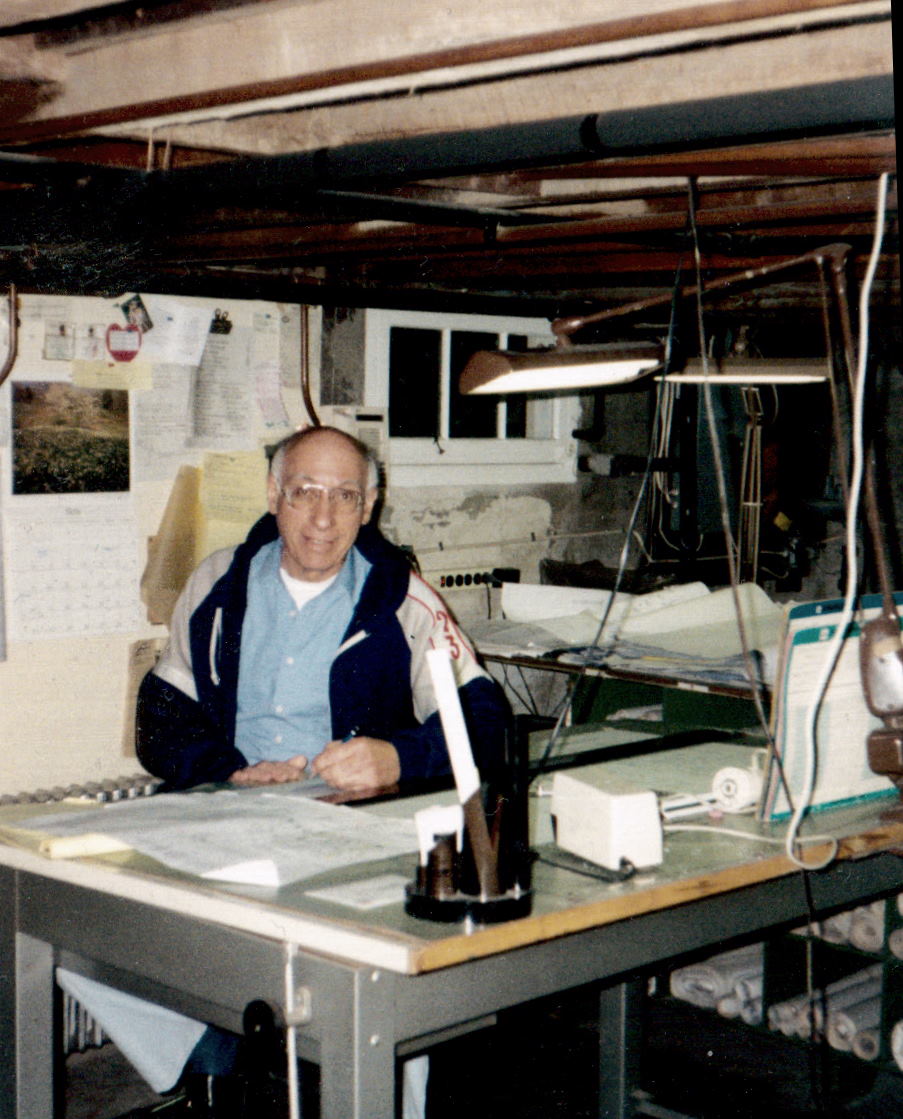
    In 1986, my dad, Francesco (Frank) Schettino, was asked to work on the renovations for the centennial project for the Statue of Liberty.  He was a structural steel detailer (also known as a draftsman) but he was really good at his job.  Everywhere we went with my dad when I was younger, he would stop and comment about the way buildings were built or if the structure of some stairs, windows or door frames was out of wack.  He could tell you if something was going to fall down in 10 years, just by looking at it.  At his wake last week, one of the project managers from a steel construction company that he worked on jobs for told me that they would save the interesting, most challenging jobs for him because they knew he would love it and do it right.
    photo (1)I remember sitting with my dad at his huge drafting desk and seeing the drawings of the spiral stairs in the Statue of Liberty.  He talked to me about the trigonometry and the geometry of the circles that were necessary for the widths that were regulated for the number of people that they needed to walk up and down the stairs.  This all blew my mind at the time – that he needed to consider all of this.  So to be able to write problems that introduce slope to students about this was just a bit simpler to me.

    If you take a look at my motivational problems on slope and equations of lines I believe it’s numbers 2 and 3 that refer to his work (excuse the small typo).  Over the years I’ve meant to go back and edit these a number of times.  If you are someone who has taken my course at the Anja S. Greer Math, Science and Technology Conference at Exeter, you are probably familiar with this series of questions because we have discussed these at length and talked about how students have reacted to them (and how different adult teacher-students have as well).  We have assumed no prior knowledge of slope (especially the formula) or the terminology at all.

    Some questions that have come up: (with both students and the teacher-students I’ve worked with)

    1. What does a graphical representation of “stairs” mean to students?
    2. What does “steeper” mean and what causes stairs to be steep?
    3.  Why are we given the “average” horizontal run for the spiral stairs? Would another measurement be better?
    4. Why does the problem ask for the rise/run ratios?  Is there a better way to measure steepness?
    5. (from a teacher perspective) why introduce the term “slope” in #3? can we just keep calling it steepness?

    These are such rich and interesting questions. The questions of scaffolding terminology and when and how to introduce concepts are always the most difficult.  Those we grapple with specifically for our own students.  I always err on the side of allowing them to keep calling it steepness as long as they want, but as soon as we need to start generalizing to the abstract idea of the equation of the line or coming up with how to calculate that “steepness” a common language of mathematics will be necessary.  This is also where I take a lesson from my dad in terms of my teaching.  His great parenting style was to listen to me and my sisters and see where we were at – how much did we know about a certain situation and how we were going to handle it.  If he felt like we knew what we were doing, he might wait and see how it turned out instead of jumping in and giving advice.  However, if he was really worried about what was going to happen, he wouldn’t hesitate to say something like “Well, I don’t know…”  His subtle concern but growing wisdom always let us know that there was something wrong in our logic but that he also trusted us to think things through – but we knew that he was always there to support and guide.  There’s definitely been a bit of his influence in my career and maybe now in yours too.

  • Late night thoughts on Assessing Prior Knowledge

    So it’s 11:50 pm on a Tuesday night, so what?  I can still think critically, right?  It was the last day of classes and I had an amazing day, but then all of a sudden Twitter started gearing up and lots of discussions began and my mind started racing.  I had planned on writing a blogpost about a student’s awesome inquiry project (which, it ends up, took me about 2 hours to figure out a way to make an iBook on my iPad into a video to try to post on my blog, so that will have to wait), but then I read a great post by Andrew Shauver (@hs_math_physics)

    Mr. Shauver writes about the pros and cons of direct instruction vs. inquiry learning but has a great balanced viewpoint towards both of them. In this post, he is discussing the how and when teachers should or can use either method of instruction.  It is important, Shauver states to remember that “inquiry can work provided that students possess the appropriate background knowledge.”

    I would totally agree, but I’m just wondering how we assess that – does it really work to lecture for a day and then say they now possess the appropriate background knowledge?  Do we lecture for two days and then give them a quiz and now we know they possess it?  I wonder how we know?  At some point, don’t we have to look at each student as an individual and think about what they are capable of bringing to a mathematical task?  We should set up the problems so that there is some sort of triggering of prior knowledge, communication between peers, resources available for them to recall the information?

    Joseph Mellor makes a great point that in PBL most of the time you might plan a certain outcome from a problem, or set of problems, but the triggering didn’t work, or the kids didn’t have the prior knowledge that you thought.  He says that he is often either pleasantly surprised by their ability to move forward or surprised at how much they lack. In PBL, we depend on the students’ ability to communicate with each other, ask deep questions and take risks – often admitting when they don’t remember prior knowledge – hopefully to no suffering on their part. This can be a big hurdle to overcome and can often lead to further scaffolding, a deeper look at the writing of the problem sequence, fine tuning the awareness of their true prior knowledge (not just what the previous teacher said they “learned”) or yes, maybe a little direct instruction in some creative ways.  However, I do believe that given the opportunity a lot of students can be pleasantly surprising.  What do you think?

  • NCTM 2015 – Reflections

    I know I’m a little late but I did want to post my own handouts and talk a little bit about my experiences at NCTM Boston this year.  I want to thank all of the great speakers  that I saw including Robert Kaplinsky, Ron Lancaster, Maria Hernandez, Dan Teague, The Young People’s Project (Bob Moses’ Group), Deborah Ball, Elham Kazemi and of course the inspiring Jo Boaler.  One of the things I thought was great about Jo Boaler’s talk on Thursday night was that even though I had heard a great deal of what she had said before, there was a different tone in the room.  I’ve been a fan of Jo’s since I first read her research in 2001 when I started my doctoral work on girls’ attitudes towards mathematics learning.  What I felt that was different that night was that she was no longer trying to convince people of anything.  There was a different message and that was “join the revolution” and the audience seemed to be on board and excited.  It made me feel very energized and empowered that a huge ballroom full of mathematics educators had bought into her ideas and were enthusiastic to make change happen.

    Some of the best times I had were spent just connecting and reconnecting with people – some who I met for the first time (MTBoS folks and other Twitter folks I met F2F which was really nice) and others who were old friends who mean a great deal to me.  I forget how much the mathematical community of professionals enriches my life and makes me proud to do what I do.  Thanks to everyone who reached out to find me and say hi – or tell me a story, talk to me about what they are doing or ask a question about what I am doing.  You are all inspiring to me.

    I left the conference with exciting ideas about teacher observation for PD, how teachers can share problems with each other better on the internet (awesome resources at Robert Kaplinsky’s problem-based lesson site), great ideas about agent-based models to add to courses, and ways in which teachers can talk to people about the Common Core and gain respect about the difficult work we do in teaching.  Overall, I felt like it was an amazing time.

    I want to thank everyone that came to my session.  Although I had an unfortunate technological snafu and was unable to do an exercise I had planned where we were going to analyze a segment of discourse from my classroom using the framework of the MP standards (which would’ve been great), I felt that at least the resources that I shared were worthwhile for the people that came.  Here is a link to the powerpoint presentation and the handouts I gave.


    Handout 1 NCTM 2015 Schettino

    Weekly Learning Reflection Sheet

    Handout 2 Schettino

    I’ll just put in one more plug for our PBL Summit from July 16-19 this summer – we still have a few more spots and would love to have anyone interested in attending!

  • Spring has Sprung – and so has the French Garden!

    So the spring term means two things for my Honors Geometry kids – the technology inquiry project and looking at the French Garden Problem.  So for those of you who are not familiar with both of those I’ll try to quickly fill you in while I talk about how they just happen to so coolly (is that an adverb?  if not I just made it up) overlapped this week.

    My Spring Term Technology Inquiry Project is something I came up with three years ago when I really wanted a way to push my honors geometry students into thinking originally while at the same time assessing their knowledge of using technology.  I did a presentation last year at the Anja S. Greer Conference on Math, Science and Technology and the audience loved it.  Basically, I give students an inquiry question (one that I attribute to my good friend Tom Reardon) that they have to work on with technology and then they have to come up with their own inquiry question (which is, of course, the fun part) and explore that with technology and/or any other methods they wish.  I have received some pretty awesome projects in the past two years and I don’t think I am going to be disappointed this year either.

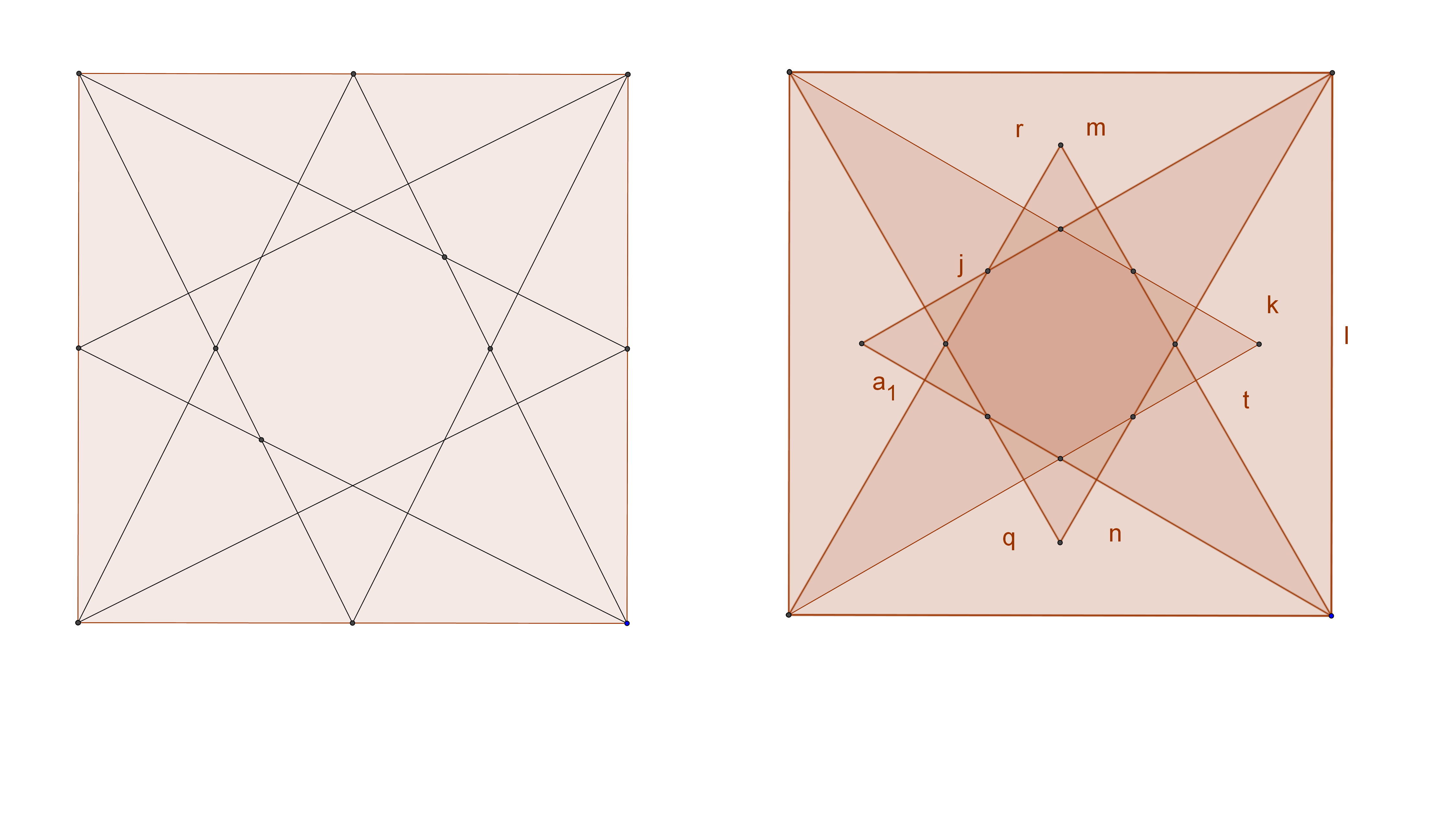
    The French Gardener Problem is famously used in my PBL courses at the MST Conference as well.  Everyone who has taken my course knows the fun and interesting conversations we have had about the many ways to solve it and the extensions that have been created by many of my friends – an ongoing conversation exists somewhere in the Blogosphere about the numerous solutions – In fact Tom sent me a link just last fall to a more technological solution at Chris Harrow’s blog. (We’re such geeks).  Great math people like Phillip Mallinson and Ron Lancaster have also been drawn in by the attractive guile of the The French Gardener Problem.  In this problem, the main question is what fraction of the area of the whole square is the octagon that is formed inside (what is the patio for the garden)?

    So the other night, after we had worked on this question in class for a couple of days and the students had meet with me in order for me to approve their original inquiry question, a student stops by to discuss his question.  John starts off with, “I can’t think of anything really. What I had wanted to do, someone else already claimed.” (I’m not letting them do a question that someone else has already decided to look into.  So John sits in my study and thinks for a while. I told him that this part of the project was supposed to be the fun part.  I gave him some thoughts about extending some problems that he liked.  He said he had liked the French Garden Problem and thought it was really cool.  So I went back to some of my work and he started playing with GeoGebra.  Before I knew it he starts murmuring to himself, “Cool, cool….Cool! It’s an octagon too!”  I’m thinking to myself, what has he done now?  I go over to his computer and he’s created this diagram:

    John's Original Inquiry Question
    John’s Original Inquiry Question

    I’m asking him, “What did you do? How did you get that?”  He says that he just started playing with the square and doing different things to it and ended up reflecting equilateral triangles into the square instead of connecting the vertices with the midpoints as in the original French Garden Problem.  Then he started seeing how much of the area this octagon was and it ended up that it was……you don’t think I’m going to tell you, do you?

    Anyway, it just made my night, to see the difference in John when he came by and the by the time he left.  He was elated – like he had discovered the Pythagorean Theorem or something.  I just love this project and I would encourage anyone else to do the same thing.  Leave a comment if you end up doing it because I love to hear about any improvements I could make.

  • Why Can’t We All Just Get Along?: Some Inquiry Math Classes are not Content-less

    Maybe it’s just how I am, or maybe I’m just always worried about what people are going to say about me, but I am hesitant to criticize other teachers publicly in the blogosphere. I’ve always felt this camaraderie with others once I’ve learned they were a teacher even if we are very different from each other – different disciplines, different pedagogical styles, different countries – there are still fundamental commonalities that even public and private school teachers have.

    I just finished reading a KQED blogpost entitled “Do You Have the Personality to be an Inquiry-Based Teacher?” that sort of summarizes the theoretical qualities that the author feels a teacher who would teach with IBL would need to exhibit in order to successfully run a classroom. It’s kind of interesting – I’m not sure I agree with it, but respect the author for putting his ideas out there. I’ve been an inquiry/problem-based teacher for almost 20 years and I don’t think I exhibit all of the qualities listed, so I’m not sure it’s quite true.

    Anyway, that’s not the point – at the end of the blogpost there are about 11 comments from people who are educators and many of them are quite negative and even degrading to the author:

    “I earned a Ph.D. in Educational Psychology, but phrases like this one still baffle me: “…the divide between a transmission model and an inquiry model…” ”

    “First, we need to make sure that we have at least a rudimentary understanding of the language in which we will be teaching. Second, we need to make sure we can write.”

    “That is what’s wrong with you teachers.You want to do it your way.”

    “Some of us have been doing this for decades, where were you?”

    Whoa, Whoa, Whoa…cowboys…hold your horses. This guy is just writing an essay about something he believes in. What kind of role model are we being for our students if this is how we are reacting to something we don’t agree with? What happened to civil communication? I totally agree that people are allowed to comment and voice their opinions on someone else’s opinion, but there has to be a way to do it with respect and decency.

    So I am going to try to model what I would like to see as a response to something I actually do disagree with. Here is a blogpost by a very respectable Professor in Canada, who I have to be totally honest, I do not know at all. I tried to learn as much as possible about him before writing a response to his blogpost in order not to make any assumptions about him (and not make a fool of myself in doing so), so I may be wrong about some of this information because I garnered it from different websites. It seems he is a research mathematician who is currently studying to get a teaching degree, but who lectures for mathematics courses at the college level. I cannot ascertain if he has any experience teaching at lower levels (like elementary or secondary). From his blogpost it does seem like he takes pride in the amount of background research he does, which again is very respectable and I appreciate in bloggers. He seems to care a lot about student learning and from his opinions on his blog he seems to lean towards being a behaviorist and cognitive theorist in terms of learning theories.

    His latest blogpost is titled “The Content-less Curriculum” and it is a critique of the movement towards 21st Century skills being a part of the mathematics classroom. It does sound like Prof. Penfound is implying that with the inclusion of “soft skills” of collaboration, critiquing others work, problem solving,communication, etc. (i.e. the MPS for the CCSS) there must be a loss of mathematical content. In fact, he says that

    “there must be a trade-off for the inclusion of “soft skills” activities into an already packed curriculum. So what gets removed from the curriculum then? Content knowledge.”

    I would respectfully, but wholeheartedly disagree with this. By teaching with the PBL curriculum that I use, I have all of the college prep geometry curriculum I desire and I also concurrently am assessing and teaching the skills of problem solving and the so-called “soft skills” that he is implying are an add-on. I still give quick quizzes to make sure that students are up on their basic skills that are so important for basic problem solving (or else they wouldn’t be able to do the open-ended problems they are given).  The mathematics that students leave my courses having experienced is rich and leaves an impression on the way they think.

    Making blanket statements about teachers implying that we all make choices that are not based in research or good practice is just not true. I actually invite you Prof. Penfound to come visit my classes and see my IBL/PBL classes in practice and let me know what you think of your opinions of the rigor of the mathematics that is discussed. Although we are most likely at different ends of the spectrum in terms of learning theories, I do believe that students have different needs and try to work with kids’ learning needs individually. However, I do believe as @danieldmccabe does that there are going to be new outcomes required of our ever-growing diverse body of graduates in the near future (or even present). I also have to say that I have thought rather thoroughly about the implementation of a teaching program which includes “soft skills” and even wrote a dissertation on it.

    It is possible to balance content and practice skills and it is what I and many other classroom practitioners strive for. I do not deny that there are some practitioners out there that are confused about what problem-based and project-based learning outcomes should be especially with regard to secondary mathematics, but that is a subject for another blogpost.  The balance between content and practice skills we should strive for does not mean that one is more important or less important and in fact they both need to be assessed with the ultimate goal being to create independent problem solvers. From my experience this does not necessarily happen in a classroom where the educator does not take into consideration the so-called “soft skills.” But that statement is, of course, based on my 25 years of anecdotal classroom experience.


  • Succeeding at Helping Students to Fail?? Part 1: Meaning

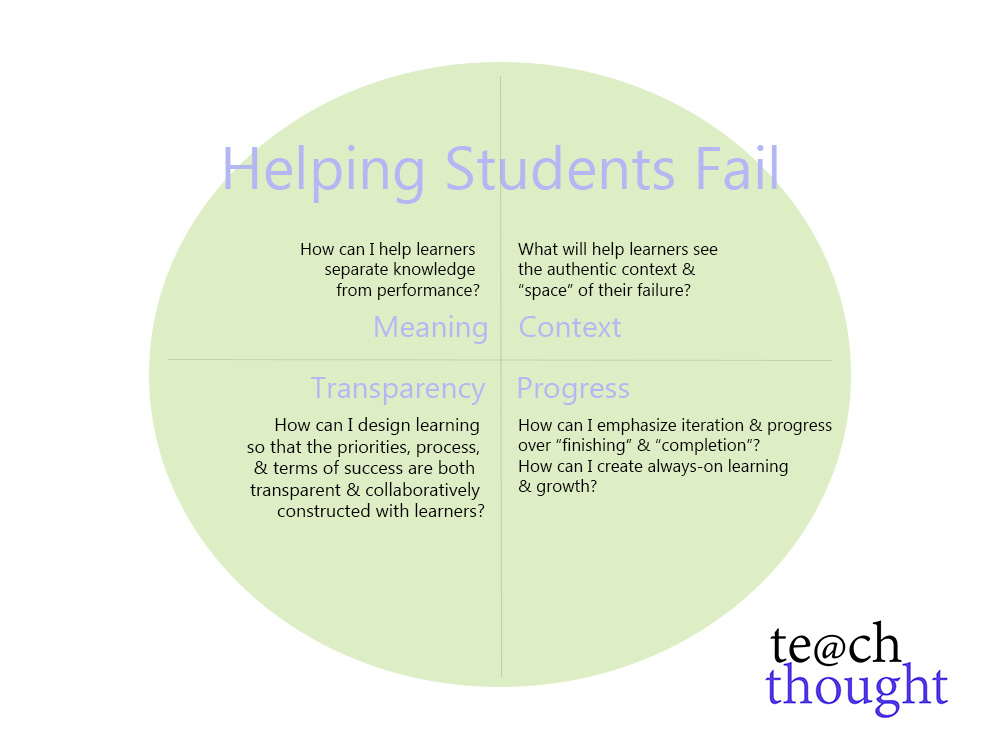
    Apologies faithful readers – those of you who know me well, know that I have been dealing with a great deal of personal issues and preparing for the summer PBL Math Teaching Summit, so I have taken a small hiatus from blogging for a while.  However, with that under control for now, I turn to reflecting on something that happened in class the other day and its relation to a great article I retweeted that was on TeachThought’s website the other day entitled Helping Students Fail.  I have been giving a lot of thought this year to the idea of Grit and Problem-Based Learning which has intrigued me for a while.  However, this article is one of the few I’ve seen that really speaks to some concrete steps that teachers can take to aid students on the journey of dealing with making mistakes and viewing them in a positive light.

    I love the framework that the author gives here:

    http://www.teachthought.com/teaching/the-role-of-failure-in-learning-helping-students-fail/
    Helping Students Fail: A Framework by Terry Heick

    Breaking the struggle into these four aspects of learning is very interesting to me (of course with respect to the PBL Classroom).  It dawned on me while reading this article that this is a continuous and completely ongoing process of learning to fail that happens.  It is so ubiquitous that the teacher and students are probably not even aware of it (or are so aware of it that that’s where the discomfort is emanating from).  It is so ubiquitous that I needed this framework for me to be able to even have it spelled out for me.

    1. Meaning: In the PBL classroom, meaning is shaped everyday – the explicit separation between knowledge and performance is spelled out in discussion and the way students are asked to share their attempts at problems.  Jo Boaler might have spelled it out best in her paper desribing the Dance of Agency, where she explained the importance of sharing what she called “partial solutions.”  Using this language is really important to make sure that students don’t feel the need to have a complete solution when they present (because no matter how many times I say it, they still say, “Is it OK if it’s wrong/”)  In their mind, they feel their presentation is a performance.  However, the other day I had an interesting experience while students were presenting.  We were doing this problem in class and I had assigned two girls to present their ideas together:

    A triangle has sides measure 9, 12 and 15 (what’s special about this triangle?).  Find the distances to the centroid from all three vertices.

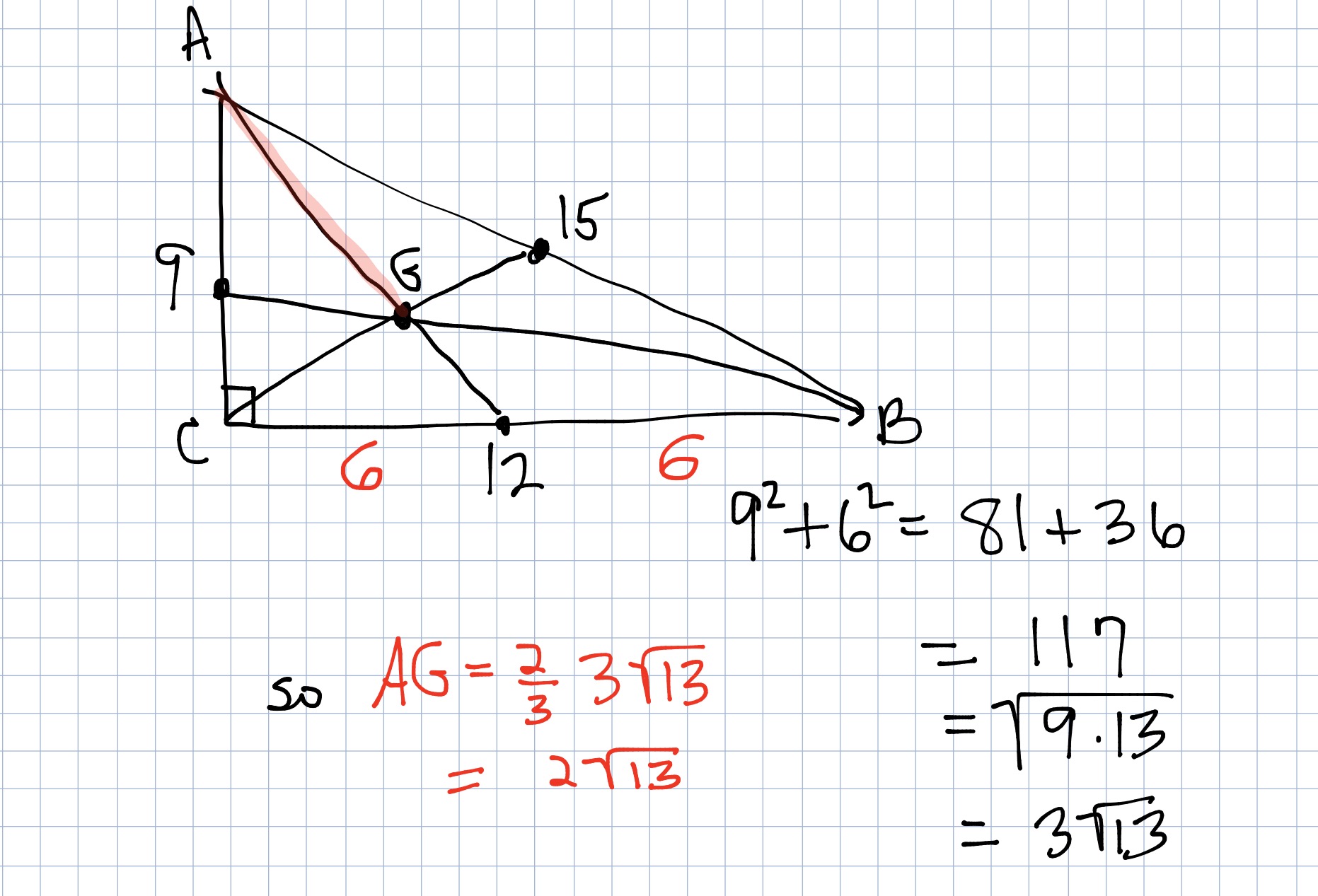
    The day before we had done a problem very similar to this with an equilateral triangle of sidelength 6 and the presenter had realized that he could connect this problem to the work we were doing with 30-60-90 triangles.  He then applied the Centroid Theorem which states that the centroid is 2/3 of the way from the vertex along the median.  So when the girls presented, they did this:

    FullSizeRender (1)

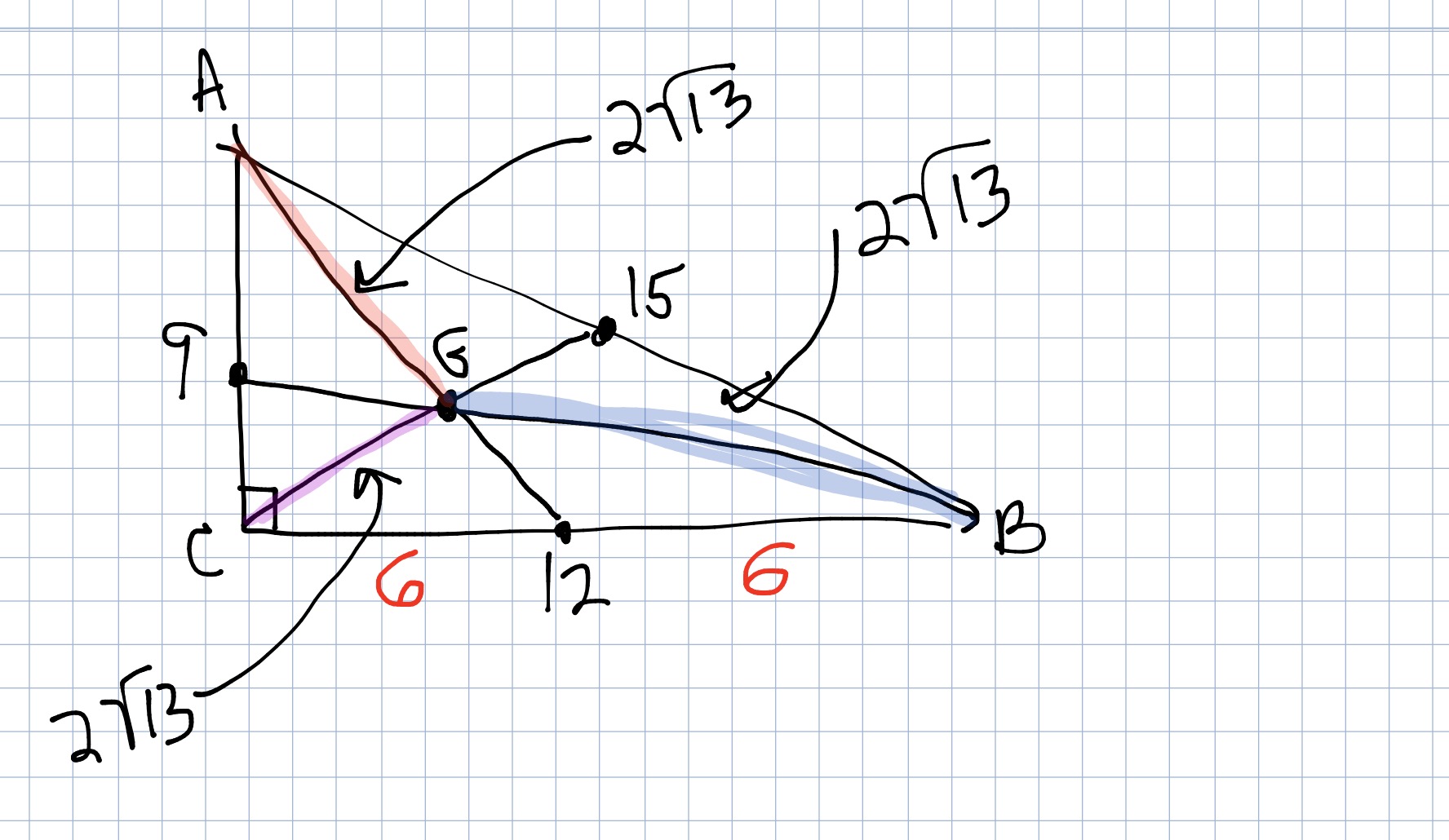
    They realized that the median from A was the hypotenuse of a right triangle and they could find its length with the Pythagorean Theorem. They then used the Centroid Theorem and found 2/3 of it. However, next, they did this:


    FullSizeRender (2)It was great that they connected this problem to the previous day’s presentation where all of the distances were the same (I’m always asking them to look for connections). However, when I asked them the question of whether they expected those distances to all be equal, they had to think about that. We put the question out to the class and it started a great discussion about why sometimes they were the same and sometimes they weren’t. I won’t go into the whole solution here since the correct answer is not the point of this blogpost but what happened that evening is.

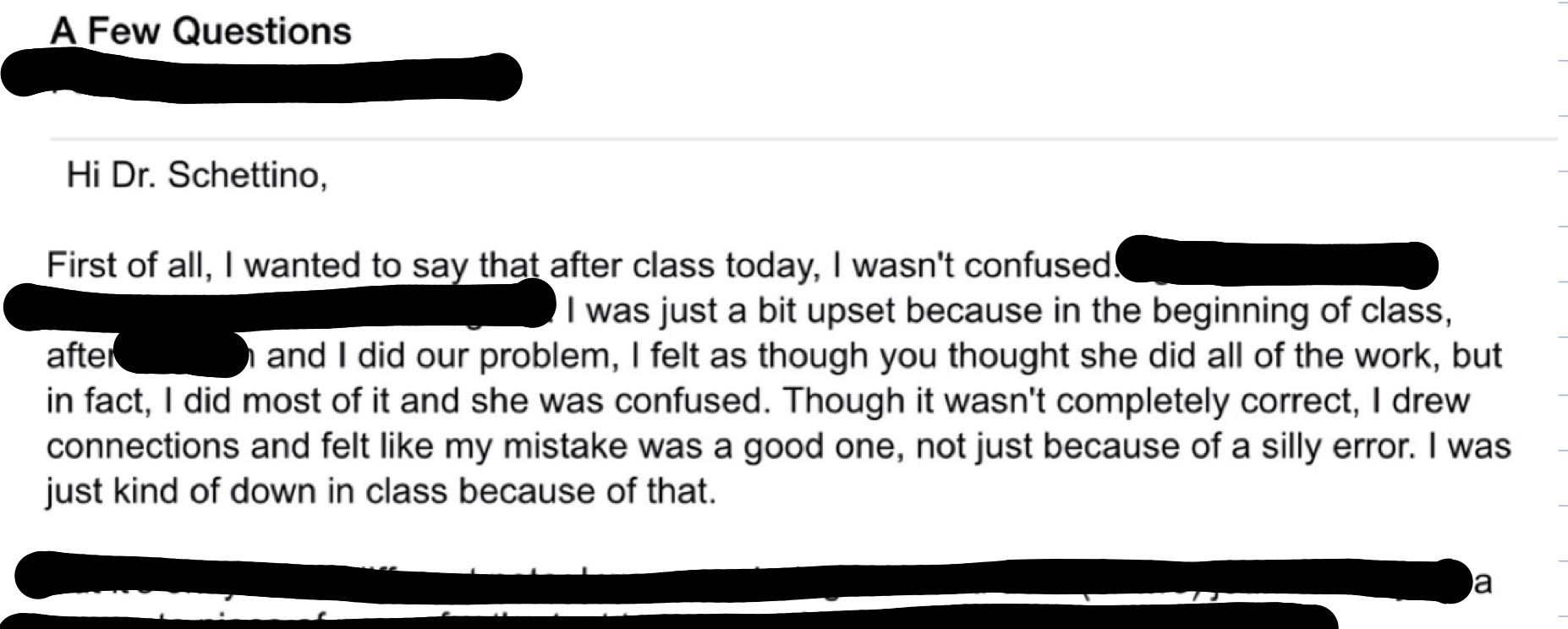
    Later on that night, I received an email from one of the girls who was part of the presenting team. At the end of class, I had noticed that she seemed very quiet and I had asked her if she was confused about something else we were discussing towards the end of the class when the bell rang. She had said no and left class very awkwardly.

    This is what she wrote to me:

    FullSizeRender
    I had been working so hard to make students feel comfortable making mistakes that I wasn’t paying attention to who had made the mistakes and that they were actually comfortable making the mistakes and proud of making those mistakes and wanted credit for making those mistakes! I was dumbfounded. I just couldn’t believe it. My perception of (at least) this student’s ability to be comfortable with being wrong was so different than what her’s was. She was proud that her “mistake was a good one” and not just a “silly error” and I needed to give her the credit she deserved for taking a risk. I learned such a great lesson from this student on this day and I owe her so much (and don’t worry, I told her that in an email response)!

    The separation between knowledge and performance has been made clear to at least some of my students and I am going to keep doing what I’m doing in the hope of getting this message to all of them.

  • Tracking, PBL and Safety in Risk-Taking

    I’ve been giving a lot of thought recently to the idea of “tracking” in PBL, mostly at the prodding of the teaching fellow I’m working with this year – which is so awesome, of course.  Having a young teacher give you a fresh outlook on the practices that your school has come to know and accept (even if I don’t love them personally) is always refreshing to me.

    I have taught with PBL in three different schools – two that tracked at Algebra II (or third year) point in the four-year curriculum and now one that tracks right from the start.  Anyone who has done Jo Boaler’s “How to Learn Math” course has seen the research about tracking.  So the question that my teaching fellow asked me, is why do we do it.  The answers I had for him were way too cynical for a first year student teacher to hear – “Because it’s easier for the teachers to plan lessons and assessments.” “Because the class will be easier to manage, as well as parents.”, etc.

    In fact, I would have to say that in a PBL math classroom the experiences that I had with the heterogeneous groupings ended up being really advantageous for both strong and weak math students.  Here’s a great quote from a weaker student in a heterogeneously grouped math class, who was part of my dissertation research (that I have used before in presentations) when asked what the PBL math classroom was like for her:

    “You could, kind of, add in your perspective and it kind of gives this sense like, “Oooh, I helped with this problem.” and then another person comes in and they helped with that problem, and by the end, no one knows who solved the problem.  It was everyone that solved the problem.  LIke, everyone contributed their ideas to this problem and you can look at this problem on the board and you can maybe see only one person’s handwriting, but behind their handwriting is everyone’s ideas.  So yeah, it’s a sense of “our problem” – it’s not just Karen’s problem, it’s not just whoever’s problem, it’s “our problem”.

    This shared sense of work, I believe, rubs off on both the strong and weak students and allows for mutual respect more often than not.  Even my teaching fellow shared an anecdote from his class wherein a stronger student had gotten up to take a picture with his iPad of a solution a weaker student had just been in charge of discussing.  The presenter seemed outwardly pleased at this and said ,”He’s taking a picture of what I did? that’s weird.”

    This mutual respect then leads to a shared sense of safety in the classroom for taking risks.  Today I read this tweet from MindShift:

    I don’t really read that much about coding, but when something talks about risk-taking, I’m right there.  In this article, the student that decided to go to Cambodia and teach coding to teenage orphans makes a really keen observation:

    “Everybody was a beginner, and that creates a much more safe environment to make mistakes.”

    So interestingly, when the students in a classroom environment have the sense that they are all at the same level, it allows them to accept that everyone will have the same questions and opens up the potential that all will be willing to help.  I don’t think this has to be done with actual tracking though – I think it can happen with deliberate classroom culture moves.

    I got more insight into this when asking some students in my Honors Geometry class why they don’t like asking questions in class.

    “It seems to not help that much because it shows others how much I don’t know.”
    “It only allows others to feel good about themselves instead of make me feel better that my question was answered.”
    “If someone else can answer my question then they end up getting a big head about it instead of really helping me understand.”

    I was starting to see a trend.  Now, this was not all kids, don’t get me wrong, but it was enough to get me concerned – This reminded me of a great blogpost I read by John Spencer (@edrethink) called The Courage of Creativity in which he write about how much courage it takes to put something creative out there and fail.  In mathematics, many students don’t see it as being creative, so hopefully John won’t mind if I change his quote a little bit (since I am citing him here, I hope this is alright!)

    “All of this has me thinking that there’s a certain amount of courage required in [risk-taking in problem solving]. The more we care about the work [and are invested in the learning or what people think of our outcomes], the scarier it is. We walk into a mystery, never knowing how it will turn out. I mention this, because so many of the visuals I see about creativity treat creative work like it’s a prancing walk through dandelions when often it’s more like a shaky scaffold up to a mountain to face a dragon.”

    Thanks John!

  • PBL Summit News!

    It’s been an extremely busy fall for me, but with the help of my friend Nils Ahbel, I have finally put together an informational flyer and schedule for the Problem-Based Learning Math Teaching Summit for next summer.  As you begin to look for professional development opportunities for yourself, please consider being a part of this great summit where like-minded math teachers can gather and share ideas.  Currently, we are making this information available and registration and final pricing will be available in January.  If you have any questions regarding the summit, please feel free to contact me.

    Check out the PBL Math Summit Flyer 2015 here. For further information see the page on the PBL Summit.

  • How do we get kids to value others’ ideas in math class?

    Some recent common situations:

    A very gifted student comes to me (more than once) after class asking why he needs to listen to other students talk about their ideas in class when he already has his own ideas about how to do the problems.  Why do we spend so much time going over problems in class when he finished all the problems and he has to sit there and listen to others ask questions?

    A parent asks if their child can study Algebra II over winter break for two weeks and take a placement test in order to “pass out” of the rest of the course and not have to take mathematics.  A college counselor supports this so that they can move forward in their learning and get to Calculus by their senior year.

    Tweet from a fellow PBL teacher:


    Over the summer, a student wants to move ahead in a math course and they watch video after video on Khan Academy and take a placement test that allows them to move ahead past geometry into an Algebra II course.  Why would they need to spend a year in a geometry course when they have all of the material they need in 5 weeks of watching videos all alone?

    It is a very accepted cultural norm in the U.S. that math is an isolated educational experience.  I’m not quite sure where that comes from, but for me, it remains a rather traditionalist and damaging view of mathematical learning.  I would even go so far as to say that it could be blamed for the dichotomous view of mathematics as black or white, right or wrong, fast or slow, etc.  For many students, if they don’t fit that mold of a mathematics learner who can learn math by watching someone do it, sitting nicely and taking notes for 45 minutes while we ‘cover’ section 2.4 today, then they are ‘bad at math.’

    Leone Burton once said that the process of learning mathematics is an inherently social enterprise and that coming to know mathematics depends on the active participation in the enterprises so valued and accepted in that community (Burton, 2002).  In other words, if we accept the status quo of the passivity of mathematics learning that is what we will come to believe is valued.   In her research on the work of research mathematicians and their mathematical learning she found that the opposite of the status quo was true.  The collaborative nature of their practice had many benefits that mathematicians could claim including sharing work, learning from one another, appreciating the connections to others’ disciplines and feeling less isolated (Grootenboer & Zevenbergen, 2007).  Collaboration was highly valued.

    We are doing students a disservice if we allow them to remain in the status quo of being passive mathematics students or thinking that they do not have to share and/or listen to others.  The CCSS are asking (well, requiring) them to critique others’ work and give feedback on problem solving methods.  They need to be able to say what they think about others’ ideas and construct their own argument.  How are they going to learn how to express their reasoning if they don’t listen to others and attempt to make sense of it?

    When working and/or learning in isolation students are not asked to do any of this or even asked to make mathematical sense oftentimes.  They are just asked to regurgitate and show that they can repeat what they have seen.  How do we know they are making any sense if they do not have to respond to anyone or interact with a group?  The importance of the social interaction becomes apparent in this context.

    So what I try to explain to students is that mathematics means more to me than just being able to have a concept “transmitted” to them by someone showing them how to do something, but for them to actually do mathematics in a community of practice.  Creating that community takes a lot of work and mutual respect, but it’s something that is definitely worth it and I encourage everyone to keep inspiring me to keep doing it!  Thanks @JASauer.