Blog

  • Getting Kids to Drive the Learning

    It doesn’t always work this way, but it would be awesome if it did.  When PBL is perfect or ideal, the students are the ones who make the natural connections or at least see the need or motivation for the problems that we are doing.  Yeah, some of them are just really interesting problems and the get pulled in by their own curiosity, but as all math teachers know, we have a responsibility to make sure that students learn a certain amount of topics, it is quite that simple.  If students from my geometry class are going into an algebra II class with trigonometry the next year where their teacher will expect them to know certain topics, I better do my job and make sure they have learned it.

    So how do I, as a PBL teacher, foster the values for the problem-based learning that I have while at the same being true to the curriculum that I know I have a responsibility to?  This is probably one of the biggest dilemmas I face on a daily basis.  Where’s the balance between the time that I can spend allowing the students to struggle, explore, enjoy, move through difficulty, etc. – all that stuff that I know is good for them – while at the same being sure that that darn “coverage” is also happening?

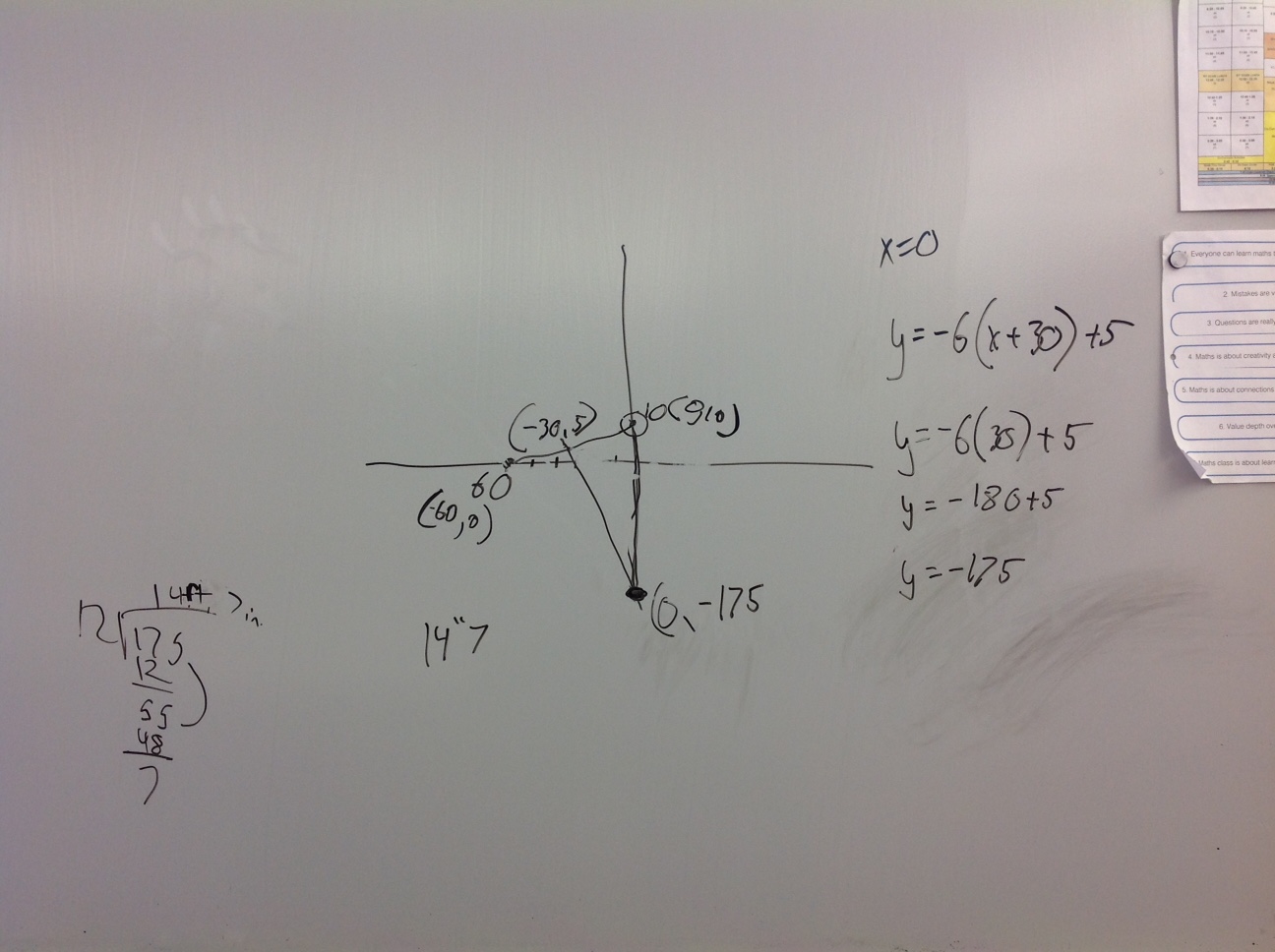
    So here’s a little story – I have a colleague sitting in on my classes just to see how I teach – because he is interested in creating an atmosphere like I have in my classes in his.  We have just introduced and worked on problems relating to the tangent function in right triangle trigonometry in the past week and now it was time to introduce inverse tangent.  I do this with a problem from our curriculum that hopefully allows students to realize that the tangent function only is useful when you know the angle.FullSizeRender (3)

    So as students realize they can’t get the angle from their calculator nor can they get it exactly from the measurement on their protractor (students had values ranging from 35 to 38 degrees when we compared), one of the students in my class says, “Ms. Schettino, wouldn’t it be great if there was a way to undo the tangent?” and the other kids are kind of interested in what she said. She continues, “Yeah, like if the calculator could just give us the angle if we put in the slope.  That’s what we want.”  I stood there in amazement because that was exactly what I wanted someone to crave or see the need for.  It was one of those “holy crap, this is working” moments where you can see that the kids are taking over the learning.  I turned to the kids and just said, “yeah, that would be awesome, wouldn’t it?  Why don’t you keep working on the next problem?” and that had them try to figure out what the inverse tangent button did on their calculator.  They ended up pressing this magical button and taking inverse tangent of 0.75 (without telling them why they were using 0.75 from the previous problem) to see if they could recognize the connection between what they had just done and what they were doing.

    At the end of the class, the colleague who was observing came up to me and said, “How did you do that?” and I said, “What do you mean?” and he said, “How did you get the kids to want to learn about inverse tangent? I mean they just fell right into the thing you wanted them to learn about.  That was crazy.”  I really had to think about that.  I didn’t feel like I did anything honestly, the kids did it all.  I mean what made them all of a sudden care about getting the angle?  Why were they invested?   It doesn’t always happen in my classroom that’s for sure.  This is not a perfect science – there’s no recipe for it to work – take a great curriculum, interested kids, an open, respectful learning environment and mix well?

    I do think however that a huge part of it is the culture that has been created throughout the year and the investment that they have made in their ownership and authorship in their own learning. We have valued their ideas so much that they have come to realize that it is their ideas and not mine that can end up driving the learning – and yes, I do end up feeling a little guilty because I do have a plan.  I do have something that I want them to learn, but somehow have created enough interest, excitement and curiosity that they feel like they did it.  It is pretty crazy.
  • Considering Inclusion in PBL

    It’s always refreshing when someone can put into words so eloquently what you have been thinking inside your head and believing for so long.  That’s what Darryl Yong did in his recent blogpost entitled Explanatory Power of the Hierarchy of Student Needs.  I feel like while I was reading that blogpost I was reading everything that I had been thinking for so long but had been unable to articulate (probably because of being a full time secondary teacher, living in a dorm with 16 teenage boys, being a mother of two teenagers of my own and all the other things I’m doing, I guess I just didn’t have the time, but no excuses).  Darryl had already been my “inclusive math idol” from a previous post he wrote about radical inclusivity in the math classroom, but this one really spoke to a specific framework for inclusion in the classroom and how in math it is necessary.


    In my dissertation research, I took this idea from the perspective of adolescent girls (which, as I think towards further research could perhaps be generalized to many marginalized groups in mathematics education) and how they may feel excluded in the math classroom.  These girls were in a PBL classroom that was being taught with a relational pedagogy which focuses on the many types of relationships in the classroom (relationship between ideas, people, concepts, etc.)  – I did not look at it from the perspective of Maslow’s Hierarchy of Student Needs and this is really a great tool.

    Interestingly,  I came up with many of the same results. My RPBL framework includes the following (full article in press):

    1. Connected Curriculum– a curriculum with scaffolded problems that are decompartmentalized such that students can appreciate the connected nature of mathematics
    2. Ownership of Knowledge – encouragement of individual and group ownership by use of journals, student presentation, teacher wait time, revoicing and other discourse moves
    3. Justification not Prescription– focus on the “why” in solutions, foster inquiry with interesting questions, value curiosity, assess creativity
    4. Shared Authority – dissolution of authoritarian hierarchy with deliberate discourse moves to improve equity, send message of valuing risk-taking and all students’ ideas

    These four main tenets were what came out of the girls’ stories.  Sure many classrooms have one or two of these ideas.  Many teachers try to do these in student-centered or inquiry-based classrooms.  But it was the combination of all four that made them feel safe enough and valued enough to actually enjoy learning mathematics and that their voice was heard. These four are just a mere outline and there is so much more to go into detail about like the types of assessment (like Darryl was talking about in his post and have lots of blogposts about) the ways in which you have students work and speak to each other – how do you get them to share that authority when they want to work on a problem together or when one kid thinks they are always right?

    The most important thing to remember in PBL is that if we do not consider inclusion in PBL then honestly, there is little benefit in it over a traditional classroom, in my view. The roles of inequity in our society can easily be perpetuated in the PBL classroom and without deliberate thought given to discussion and encouragement given to student voice and agency, students without the practice will not know what to do.  If we do consider inclusion in the PBL classroom, it opens up a wondrous world of mathematical learning with the freedom of creativity that many students have not experienced before and could truly change the way they view themselves and math in general.

  • Revisiting Journals: Getting Kids to Look Back

    I have been using metacognitive journaling in my PBL classroom since 1995.  I first learned about it the Summer Klingenstein Institute when I was a third year teacher and just fell in love with it.  At that time, the colleagues at my school thought I was crazy trying to make kids write in my classes – it was just “something else for them to do” and didn’t really help them learn but I did more reading on it and there was clearly more and  more research as time went on that showed that writing-to-learn programs especially those that prompt for metacognitive skills really do help in learning mathematics (see my metacognitive journaling link under the Research tab for more info and sample journal entries).

    Every once in a while a student will write a journal entry that I think is so thoughtful that I will write about it like this one a few years ago that just impressed me with his insight into his learning process of a particular problem. But other times kids write about their understanding of their learning overall like one I’ll write about today and I am also blown away.

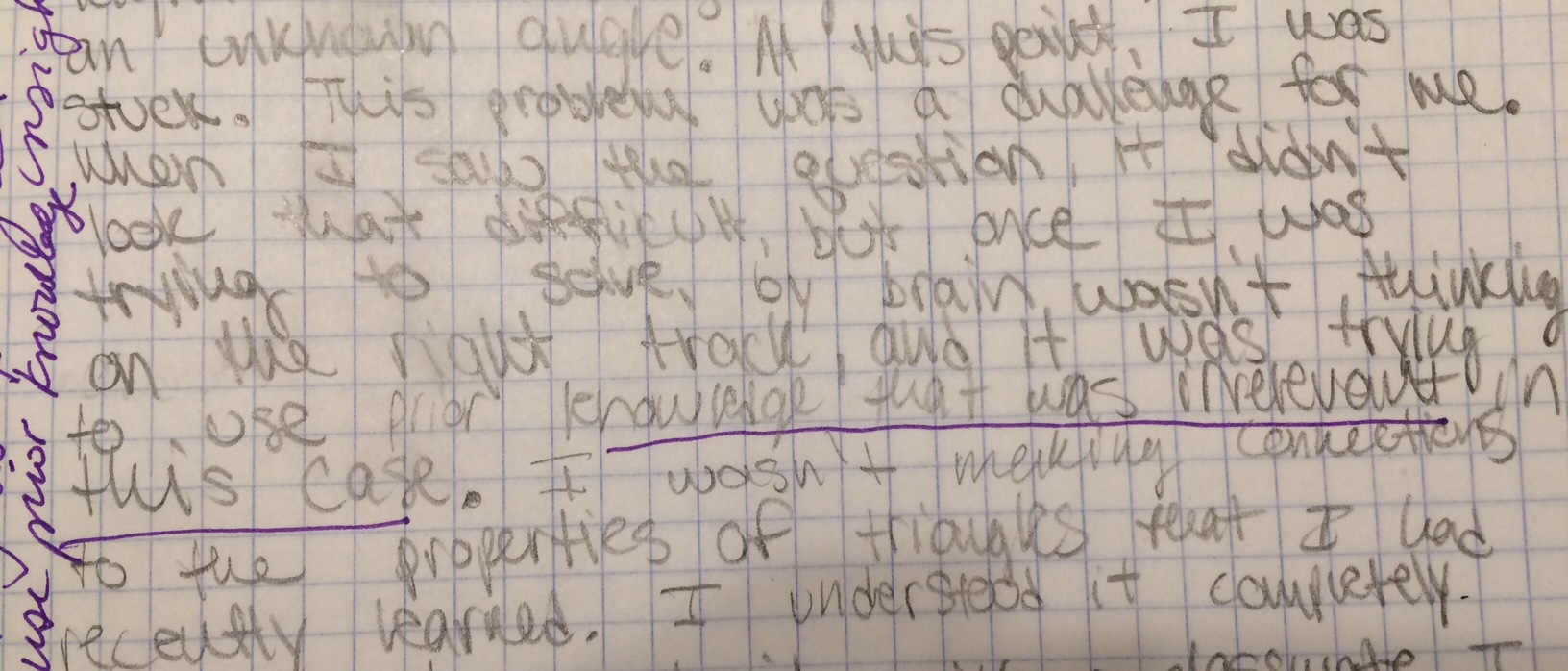
    Here’s a student I’ll call Meaghan reflecting on a problem that she found challenging for her.  Really, it doesn’t matter which problem it was or what topic it was, just the fact that she had a hard time with it at first, right?  The most important part was that after she wrote about how to do it correctly, she then took the time to write this: (in case you can’t read her handwriting, I will rewrite it below).

    FullSizeRender
    Part of Meaghan’s Journal Entry

    “This problem was a challenge for me.  When I saw the question, it didn’t look that difficult but once I was trying to solve by [sic my] brain wasn’t thinking on the right track, and it was trying to use prior knowledge that was irrelevant in this case.  I wasn’t making connections to the properties of triangles that I had recently learned.”

    Why is this realization so important for Meaghan?  Polya’s Fourth Principle of Problem Solving is “Look Back” – why is this fourth principle so important?  In my mind, this is where all the learning happens.  The three other principles are very clear

    1. Understand the problem
    2. Device a plan
    3. Carry out the plan

    These three are all very basic – if they work, right?  But most of the time they don’t work for kids.  It’s the fourth step that we know is the most important – it’s where the critical thinking and analysis takes place.  If this part isn’t taken seriously and the right steps within it are not taken nothing happens, no moving forward, no growth.

    So what did Meaghan do?  She realized that she had not made a connection between the triangle properties that we had just learned and how it applied to this problem.  She had not use the correct prior knowledge.  She  just created more openings to other knowledge that she knows- and I know what you’re thinking.  Does this mean that next time she will use the correct prior knowledge in another problem?  From my experience with kids, no, it does not.  But honestly, what I have seen is that the more they realize that there are more possibilities and also that the option of just saying “I don’t get it” or “I can’t do this” is unlikely, the more they will keep trying.

    So what did Meaghan do? By just being asked to write a reflection about one problem (every two weeks) she has reinforced her own potential in problem solving on HER OWN.  That she may, in the future, weed out the irrelevant prior knowledge and possibly see the connections to the relevant prior knowledge, with more practice.  I think it’s made her feel just a little bit more confident – and they said it was just “something else for them to do.”

  • Everything Old is New Again…(or why teaching with PBL is so great)

    So I heard that what everyone is saying about the new Star Wars Movie, The Force Awakens, is that “Everything Old is New Again” – go ahead google it, there are at least 5 or 6 blog posts or articles about how “BB-8 is the new R2D2” or “Jakku is the new Tattoine” or whatever.  I actually don’t have a problem with J.J. Abrams reusing old themes, character tropes or storylines because I think that really great stories are timeless and have meaning and lessons that surpass the movie that you are watching.  I still thought it was awesome.

    This concept of everything old is new again really hit home to me today in my first period class when I was having the students do a classic problem that I probably first did in 1996 while I was under the tutelage of my own Yoda, Rick Parris (who I think wrote the problem, but if someone reading this knows differently, please let me know).  The problem goes like this:

    Pat and Chris were out in their rowboat one day and Chris spied a water lily.  Knowing that Pat liked a mathematical challenge, Chris announced that, with the help of the plant, it was possible to calculate the depth of the water under the boat.  When pulled taut, directly over its root, the top of the plant was originally 10 inches above the water surface.  While Pat held the top of the plat, which remained rooted to the lake bottom, Chris gently rowed the boat five feet.  This forced Pat’s hand to the water surface.  Use this information to calculate the depth of the water.

    What I usually do is have students get into groups and put them at the board and just let them go at it.  Today was no exception – the first day back from winter break and they were tired and not really into it.  At first they didn’t really know what to draw, how to go about making a diagram but slowly and surely they came up with some good pictures. Some of the common initial errors is not adjusting the units or mislabeling the lengths.  However, one of the toughest things for students to see eventually is that the length of the root is the depth of the water (let’s call it x) plus the ten inches outside of the water’s surface.  Most students end up solving this problem with the Pythagorean Theorem – I’ve been seeing it for almost 20 years done this way.  Although I never tire of the excitement they get in their eyes when they realize that the hypotenuse is x+10 and the leg is x.

    However, since everything old is new again, today I had a student who actually is usually a rather quiet kid in class, not confused, just quiet, but in a group of three students he had put his diagram on a coordinate plane instead of just drawing a diagram like everyone else did.  This intrigued me.  He initially wrote an equation on the board like so:

    y= 1/6 (x – 0)+10

    and I came over and asked him about it.  He was telling me that he was trying to write the equation of one of the sides of the triangle and then I asked him how that was going to help to find the depth of the water.  He thought about that for a while and looked at his partners. They didn’t seem to have any ideas for him or were actually following why he was writing equations at all.  He immediately said something like, “Wait, I have another idea.” and proceeded to talk to his group about this:

    Jacksons solution to Pat and Chris
    Jackson’s Solution to the Pat & Chris Problem

    He had realized from his diagram that the two sides of the triangle would be equal and that if we wrote the equation of the perpendicular bisector of the base of the isosceles triangle and found its y-intercept he would find the depth of the water.  He proceeded to find the midpoint of the base, then the slope of the base, took the opposite reciprocal and then evaluated the line at x=0 to find the y-intercept.  I was pretty impressed – I had never seen a student take this perspective on this problem before.

    This made my whole day – I was really dreading going back to work after vacation and honestly, first period was the best class of the day when this wonderful, new method was shown to me and this great experience of this student’s persistence refreshed my hope and interest in this problem.  Perpendicular bisectors are the new Pythagorean Theorem!

  • Someday I’ll get this assessment thing right… (Part 2 of giving feedback before grades)

    So, all assessments are back to the students, tears have been dried and we are now onto our next problem set (what we are calling these assessments).  What we’ve learned is that the rubric allowed us to easily see when a student had good conceptual understanding but perhaps lower skill levels (what we are used to calling “careless mistakes” or worse). We could also quickly see which problems many students had issue with once we compared the rubrics because, for example, problem number 6 was showing up quite often in the 1 row of the conceptual column.  This information was really valuable to us.  However, one thing we didn’t do was take pictures of all of this information to see if we could have a record of the student growth over the whole year. Perhaps an electronic method of grading – a shared google sheet for each student or something to that effect  might be helpful in the future – but not this day (as Aragorn says) – way too much going on right now.

    We also changed the rubric a bit for a few reasons.  First, we found that when students completed the problem to our expectations on the initial attempt we felt that they should just receive 3’s for the other two categories automatically.  We considered not scoring them in this category but numerically felt that it was actually putting students who correctly completed a problem at a disadvantage (giving them fewer overall points in the end). Second, we also changed the idea that if you did not write anything on the revisions you earned 0 points for the revisions columns.  Many students told me afterwards that they felt like they just ran out of time on the revisions and actually had read the feedback.  This was unfortunate to me since we had spent so long writing up the feedback in the hope that the learning experience would continue while doing revisions.

    Here is the new version of the rubric: Revised Problem Set Grading Rubric new

    What we decided to do was to try the revisions this time without the “explanation” part of writing.  I think it will keep the students focused on reading the comments and attempting a new solution.  I was frankly surprised at how many students stuck to the honor pledge and really did not talk to each other (as they still got the problem wrong the second time around – with feedback).  Truly impressive self-control from the students in my classes and how they were sincerely trying to use the experience as a learning opportunity.

    I do think the second assessment will go more smoothly as I am better at doing the feedback and the rubric grading.  The students are now familiar with what we are looking for and how we will count the revisions and their work during that time.  Overall, I am excited about the response we’ve received from the kids and hope that this second time is a little less time-consuming.  If not, maybe I’ll just pull my hair out but I’ll probably keep doing this!


  • Why Teachers Don’t Give Feedback instead of Grades, and Why We Should

    First in a series of posts about my experiences with “Feedback Before Grades”

    Holy Mackerel is all I have to say – Ok, well, no I have plenty more to say – but after about a week and a half of holing myself up with my colleague, Kristen McVaugh, (big shout-out to Ms McVaugh who is not only teaching PBL for the first time but was willing to dive into this amazing journey of alternative assessment with me this year too), I am totally exhausted, almost blind as a bat, partially jaded and crazy – but mostly ready for a drink.  This little looped video of Nathaniel Rateliff and the Night Sweats pretty much sums it up…

    So here was our well-intentioned plan:  we wanted to start the year off with a different type of assessment.  I put out my feelers on twitter and asked around if anyone had a rubric for grading assessments where the teacher first gave only feedback and then allowed students to do revisions and then once the revisions were done the students received a grade. Kristen and I knew a few things:

    1. we wanted to make sure the revisions were done in class
    2. we wanted to make sure the revisions were the students’ own work (tough one)
    3. we wanted to give students feedback that they needed to interpret as helpful so that we weren’t giving them the answer – so that it was still assessing their knowledge the second time around
    4. we wanted to make sure that students were actually learning during the assessment
    5. we wanted students to view the assessment as a learning experience
    6. we wanted students to be rewarded for both conceptual knowledge and their skills in the problem solving too

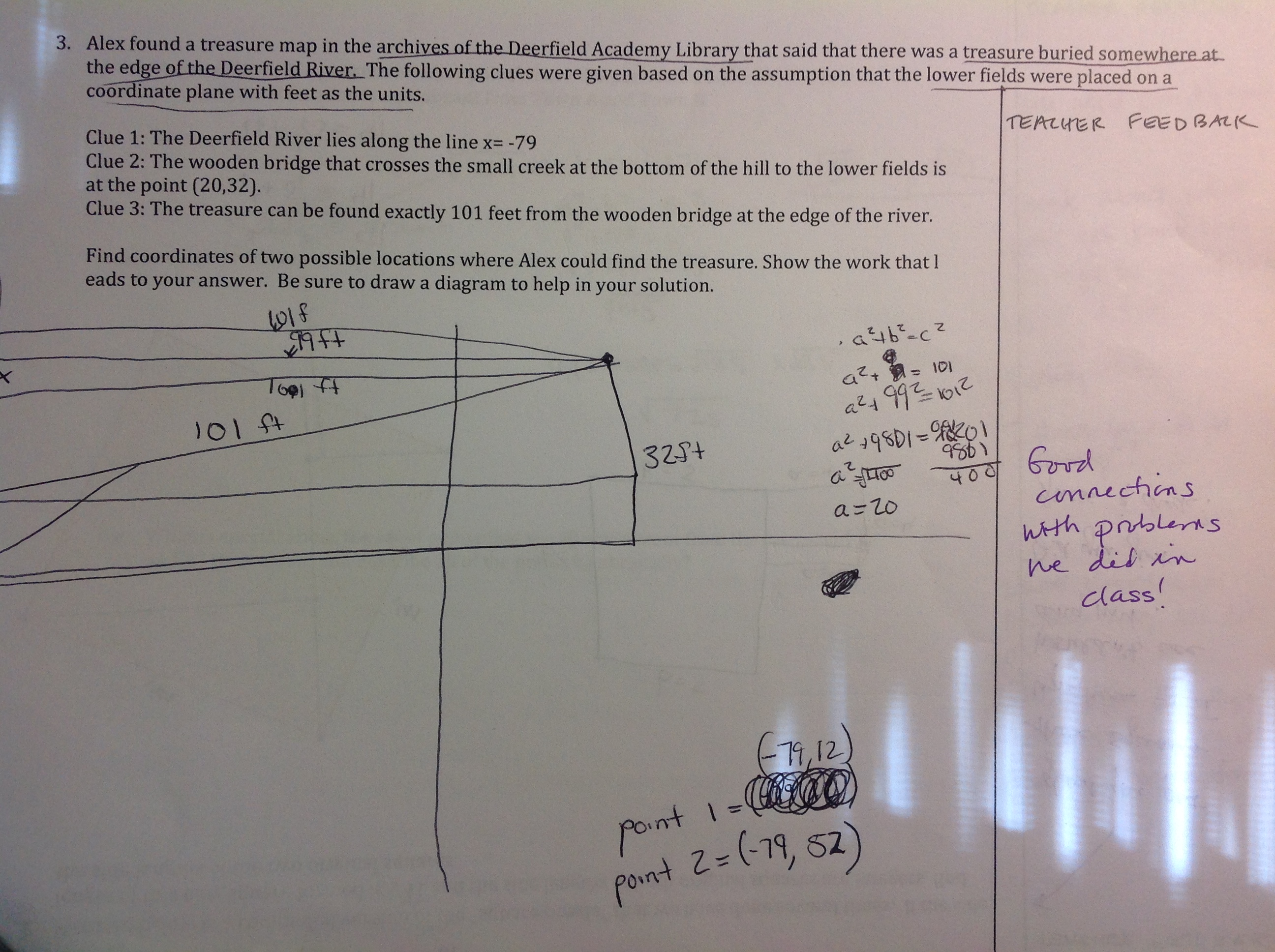
    So we created this rubric Initial Draft of Rubric for Grading.  It allowed us to look at the initial conceptual understanding the student came to the problem set with and also the initial skill level. Kristen and I spent hours and hours writing feedback on the students’ papers regarding their errors, good work and what revisions needed to be done in a back-handed sort of way.

    Here are some examples:

    Student 1 Initial Work
    Student 2s initial work
    Student 3 initial work


    Some kids’ work warranted more writing and some warranted less.  Of course if it was wonderful we just wrote something like, excellent work and perhaps wrote and extension question.  The hard part was filling out the rubric.  So for example, I’ll take Student 3’s work on problem 6 which is the last one above. Here is the rubric filled out for him:

    Student 3’s Rubric

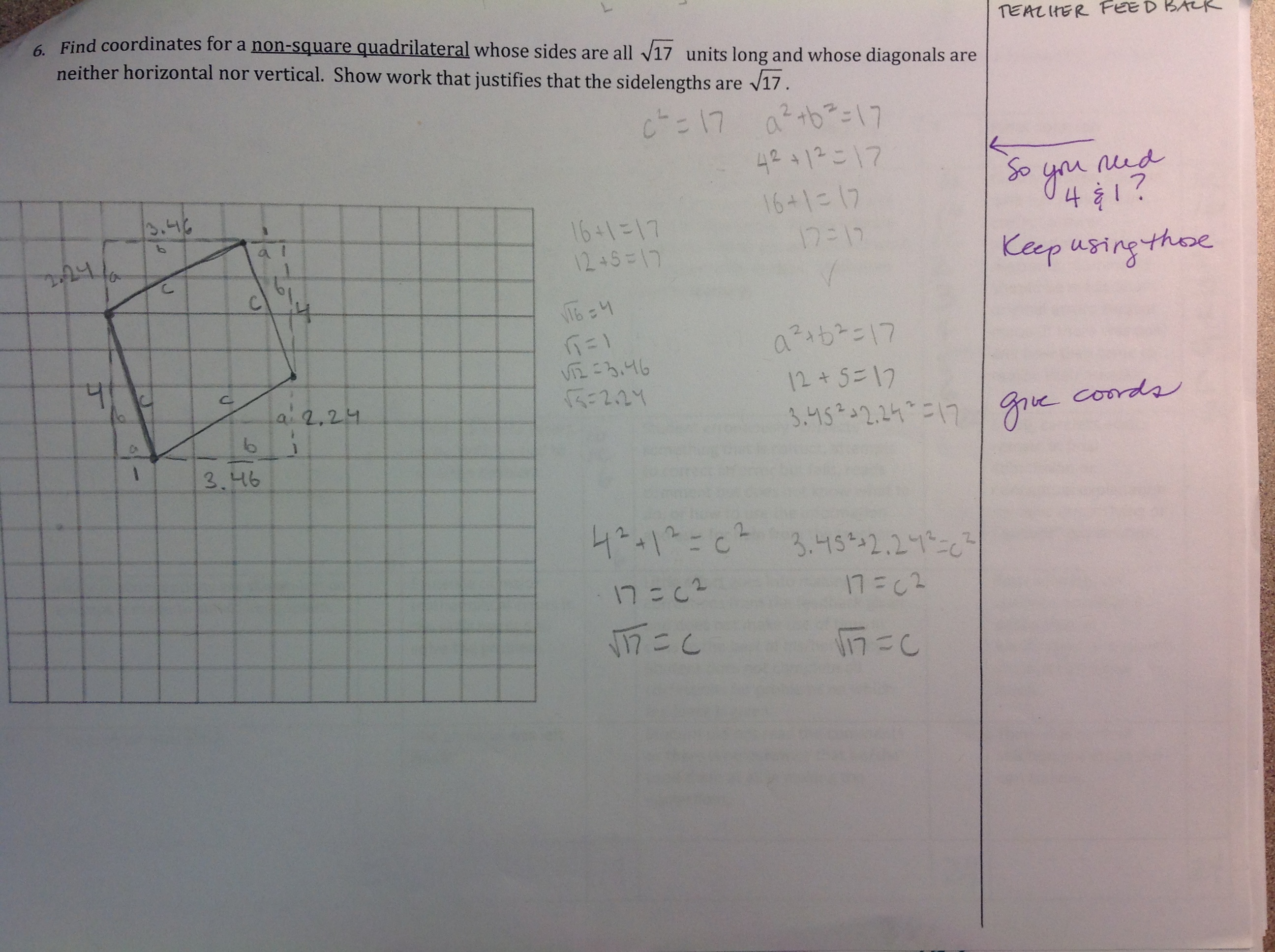
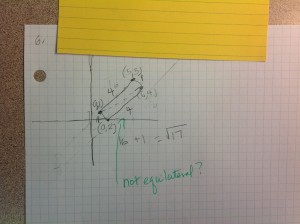
    You will notice that I put problem 6 as a 1 for conceptual understanding and a 2 for skill level (in purple). In this problem students were asked to find a non-square quadrilateral with side lengths of sqrt(17).  Student 3 was definitely able to find vertices of a quadrilateral, but he was unable to use the PT to find common lengths of sides.  I gave him feedback that looking at sqrt(17) as a hypotenuse of a right triangle (as we had done in class) would help a bit and even wrote the PT with 17 as the hypotenuse in the hope of stimulating his memory when he did the revisions.

    The day of the revisions Student 3 was only capable of producing this:

    Student 3 revisions

    He followed my direction and used 4 and 1 (which are two integers that give a hypotenuse of 17, but did not complete the problem by getting all side lengths the same. In fact, conceptually he kind of missed the boat on the fact that the sqrt(17) was supposed to be the side of the quadrilateral altogether.


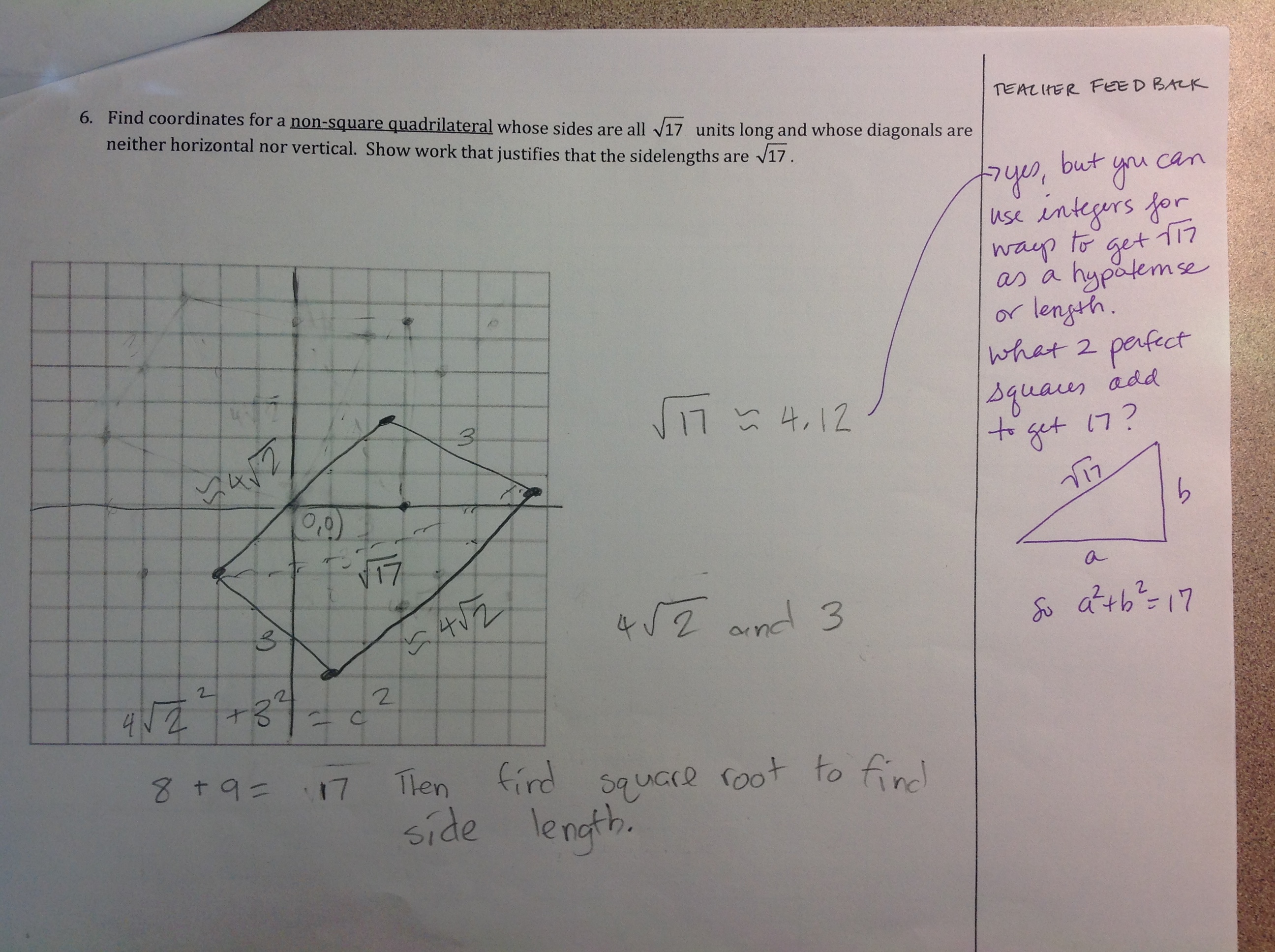
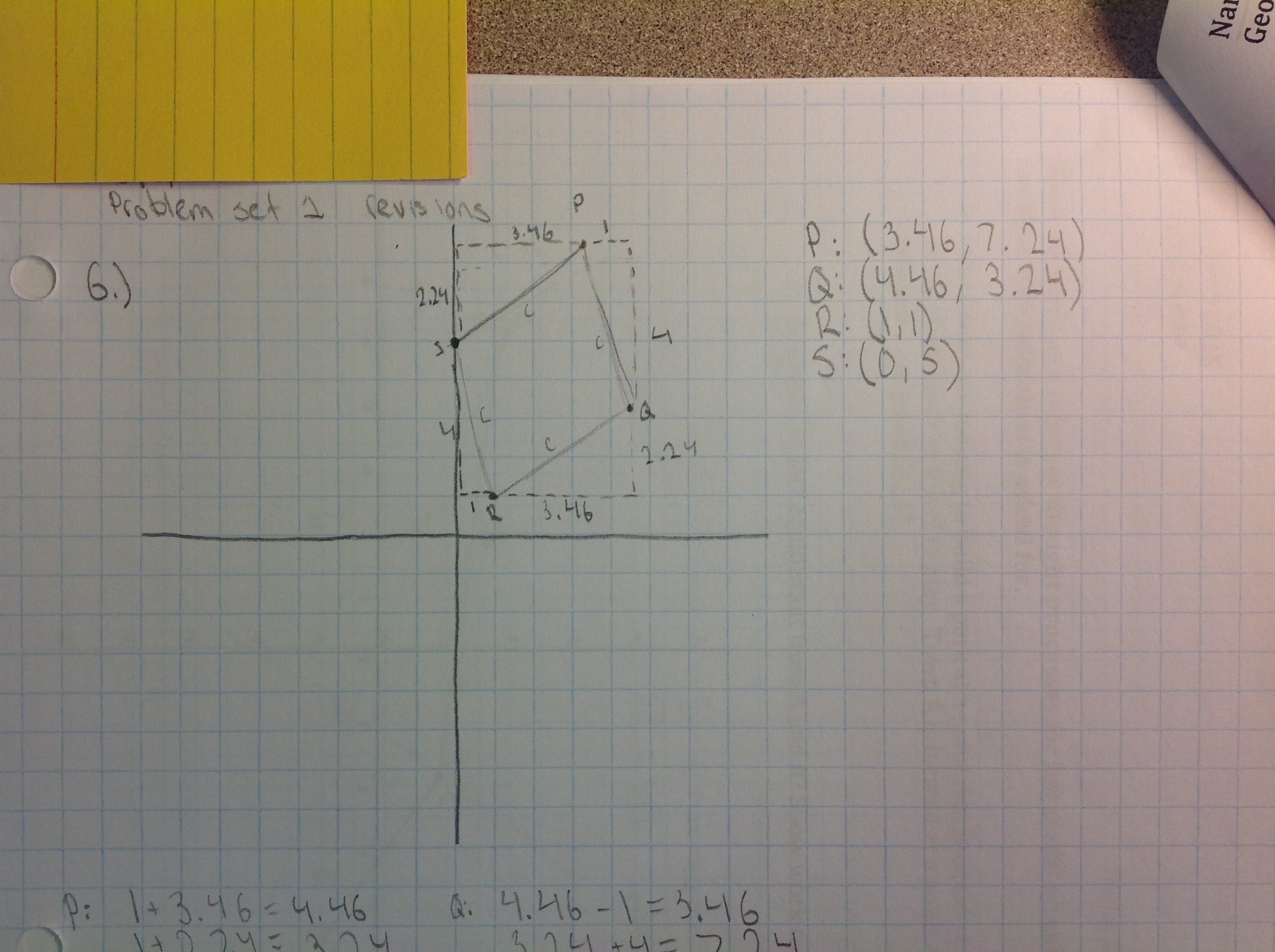
    One success story was Student 2.  She also did this problem incorrectly at first by realizing that you could use 4 and 1 as the sides of a right triangle with sqrt(17) as the hypotenuse but never found the coordinates of the vertices for me. I gave her feedback saying there might be an easier way to do this because she needed vertices.  However, she was able to produce this:

    Student 2s revision
    Student 2s revision

    Although she did not give me integer-valued coordinates (which was not required) and she approximated which officially would not really give sqrt(17) lengths it came pretty darn close! I was impressed with the ingenuity and risk-taking that she used and the conceptual knowledge plus the skill-level. Yes, most other kids just used some combination of 1’s and 4’s all the way around but she followed her own thought pattern and did it this way.  Kudos to student 2 in my book.

    Next time I will talk about some of the lessons we learned, other artifacts from the kids’ work and what we are changing for next time! Oh yeah and some great martini recipes!

  • Why PBL Works for Introverts

    My school year is underway and as September just flew by, I have been completely overwhelmed by work – of course.  I am undertaking a new assessment method with a colleague of “feedback first and then grades” (blogpost to come when I give back the first set next week) but for now I wanted to comment on an article I just read this morning entitled “When Schools Overlook Introverts” that was posted on the Atlantic’s website.  This is a very thoughtfully written piece by Michael Godsey that is discussing how so much education is based on the idea of social constructivism which might be hard on those of us who are built to work best in “quieter, low-key environments.” This implies that the environments of collaboration and working with others are always loud, chaotic and multi-faceted.

    And you know, sometimes it is.  Classrooms where kids are all at the board or working with technology can be messy.  Everyone’s talking at once, kids are calling me over and asking questions out loud (often the same questions 5 times in a row) and they are seeing themselves as the center of attention.  Once they understand, they move on and help their partner move on.  In my classroom, they take pictures with their iPads, record work in Notability or use GeoGebra to get a different perspective – either algebraic or geometric.  This can be quite chaotic.

    However, most of the time in the PBL classroom.  everyone is required to sit quietly and listen to one student describe their thought process.  They need to learn to sit patiently while another student works though confusion and misunderstanding and ask questions of the presenter.  An introvert has a great deal of time of quiet to themselves being inside their head while the presenter is discussing his or her own grappling with a problem from the night before and the introvert can sit there and think, “Huh, that’s not what I did.  Should I say something and comment, or just accept that as the right answer?” The introvert grapples with different demons in the PBL classroom if they are a strong mathematics student in many ways because they might feel confident in the material but not confident that people care about their ideas.  Who knows?  It depends on their personality.

    The introvert also has the opportunity to write journal entries for me and also to write bi-weekly learning reflections about what his or her learning successes were for the week.  This year I have a student with a speech impediment who was upfront with me about it at the beginning of the year.  This student has quickly become one of my best communicators because he realized how much I value what he has to say and that I would be patient and so would the rest of the class.  If he can’t say what he needs to say at the moment he wants to in class, he will always have an opportunity each week to do it.

    I am very clear on my classroom contribution Assessment Rubrics that the grade does not depend on quantity of contribution, but quality.  Introverts should contribute because they have something important to add, an excellent question to make a clarifying point or something that will add depth to the conversation – never just to add to their grade. They can look at what they need to improve on by using my Student Analysis of Contribution which I will be doing next week – it’s about that time of the term.

    I believe that although PBL strives to allow for all voices to be heard (both extrovert and introvert) it is the teacher that makes or breaks the classroom culture.  We need to be continually checking and rechecking the barometer of communication and tone of the class to be sure to all students are feeling heard. So that as Godsey says at the end of his article, the kids can learn with others and not by the “hell of other people.”


  • Disruption in Presence: Missing PBL Math Class

    What do we all do with kids who miss out on the wonderful rich discussions where the learning happens in a PBL math class? @0mod3 asks what to do about kids’ absences. (thanks for the great question!)

    It’s not as simple as “get the notes from somebody who was there” is it?  What did they actually miss by not being in class? Yes, new vocabulary possibly, new concepts, whether their problems were right or wrong – these things can all be “looked up” in some ways in another students notes or with a conversation with the teacher or a tutor just like in any other mathematics class.  So what is it we are really concerned with that they missed?

    It seems that DReycer is hitting the nail on the head in her second tweet here.  Of course, it’s the experience of being a part of the rich mathematical discussions.  Hearing other students’ ideas and deciding for themselves or analyzing critically in the moment what they think of those ideas – is it right? wrong? potentially right? more efficient? similar to what I did?  These experiences are very hard to re-simulate for students who are absent from the PBL classroom.

    When students come to me who have missed class.  I do tell them to look at other students’ notes.  However, this is because of how I tell students in my classes to take notes.  Kids are supposed to attempt the homework problems on one side of the notebook and then on the other side take “note of” what the other student who is presenting the problem did differently from them.  Eventually when we, as a class, come to some type of consensus about how the problem connects to a new concept or to a problem we have already done, it is then that a student should take note of the new idea as we formalize it into a theorem or new idea.

    Absences will always be a problem for us who teach in the PBL classroom since we can’t recreate the in-the-moment learning that happens when a student sees another’s presentation (unless you feel like having parental consent for recording every single class, and even then you can’t really have the interaction with the student that missed it) however, what you can do is make the most of the time when each kid is there. PBL is by its nature relational learning and student and teacher presence is extremely important.  Be sure that students are the ones who are talking and asking questions in order for them to actively be engaging with the presenter.  Be sure that you are present to their needs when they return from an absence.  On days when they are not there, it might be enough for them to ask questions on the next day after they have read through the vocabulary or seen someone’s complete solution.  Sometimes active learning the next day can just be enough.

    I’d love to hear other people’s ideas and thoughts!

  • Virtual Hand-outs for #GlobalMathDept conference

    So tonight I give my very first online talk – I’m a little worried that talking to my computer will be a little strange at 9:00 at night, but we’ll see what happens.  Hopefully, there will be some type of audience interaction.  I’m such a relational person that I think I’m one of those people that really needs feedback will I’m talking.  We’ll see!

    My hope is to discuss the differences between PBL & PjBL and how people can find a way to make some type of PBL work in their classroom no matter what place they are at in their teaching.

    Here are the documents that I will be mostly referencing.  Hope to see you all there!

    Student Self-Report on Class Contribution
    Thinking_About_Thinking_Problem_Solving_Tool
    Weekly Learning Reflection Sheet
    Keeping a Journal for Math Class

  • Connections Between IBL and PBL

    At the PBL Summit a few weeks ago, we had two wonderful speakers, Julian Fleron and Phil Hotchkiss from Westfield State University who are founding members of the Discovering the Art of Mathematics Project.  They gave a great key note address on Friday night about Inquiry-Based Learning and motivating students in an IBL classroom.  You can find their talk at our Summit Resources website if you are interested.  I wrote a blogpost a few years ago about my interest in IBL and the commonalities between PBL and IBL and I thought I’d reshare in honor of them.  Enjoy!

    A number of years ago, I needed some kind of suport text for a Number Theory tutorial that I was doing with two rather advanced students who had gone through the curriculum at the school where I was teaching.  These two girls were advanced enough that I knew that if I used my notes and problems from my wonderful Number Theory course from college (some many years ago) we would have a great time.  I looked online and found a great book called “Number Theory Through Inquiry” published by the MAA which came with an instructor’s supplement including pedagogical discussion and some solutions.  It sounded so much like what I was doing with my other classes that I couldn’t turn down the opportunity to see what it was like.  So I ordered the book and while I was reading the instructor’s supplement I came across something that I had not heard about before (and now I am so embarrassed to admit this). The authors described what they called the “Modified Moore Method” of instruction or Inquiry-Based Learning and went on to describe what sounded interestingly so much like what I was doing in my classroom.  I had to learn about this Moore Method.

    I ended up researching R.L. Moore online and it seems that he was one of the first math teachers – ever – to think about and act on this idea of not teaching mathematics with direct instruction.  He did it all the way back in 1948, but at the college level – and it was radical there!  The idea of Inquiry-Based Learning has expanded from there, but it has really only stayed at the college level in mathematics for a very long time.  There are many initiatives at the college level, including the folks at Westfield State University who are writing a wonderful curriculum project funded by the NSF called Discovering the Art of Mathematics with is a math for liberal arts curriculum at the college level.  I think it could be used at the secondary level as well for an alternative elective in the senior year for those students who still want to take a college-level math course but aren’t ready for or interested in an AP course in Calculus or Stats.  If there are any secondary teachers interested in beta-testing this unique curriculum please contact me and let me know.  I am on the advisory board for this project.

    What made me think about the connection between IBL and PBL was this wonderful blogpost I just read by Dana Ernst, of Northern Arizona University in which he describes, in such wonderful ways, the pedagogy and nature of IBL.  The similarities between the definition of IBL he cites (by E. Lee May) and my definition of PBL are eerie – and it is one of the only ones that I’ve seen that stresses a reference to teacher authority being diminished.  Many wonderful resources are given by Ernst at the end of his post as well.

    I do remember back in 2003, when I published my first article on my experiences at Emma Willard, after I left Exeter (where they called in Harkness teaching because of the table), in attempting to teach the way I wished to.  I had no idea what to call what I was doing.  I believe in my first article I called it teaching with a Problem-Solving Curriculum (PSC).  After I started my doctoral work, I found PBL and I realized that’s what it was.  Then I read more and more and realized that others thought PBL was project-based learning and called what I did discovery learning.  After reading about R.L. Moore, it sounds like he was doing it all along since 1948 and called it IBL.  In whatever branch of the pedagogical family tree you find yourself, if you are asking students to look at mathematics with wonder and question what they know – you should know that you are supported, know that you are doing good work and know that there is someone out there who has done it before and wants to discuss it with you.

    PS – I’m hoping to attend the Legacy of R.L. Moore Conference next year in Austin, if anyone is interested!