Blog

  • The First Followers…how do I get them in the PBL classroom?

    So I have one class this year that is rather frustrating and pretty tough to handle when it comes to buy-in with what I’m doing in the mathematics classroom.  Perhaps it’s because it’s first period, or perhaps it’s the mix of kids (quiet, shy, cynical?) – but I’m having a hard time inspiring them to speak out about their ideas or even be somewhat active in class.  This has made me wonder if I’m doing anything differently?  What’s the difference between first period and second period?  Why would this class be that much different in student make-up and personality than other challenging classes that I’ve had.

    These thoughts made me remember a video I saw at a conference talk this summer and how important the “first followers” are.  This video is basically about a guy the narrator calls the “lone nut” who is dancing at a music festival (maybe you’ve seen it, it’s been around for a while) and how his leading becomes a “movement.”

    It’s one of my favorites and so true.  But what I am afraid of is that the “first followers” I had in my first period class are not necessarily “followers” but students who realized they better do what I want or they won’t do well in my class.  This is not the same as “buy-in” to PBL.  This led me to think about what I needed to do in order to create first followers who would truly be inspiring and lead to more followers.  I’m not sure about this, but a couple things I tried:

    • talking about the pedagogy and how it’s different with the students
    • discussing the class contribution rubric with them and having them do a self-evaluation of their contributions to class
    • discussing listening skills when learning
    • Being deliberate about asking questions that are more open-ended (not just procedural)
    • Being less “forgiving” that it’s first period and they are tired – keeping my standards up of what I expect from them.
    • Giving praise when students take risks and learn from mistakes at the board
    • Offering a reward (like a Pez Candy) when a student is wrong but has taken a risk

    So far my attempts have not been in vain, but I still don’t feel the “movement” as I do in other classes.  This has been an interesting first month with this group and I think many of them are actually learning, but don’t seem to be enjoying themselves.  I think I just need a couple more “first followers” to allow the others to see that what I am asking of them – although harder and requiring more energy and effort on their part – is actually an important part of their journey of learning.  I would love to hear from anyone who has experienced this and what steps can be taken to increase the followers in a “mob” of the whole class!

  • Teaching Persistence Takes Time….But How Much Time?

    I just read a great story posted on a blog about Malcolm Gladwell’s comments about Alan Schoenfeld’s research on persistence in problem solving in Gladwell’s book Outliers. In this story, a young woman persists for 22 minutes on a problem that had an average persistence time for most students of about two minutes.  Of course we would love to have students be persistent in the face of a problem they couldn’t solve and have some determination and creativity to bat to allow themselves to grapple with the problem (in other words, not just sit there and persist in the feeling of gosh-I-wonder-how-to-do-this).

    But at the same time, imagine that you actually have kids who are well-intentioned, pretty smart and actually interested in learning.  Let’s just give them the benefit of the down for a second here – and we’re in a classroom where we have interesting problems that might keep them engaged in the evening with an cool idea with which they must grapple for a while.  I would ask the question, “How persistent do we want them to be?” (and so would they).

    Many kids in the PBL classroom wonder this in the beginning of the year and I am asking myself now too.  This student of Schoenfeld’s that persisted for 22 minutes –  is that a good thing?  How long is too long?  When would we want a kid to know to look for resources?  To question their prior knowledge in a different way?  To know to stop and wait to discuss with others the next day?  To try using technology?

    So my question would be how do we know when we are teaching persistence as a good  and productive thing or when we are teaching students that their problem solving is just the definition of insanity (repeating the same thing over and over expecting different results?).  My thought is that persistence without a growth mindset (or the belief that you can change your way of thinking and knowing) can be just as dangerous as no persistence at all.

  • Inspirational colleagues? Wow…

    OK, so I’m not really doing the full blog challenge – This weekend was nutso and blogging everyday is really tough – enough with the excuses.  But this question, “Who was or is your most inspirational colleague and why?” just really struck me at my core.  There have been so many, probably for all of us in education, it would be extremely difficult to pinpoint just one who was MOST inspirational.  I continue to be inspired rather regularly by my past professor (now friend) Carol Rodgers (SUNY) who is just one of the most amazing writers, Dewey Scholars and researchers and reflective practice I have ever met.  She is an amazing teacher mentor and has taught me a great deal. Ron Lancaster (OISE – Toronto) continues to show me how to be a true teacher of teachers every time I see him.  Nils Ahbel (Deerfield) and Maria Hernandez (NCSSM) and two of the most passionate mathematics educators I have ever met and every time I speak with them about my practice, I learn something new – period.  If you all ever get a chance to hear any of them speak, I highly recommend it.

    I’ve already written about my inspiration and admiration for Rick Parris and the amazing life he led as a an educator, so I won’t go into that again, but I do feel that if I had to name someone who was not only inspiring, a major role model, caring, patient and kind, and truly changed my life, it would have to be Anja Greer.  If there is anyone to whom I have to attribute my work and lifelong love of teaching mathematics with problem-based learning, it would be Anja, mostly because I would not have had the opportunities and the courage to have taken the risks and to work with people who intimidated the heck out of me when I was only 26 years old.  She was a woman at school that had a very male-dominated history and she always spoke up for the students that were underserved and underrepresented.  She gave of herself in every way and gave me a job opportunity in 1996 that changed my life.

    In the classroom, she was a teacher, mentor, innovator and amazing administrator.  To watch her handle a room full of very opinionated and argumentative mathematics faculty was amazing – never losing her grace and determination.  She took her time finding the words that she wanted to say and to this day, when I feel that I am pressured to quickly say something I think of her, take a breath, and rethink my words in my head.

    The day I met Anja she frankly explained that she had to put a wig on in order to take me to campus because the students hadn’t seen her with her hair so short.  You see, she was battling cancer at the time that she was serving as department chair, implementing a new curriculum and hiring 4 new teachers that year.  The courage she had to “put on that wig” and move through her days for the next few years inspired me so much.  My son was born the year she lost her battle to cancer and she still had the compassion to let me know how happy she was for me that January.

    I am so grateful for Anja’s influence on my life and I continue, in her memory, to teach annually at the conference that was named for her.  If I can even remotely come close to influencing another teacher in the way she has for me, I will have just started to repay her.

  • Blog Challenge Day 3: Do I really practice what I preach?

    So the question for today is “Discuss one observation “area” that you would like to improve upon for your teacher evaluation.”  This is a tough one for me because as a teacher at an independent school formal evaluations are done in the second and sixth years so I don’t have formal evaluation “areas” per se.  Last year, I had a colleague sit in on my classes and give me feedback over a month’s period  and it was extremely helpful to have his perspective.  I also have many teachers come from other school at different points in the year in order to learn about problem-based learning, so I am used to having people in my classroom, but I haven’t really asked for feedback in one particular area in very long time.

    However, I do believe that something I wonder about when I speak to teachers learning about PBL is how well I really facilitate PBL discussions.  I know what I’m supposed to do but the time constraints and the issues of adolescent life often keep me from being the best I can be.   I know I can be hard on myself, but if I had an expert in questioning, wait time, reactions to statements, inquiry and scaffolding who could come in and watch me teach for a week or so, that would probably be the best thing for me right now.  It would be so helpful.  So if anyone is willing…please get in touch!

  • Blog challenge Day2: New Technology for Collaboration in PBL

    For the past two years, I have been lucky enough (or unlucky if you are less inclined to use technology) to have classroom sets of iPads for my geometry classes and have been able to experiment pretty easily with some different ways of teaching – collecting homework electronically (that was a fail), using Geogebra and Notability to get some really nice diagrams (that was pretty great!) and working with Voicethread to have students collaborate at home during homework. I gave a CwiC session talk last year at the Anja S. Greer conference on my use of Voicethread as a means of collaboration in problem solving and it went over really well. Here’s an example of how students used it:

    So since I felt like that was so helpful as a discussion forum in the evenings (and also allowed more time in class for discussion the next day), I wanted to find other apps that might be just as helpful.  One of the things kids didn’t like about Voicethread was that it forced asynchronicity – there was no way to talk to someone online.  In fact, what sometimes happened was that a student would post a question and no one would respond until maybe 11 pm, and then by that time they might’ve gone to bed or moved onto their French homework or something.  Bummer.

    So now this year I’m going to try a new app called Talkboard.  This is a really cool app that allows a student to send an IM or email to another student (or more than one) and then have a conversation (with voice) while also seeing writing and drawing real-time.  These synchronous discussion are kept in “projects” that can be saved and even exported as a pdf (without sound sadly) but there can be a record of their ideas.  Students can come to class the next day with some work on the iPad that contains the ideas they had for the problem solving process.  You can keep adding pages to the project and you can also import pictures – like graphs and diagrams from geogebra or desmos.  So I’m pretty pumped to try this out.

    If anyone has used this app and has some experience with it, I’d love to hear about it!  Thanks so much!  …and happy experimenting!

  • TeachThought Blogging Challenge Day1: Goals for this Year

     OK, so I’ve decided to try to blog more this coming year (like I don’t have anything else to do working at a boarding school) and I happened to run across the TeachThought Blogging Challenge the other day, so I thought I would try to see how many of the 30 days, I might be able to actually write something that was worthwhile.
     
     I even downloaded a new app for my iPad to make blogging easier (we’ll see if that prediction comes true or not) called BlogPress which had some really nice reviews. (Using it right now, with a little help from my java programming husband).
     
     So Day 1 assignment is to “Write your goals for the school year. Be as specific or abstract as you’d like to be.” This is quite an overwhelming task honestly, there are often so many of them. So after some thought I came up with three and here they are:
     
     1. I am mentoring a teaching fellow in my department this year and so one of my goals this year is to be a good mentor. I know that’s pretty abstract but when you have another teacher’s success or failure connected to how well you discuss teaching, mathematics and learning with that person I find the overall goal pretty important. Mentoring someone in PBL is even trickier if it’s their first time teaching and they haven’t actually seen it in action yet. From doing this in the past, I know I also have to find ways to allow young teachers to express their hesitation and doubts with this method of teaching, so being aware of the discussion and keeping the dialogue open will parts of being a good mentor.
     
     2. My second goal is to work on assessing student learning through listening. One of the biggest issues I am grappling with in the classroom and have thought about a great deal in PBL, is how well students can learn from each other by listening to discussion. In fact, I know that one of the biggest arguments that “doubters” have with PBL is that if students are not just told what the important facts are and given clear instruction (what to learn when) learning can’t happen. I want to find ways in which to assess how well students are learning through dialogue. This was inspired when I heard a talk a year or so ago by Karl Kosko (Kent State University) about a study he did related to student listening and their learning. If I remember correctly there was a direct relationship between how well a student could articulate their ideas during a conversation and how well they listened. (So talking and listening are connected.)
     
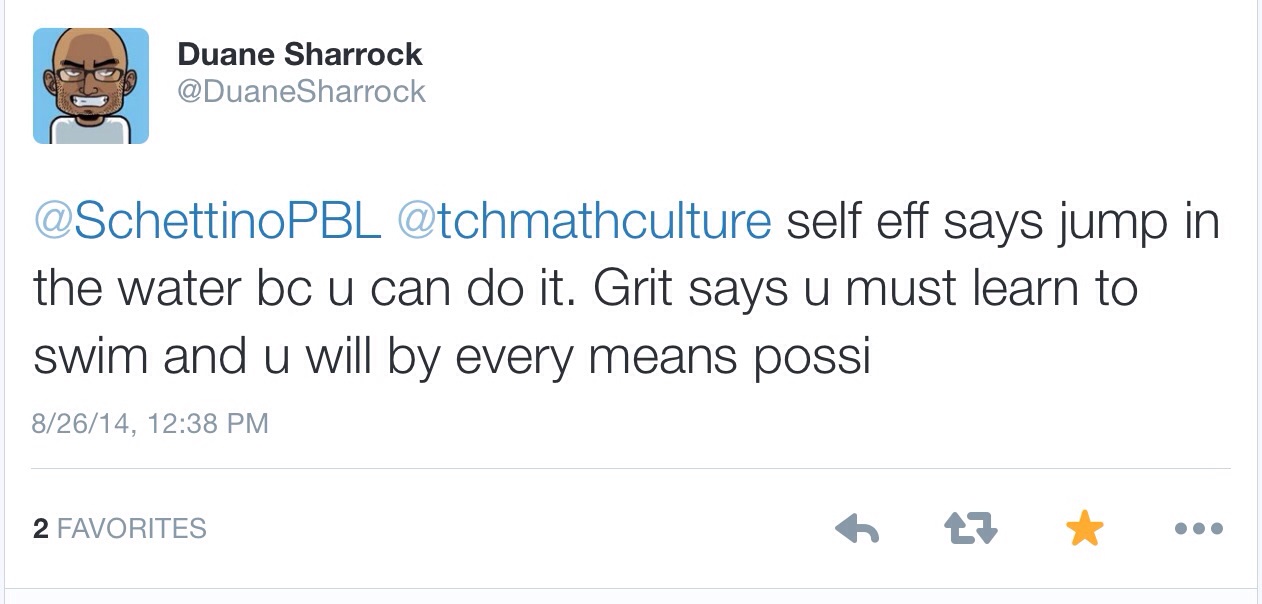
     3. My third goal is to think about the connections between PBL and grit or self-efficacy. I gave a lot of thought this summer to the differences between grit and self-efficacy and I think one of the best differences I found was tweeted by a guy named Duane Sharrock (@DuaneSharrock) when he responded to request for any distinctions that people had in a tweet I put out there. He said:


    So in my mind it seems like Self-Efficacy has more to do with confidence and self-attribution of skills and Grit might have more to do with persistence and determination. I am actually interested in both with respect to what PBL fosters in students. To that end, I am going to do a lot of reading and research to see what’s out there and would love to hear from any readers if you have thoughts or experiences with this.
     
     There are my three main goals for the year. My classes start on Friday, but tomorrow they all arrive – wish me luck! Good luck to all of you out there!

  • What does “making students metacognitive” mean? – answering “why should someone learn?” in Math

    So I recently tweeted a nice article that I read that discussed “12 Questions to Help Students See Themselves as Thinkers” in the classroom (not specifically the math classroom


    and appropriately, Anna Blinstein tweeted in response:


    So I thought I needed to respond in a post that spoke to this question. First of all, I should state the caveat that even when I am in a more “standard” classroom (i.e. not a PBL classroom) – which happened to me last year – I try as much as possible to keep my pedagogy consistent with my values of PBL which include

    1) valuing student voice
    2) connecting the curriculum
    3) dissolving the authoritative hierarchy of the classroom
    4) creating ownership of the material for students

    I find that helping students to be metacognitive helps with all of this. An important aside her is also Muller’s definition of 21st century learning* which is much more than that 20th century learning and education that often comes with direct instruction in the mathematics classroom (not always).I think it’s important to note that the more fluid concept of knowledge that is ubiquitous with technology today and is no longer static in textbooks or delivered by teachers.  Students can go find out how to do anything (procedurally) nowadays, but it is the understanding of it that is more important and the true mathematical learning and sense making.

    Anyway, I think I would write way too much if I responded to every one of the questions, but how would I use these questions in my direct instruction class that I taught last year?  What I tried to do was introduce a topic with some problems (and then we would do some practice with problems from the textbook so I could keep up with where my colleague was in the material).  Well, this course was Algebra II, which often referred to prior knowledge that always reminded students of something they had studied before.  I let them use computers to look things up on the internet and use the technology at hand, GeoGebra, Graphing Calculators, each other to ask questions about the functions we were studying.  They could look up topics like domain, range, asymptotes (why would there be an asymptote on a rational function)…but then the bigger questions like “what am I curious about?” had more to do with how did those asymptotes occur, what made vertical vs. horizontal asymptotes and then I would have them do journal entries about them (see my blogposts on metacognitive journaling – journaling and resilience, using journal writing, page on metacognitive journaling).

    The more “big picture” questions like “Why learn?” and “What does one *do* with knowledge?” I find easier to deal with because the students ask those.  I think that all teachers find their own ways to deal with them, but I enjoy doing is asking students about a tough question they are dealing with in their life – I use the example of whether or not I should continue working when I had my two kids.  Was keeping my job worth it financially over the cost of daycare? and of course I had to weight my emotional state when I wasn’t working – this is why I enjoy learning and what I do with my knowledge.  When kids see that there’s more to do with functions than just points on a grid, it becomes so much clearer for them – but you know that!

    What I really like about Dr. Muller’s list is that he lays out some nice deliberate ways in which we as math teachers can get students to think more clearly and reflectively about mathematics as a purposeful process as opposed to a just procedures that they can learn by just watching a Kahn Academy video.


    *”Learning – here defined as the overall effect of incrementally acquiring, synthesizing, and applying information – changes beliefs. Awareness leads to thoughts, thoughts lead to emotions, and emotions lead to behavior. Learning, therefore, results in both personal and social change through self-knowledge and healthy interdependence.” Muller http://tutoringtoexcellence.blogspot.com/2014/08/helping-students-see-themselves-as.html

  • Six of one, half a dozen of the other…I think not

    (Sorry, this is a long one! and caveat: I am not claiming that Wikipedia is the be all and end of definitions!)

    So according to Wikipedia, PBL means two things (well, three if you count Premier Basketball League, but that’s neither here nor there). If you look up PBL on Wikipedia, the first hit is, in fact, Problem-Based Learning. Why, you may ask? I believe that this is because Problem-Based Learning has been around in various forms longer than Project-Based Learning, but the term itself was coined in the 1960s by Howard Barrows at McMaster University in Ontario, Canada ( http://en.m.wikipedia.org/wiki/Problem-based_learning). You can read more about Barrows’ specific definition of Problem-Based Learning at this site and in my tab at the top of my website that says “Problem-Based Learning.” However, what I feel is one of the biggest parts of Barrows’ definition is the fact that “the problem is a vehicle for the development of problem solving skills” – that is it, that it is the problem – hopefully well developed and set in a context that is interesting, challenging and meaningful to students – through which the students will development and learn the problem solving skills.

    Wikipedia names Project-Based Learning (http://en.m.wikipedia.org/wiki/Project-Based Learning) almost the same thing, however, they connect it more to Greeno’s theory of situated learning – “learning by doing” and “teaching by engaging students in investigation.” However, all of these theorists ideas range from about 1991-2006, so it would seem that a PBL by any other name…is not really the same?

    One of the most important distinctions in Project-Based Learning (which I will write as PjBL, because you know, it came 2nd, for the record) is the authenticity of the task that is motivated by a larger “driving question” – students learn by creating a project and investigating what they need to do in order to organize or structure their presentation for the project.

    So what does this mean in mathematics? A few weeks ago, there was quite a discussion going down on Twitter about what constituted Problem-Based Learning.


    image

    image

    image

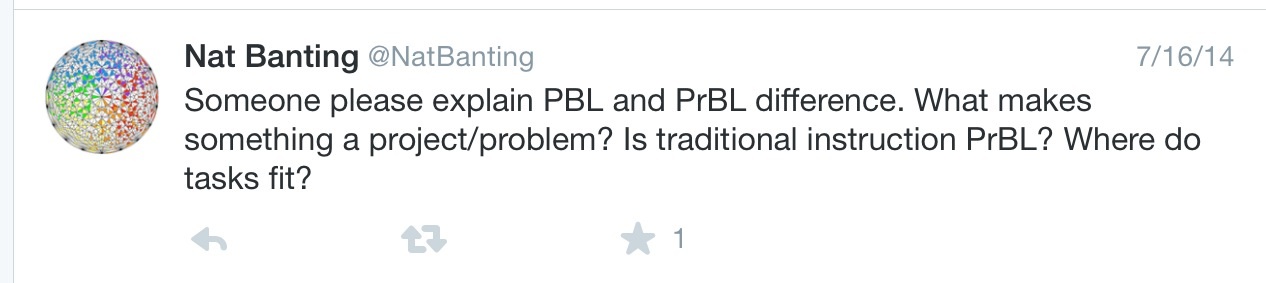
    Dan Meyer seemed to be criticizing Problem-Based Learning saying that it was discussed by others as “too much curriculum and too little time for PrBL” and he says that he saw “a lot of fluff in PrBL” – to which I would say, there’s much more to Problem-Based Learning than just doing problems, Mr. Meyer. Nat Banting also asked for a clarification of what the difference was between a project and a problem in math education.

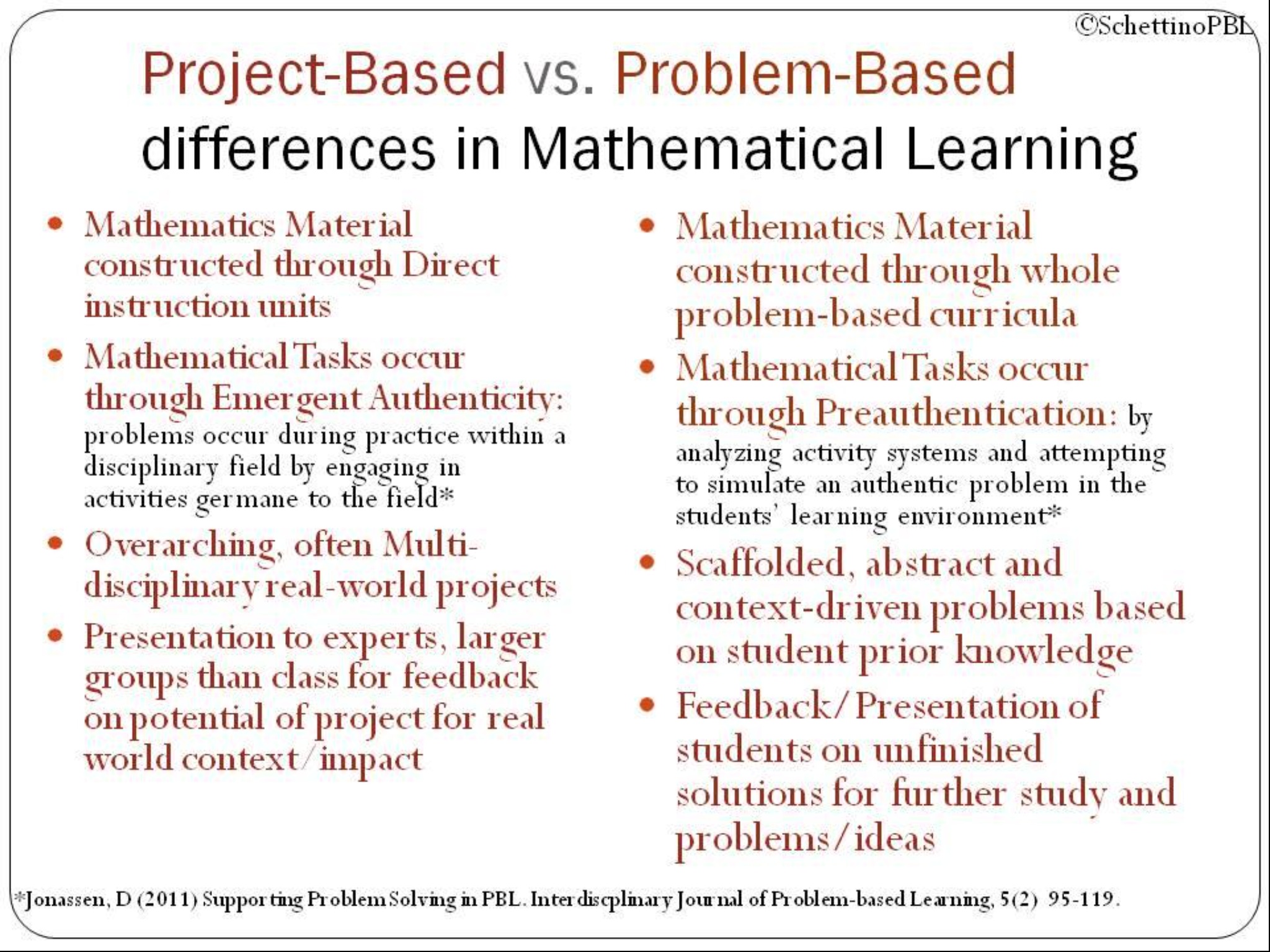
    In response to this discussion and Mr. Banting’s question, I posted an image of a table I created listing differences that I saw between project- and problem-based learning in mathematics education and had hoped for some feedback.
    image

    Then I thought that maybe my description on the image of the differences wasn’t clear enough, so I thought I’d try one more time to make the distinction between the authenticity clear.

    If we revisit the idea that Problem-Based Learning has at its core, problems as the vehicle for learning and constructing knowledge, I think this is at the heart of the difference of the learning/teaching experience. When I look at purposefully scaffolded and written curriculum for problem-based learning, yes there are outcomes that need to be met, there are topics that are discussed that are set by the teacher (or curriculum writer). Mathematics has within it many very interesting abstract concepts that are worthwhile to teach even though the “real-life” applications don’t have much context for students (will a student appreciate the logic and problem solving skills that are learned in factoring a polynomial, for example, or do they just accept and take it as a skill they need, or use technology and not use that part of their brain – who knows?) The point I’m trying to make is that in problem-based learning the problems would lead students to figuring out (through discussion and with prior knowledge and experience) the skills needed to create a process of factoring and perhaps “unfactoring” an algebraic expression and hopefully what that expression might represent. This is what’s known as “preauthentication” – when the curriculum writers or teachers try to come up with some kind of experience for the students that simulates the mathematicians authentic experience or “ah-ha” moment of understanding or realization. Then there are other problems that allow the students to dig deeper and apply those ideas to other areas of mathematics, and yes, real-life problems too.

    In Project-Based Learning, “emergent authenticity” allows the mathematics to emerge from the ideas of the project (or driving question at hand) which is up to the students to then find out what they need to know. This is where Project-Based Learning can fall short in the area of secondary mathematics – in a world of standards. Where does the learning take place and how does it happen? Once students understand a concept, having gone through rather traditional instruction and some type of formative assessment, the project can then be given. Yes, Mr. Meyer, I believe that there is a hard balance to make there between traditional instruction and when to do the projects – quite a dilemma of time (although schools do it with very nice interdisciplinary time schedules).

    However, I do believe that in problem-based learning the rigor, content, problem-solving and all the other “4C’s” skills that project-based learning also promote end up happening in the discussion and presentation of problem ideas and solutions. So I would have to argue with those who say “it doesn’t matter what you call it” and “they’re all the same thing” because the learning process in mathematics is so very different in these two methods. Hopefully, I can shed some light on the differences between PBL and what I hope will be called PjBL soon!

  • Keeping the Dice Rolling: Questioning in PBL

    Returning from a week-long conference is always invigorating for me – not for the reasons that many people think.  I do appreciate the great feedback I get from my “teacher-students” that I interact with during the week who are so extremely eager to learn about PBL – this truly invigorates me and allows me to do so much work over the summer myself.  However, what I always look forward to is how much I personally learn from the interactions with my students that week.  At this point, PBL is so popular in its use in mathematics classrooms across the country, although people see me as an expert in the field, I gain so much from the questions and process of those who are learning that it is so useful for me to move through that process with them all the time.  I believe this is why they call it “professional development”!  So I just wanted to give a HUGE shout-out of thanks to everyone who took my workshops, came to my Cwic sessions, had conversations with me or interacted in some way – it might have been one of the best professional weeks I’ve ever had!

    Since that week in New Hampshire, I’ve done a lot of reading, editing of my own materials, and catching up with my own work.  I recently read a blogpost on edutopia entitled “The Importance of Asking Questions to Promote Higher-Order Competencies” which stood out to me as something that we talked a great deal about in my own PBL classes, although this blogpost was not specifically about PBL or math at all.  It was written by a professor at Rutgers University in the Psychology Department, Maurice Elias, who is part of the Rutgers Social-Emotional Learning Lab, and made me wonder if he had done any work with Cindy Hmelo-Silver, who is also at Rutgers and does work with PBL in Psychology.  The concept of asking questions is something that we discuss and practice in my workshops because Hmelo-Silver says that it is a characteristic of an experienced PBL teacher to ask probing questions that are metacognitive and at a higher-order level.  Interestingly, the four areas that Elias discuss are often not linked to higher-order thinking (for example, yes/no questions) so I thought I might take his “Goldilocks” example and try it through the lens of math PBL.  Elias’ four questioning techniques are 1)Suggest 2) Ask a Closed Question 3)Ask an open question and 4)The Two Question Rule.

    The idea of “suggestion” is one that I always tried to stay away from since student voice and experience is first and foremost in my mind as a pillar of the PBL pedagogy.  Allowing students to make first attempts at making those connections on their own I believe takes precedence over critical thinking skills of choosing from alternatives.  However, that concept of making a choice between alternatives is important as well and might be a very good skill to have them practice every now and then deliberately.  I think I will begin to try this in class.  The next time when it seems like no one has an idea or when the student at the board is going in the wrong direction, I may decide to say something like “Should Joe go with the method of completing the square or factoring here?”

    The second idea of asking the closed question (yes or no) is also one that I have always tried to stay away from.  In my experience it’s kind of a conversation staller, but the way it’s explained by Elias in his blogpost is actually a very interesting twist on the closed question.  It takes a yes or no question but embeds an opinion in it, so almost forces a justification of the closed question with the yes or no.  It makes the teacher find a way for the student to continue (well, the teacher must make sure the student follows up).  So for example, if the teacher asks asks, “Do you think the quadrilateral is a rhombus?” it might seem very obvious that a student could just say yes or no and the conversation could just end there.  Everything I’ve read about closed questions say that you should not phrase the question that way but be sure that the question has within it some interest in the student’s opinion. “Why do you think it’s a good idea to argue that this quadrilateral is a rhombus?” (Which is a closed question in disguise but opens up the conversation).

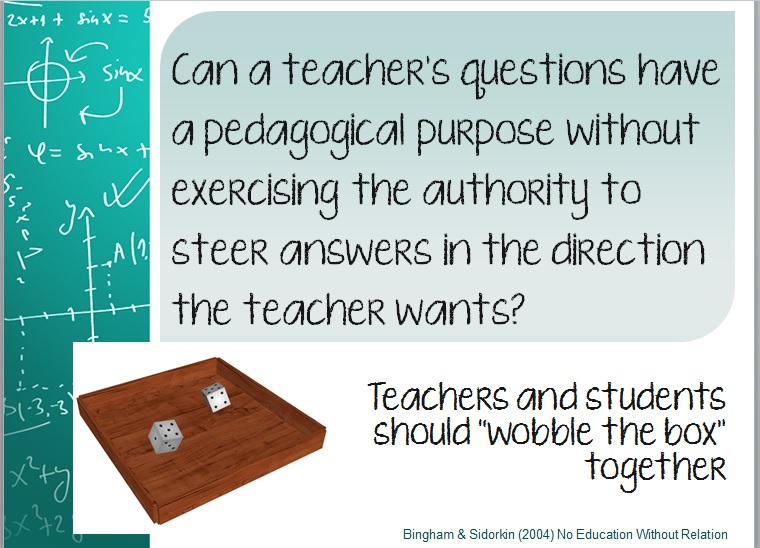
    Then there’s the Open-Ended Question (or what Bingham calls a True Question) which I have written about before.  I talk about this in my workshops as well and real open-ended questions are questions that the teacher doesn’t really know the answer to.  I love Bingham’s analogy of trying to predict with your students what the sum of two dice will be (the answer)  but trying to keep the dice rolling for as long as possible without knowing the answer.

    Dice Metaphor

    What’s an example of this type of question in mathematics?  This is a tough one because as we know so well, there are definitely right and wrong answers in mathematics.  However, we can ask questions like “Why did you chose that method?” and “What do you think of Sara’s argument? Do you agree with her?” These types of questions can make mathematics teachers very uncomfortable but we can keep the box wiggling for great deal longer than we could before with these questions and they allow us to work towards the CCSS Mathematics Practice Standards of persevering and critiquing other students’ work.

    Elias’ Two Question Rule isn’t just as simple as asking a follow-up question, but makes the assumption that students want to see if when you ask a question the first time, you really wanted to know what they wanted to say.  For example, in most mathematics classrooms, students are accustomed to the I-R-E form of dialogue which is short for Initiation-Response-Evaluation (Teacher-Student-Teacher) where the teacher generally knows that answer that they want for the question they have asked (kids know this, they’re not dumb).  So when the same old kids do the response part of this, instead of just doing the evaluation part, why not blindside them and actually rephrase the question and ask it again in a different way, or ask one kid themselves individually in order for them to know that you really want to hear from them?  I think that’s what Elias is talking about.  (or even better don’t use IRE, break that darn habit, I know I’m still trying to!)

    We had some great fun during my workshops role modeling and just trying out different ways of questioning the mock student who was at the board – it’s hard to break old habits.  But the more we are aware of what we are trying to do and do it deliberately, the more important it becomes and bigger agents of change we can be as well. If you have any thoughts on these questioning techniques in math PBL classroom – please let me know

    Hmelo-Silver & Barrows (2006). Goals and strategies of a PBL Facilitator. Interdisciplinary Journal of Problem-Based Learning , 1(1), 21-39
  • Looking for the Teacher of Grit

    I’m in the middle of working on organizing my courses for the Exeter conference in about a week and something I’m really struggling with is trying to articulate to teachers how they can impart to their students this idea of grit in the PBL classroom.  So I started doing a little research online (besides looking through all of the books I have read on the subject).  I took Angela Duckworth’s Grit Test at her lab’s website (got a 3.63 grit score- grittier than 60% of other U.S. citizen’s my age…hmmm).  Then I started reading some blog posts of other PBL teachers and writers like here on the MAA’s blog which is trying to encourage math students to tinker with problems or here which is more of an all-purpose index of resources to teaching grit. There was this wonderful video of a teacher in NH who created a neat grit curriculum for her 5th grade class (with Angela Duckworth too)

    John Larmer of the Buck Institute wrote a really nice blog entry on how project-based learning fosters grit in students. I even found a nice video of Po Bronson, author of Nurture Shock (the book about how parents have failed kids because we don’t let them fail).  This is a short video of how Mr. Bronson believes we should be allowing kids to fail these days.

    He says (in so many words) that if kids grow up without learning how to fail, they will become risk-averse.  This is what I am finding in my classroom at times.  The risk-averse kid combined with the fixed mindset kid, combined with the “I-have-to-get-into-college-and-make-my-parents-happy” kid makes the PBL classroom very difficult when you are trying to get them to take risks and be creative.  Add that to the classroom culture that they have been used to for the first 9 years of their education in the U.S. and sadly, it makes for a tough place to foster the teaching of grit.

    In fact, on my most recent course evaluations I asked students what they found most challenging about the class and the two pieces that tied for first place were journal writing and

    “having to be vulnerable and make mistakes in front of my peers.”

    I so want to change that and I always thought that I created a classroom atmosphere where students were comfortable.  I did all of these things that the professionals are suggesting on these websites:

    1. modeling risk-taking and making mistakes myself
    2. talking about growth mindset regularly
    3. ask them to write about positive experiences when they are proud of themselves
    4. using class contribution feedback forms (self-report and analysis of class contribution sheets)
    5. using strategies where students think of a wrong way before we talk about the correct solution method together.

    But somehow, even at the end of the year, their fear of being wrong in front of each other (and me, some commented) is still predominantly what they say challenged them.  So I would say to Po Bronson, where is the teacher of Grit?  What is the secret?  How do I make it so?  Is there a time when it’s too late for some kids?  Most of what I’ve seen on the internet is teaching grit to elementary school children – does the fact that I am teaching high school kids make it any harder?

    I finally found this great Prezi created by a teacher named Kristen Goulet which, I know, is geared towards elementary school kids, but I think I could find a way to direct it towards older students.  The idea of having them ask themselves whether their self-talk is “because of me” or “because of other” and whether it is “permanent (i.e. fixed mindset)” or “temporary (i.e. growth mindset)” definitely would help them realize how much of the way the deal with adversity is flexible.  It also helps with seeing how to have a more realistic and optimistic view of a certain situation (and is kind of hard to argue with).

    So, I’m still in search for the best practices to teach grit (and apparently so is Angela Duckworth – she admits this in her TED talk), but now I know that it is way more complex than just following a certain number of steps – it has so much more to do with a student’s socio-emotional state of mind. Vicki Zakrzewski’s article “What’s wrong with Grit?” is probably the closest I got to agreeing with someone’s assessment of grit and how to teach it.  I know that I am really good at letting kids know what is important to me and doing that modeling that is important as well.  Undoing what has happened to them before they got to me is a tall order, but I’m not going to stop trying.